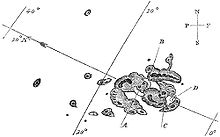
The geomagnetic storm of 1859 is the most powerful geomagnetic storm in the history of observations. The set of events, which includes both a geomagnetic storm and powerful active phenomena on the Sun that caused it, is sometimes called the Carrington Event [1] or, following the English language literature, the Solar Superstorm [2] .
From August 28 to September 2, numerous sunspots and flares were observed on the Sun. Immediately after noon on September 1, the British astronomer Richard Carrington observed the largest flare [3] , which caused a large coronal mass ejection . He rushed to the Earth and reached it after 18 hours, which is very fast, since this distance is usually covered by an ejection in 3-4 days. The release moved so fast because previous emissions cleared its path [4] .
September 1–2, the largest geomagnetic storm in the entire history of registration began, which caused the failure of telegraph systems throughout Europe and North America [5] . Northern lights were observed all over the world, even over the Caribbean ; it is also interesting that over the Rocky Mountains they were so bright that the glow woke the gold diggers, who began to cook breakfast, thinking that it was morning [3] . According to the first estimates, the Dst-index of geomagnetic activity (Eng. Disturbance Storm Time Index ) during the storm reached −1760 nT [6] . Extrapolation of available measurements of the Dst index to the region of extreme storms shows that storms with Dst = −1760 nT occur on Earth no more than 1 storm in 500 years [7] . However, it should be noted that serious arguments are expressed in the scientific literature that, due to methodological problems in analyzing data of a century and a half ago, the estimate Dst = −1760 nT was found to be too high, and the magnitude of the storm was no more than −900 nT [8] [9] .
Ice cores indicate that events of this intensity recur on average about once every 500 years. The strongest storm since the beginning of the space era (since 1957) occurred on March 13, 1989 , when the Dst-index of geomagnetic activity reached −640 nT [6] . Also after 1859, less severe storms occurred in 1921 and 1960 , when there were massive interruptions in radio communications [3] .
See also
- Geomagnetic storm
- Geomagnetic storm March 13-14, 1989
- 2012 Geomagnetic Storm
Notes
- ↑ NASA - Severe Space Weather.
- ↑ Timeline: The 1859 Solar Superstorm.
- ↑ 1 2 3 “Bracing the Satellite Infrastructure for a Solar Superstorm.”
- ↑ “Bracing the Satellite Infrastructure for a Solar Superstorm”, slide # 2.
- ↑ "The Great Storm: Solar Tempest of 1859 Revealed."
- ↑ 1 2 Lakhina GS, Alex S., Tsurutami BT, Gonzalez WD Research on Historical Records of Geomagnetic Storms (English) // Coronal and stellar mass ejections: proceedings of the 226th symposium of the International Astronomical Union held in Beijing, China, September 13-17, 2004: Collection. - Cambridge University Press, 2005. - P. 3-13 . - ISBN 0521851971 . - ISSN 1743-9213 .
- ↑ Yermolaev, YI, IG Lodkina, NS Nikolaeva, and MY Yermolaev (2013), Occurrence rate of extreme magnetic storms, J. Geophys. Res. Space Physics, 118, 4760-4765, doi: 10.1002 / jgra.50467
- ↑ Siscoe, G., NU Crooker, and CR Clauer, Dst of the Carrington storm of 1859, Adv. Space Res., 2006, 38, 173-179.
- ↑ Cliver, EW and Dietrich, WF, The 1859 space weather event revisited: limits of extreme activity, J. Space Weather Space Clim. 3 (2013) A31 DOI: 10.1051 / swsc / 2013053
Links
- A Super Solar Flare , Trudy E. Bell & Dr. Tony Phillips, May 6, 2008, Science @ NASA
- Space storm alert: 90 seconds from catastrophe , New Scientist, March 23, 2009 by Michael Brooks, accessed March 28, 2009
- The Largest Magnetic Storm on Record , The Carrington Event from August 27 to September 7, 1859; recorded at Kew Observatory , London , (images of magnetometer records), verified March 28, 2009
- The Sun Kings: The Unexpected Tragedy of Richard Carrington and the Tale of How Modern Astronomy Began , ISBN 978-0-691-12660-9 , Stuart Clark, 2007
- Extremely strong geomagnetic storm September 2–3, 1859 according to archival magnetic data of the Russian observational network , Tyasto M.I., Ptitsyna N.G., Veselovsky I.S., Yakovchuk O.S., Geomagnetism and aeronomy . 2009.V. 49. No. 2. P. 163-173.
- Carrington Report