Nijo Castle ( 二条 城 Nijo: -jo:) is a fortified residence of the Tokugawa shoguns in the Japanese city of Kyoto . The castle complex consists of many buildings and several gardens. The central structure of the castle is the Ninomaru Palace. The area of the residence is about 275,000 m², of which 8,000 m² are occupied by buildings.
| Castle | |
| Nijo Castle | |
|---|---|
| 二条 城 | |
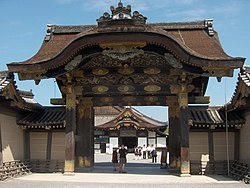 The main gate of the Ninomaru Palace | |
| A country |  Japan Japan |
| Location | |
| Established | 1603 (stone, wood) |
| Material | |
| condition | open [1] |
| Site | city.kyoto.jp/bunshi/nij... |
Nijo Castle is located in the Nakagyo district of Kyoto , the former capital of Japan . The castle bears the name of the road on which it is located. The castle complex has two concentric rings of fortifications, each of which consists of a wall and a wide moat with water. Three gates were located in the outer wall, two in the inner. The castle complex includes Hommaru Castle and Ninomaru Castle. Hommaru Castle and gardens are located in the inner ring of fortifications. Ninomaru Castle, kitchens, a guard building and several more gardens are located between the two fortification rings.
The construction of the castle was initiated by order of the Shogun Tokugawa Ieyasu in 1601. The construction was completed in 1626, during the reign of the Shogun Tokugawa Iemitsu . Parts of Fushimi Castle were moved here in 1625-1626. Since Nijo was built mainly from wood, a significant part of it was destroyed by fires in 1788 and in 1791. After the fall of the Tokugawa Shogunate , Nijo Castle passed into the possession of the imperial family and was renamed the Nijo Palace. Since 1939, the Nijo complex has been transferred to Kyoto City Administration and since 1940 has been open to visitors all year round. Since 1994, it is listed as a UNESCO World Heritage Site - Historical Kyoto . It is also among the National Treasures of Japan .
Content
History
Nijo Castle was built in 1603 by order of Tokugawa Ieyasu, the unifier of Japan. He was on the banks of the Khori River along Nijo Street, in the Kyoto area of Nakagyo . The predecessors of this castle were two castles of the same name, built in the second half of the 16th century at the expense of Oda Nobunaga . The first was built in 1569 for the needs of the shogun Asikagi Yoshiaki . It was located west of the Imperial Palace , in the area of the Muromachi quarter along Kageyu Street ( 勘 解 由 小路 室町, か げ ゆ こ う じ む ろ ま ち ) [2] . In 1573, during the Nobunaga war with the shogun, the castle burned down. The construction of the second Nijo castle lasted from 1576 to 1579. It was located along the Osi street of the Muromachi quarter, east of the Mekaku-ji monastery. Nobunaga gave the new castle to the Prince of Blood Sanahito, but in 1582 the building burned down again during the riots in Kyoto, in which Nobunaga and his son died [3] .
The construction of the third Nijo castle began in 1601. Formally, the construction was to serve as the metropolitan residence of Tokugawa Ieyasu during travels from the eastern Japanese city of Edo . In fact, it was built as a solemn place for awarding the post of shogun to Ieyasu in 1603. The castle became a symbol of the new shogunate in the capital. It housed the administrative apparatus to oversee unreliable West Japanese feudal lords and the Imperial Court. The castle had a 5-story main tower and two small courtyards. During the years 1624-1626, during the reign of the Shogun Tokugawa Iemitsu , the grandson of Ieyasu, it was expanded to modern sizes. At the end of construction work, the castle was visited by Emperor Go-Mizunoo [3] .
In 1750, due to a lightning strike, the main tower of Nijo Castle burned down. 18 years later, the main palace of the first courtyard also burned down. The latter was restored in 1896 by transferring a number of buildings from the imperial villa of Katsura. The authentic constructions on the territory of the castle remained the Palace of the second courtyard, the gate of Karamon , the East, West, North Gate, as well as the southeast and southwest corner towers.
Palace of the second courtyard | Gateway to Ninomaru Palace | East gate | North gate |
South east tower | Palace garden | Palace garden | Rice pantry |
During the years 1634-1863, the shoguns did not visit the capital and did not live in the castle. He was led by a metropolitan inspector who looked after the calm in Kyoto and the politicians of the Imperial Court. In 1867, the castle abdicated the last shogun Tokugawa Yoshinobu and returned the state power to the Emperor . Since 1884, the castle received the status of an imperial villa. Subsequently, in 1939, the Emperor presented it to the city of Kyoto, turning it into a public museum [3] .
The main attraction of the castle is the palace of the second courtyard. It was built between 1624-1644. The main gate of the Ninomaru Palace, a staircase, a large hall, a palm room, a “black office”, a “white office” and a number of other components of the palace are made in the architectural style of the “ Shin-zukuri ” inherent in the Momoyama culture . The corridors and halls of the palace are decorated with wall and ceiling paintings by artists of the Japanese school of decorative painting Kano . In particular, the paintings of the “white cabinet” belong to the artist Kano Koy , and the paintings of the “black cabinet” belong to the artists Kano Naonobu and Kano Tanu . Near the palace is an old garden , broken in the beginning of the XVII century by gardener Kobori Ensu [4]
Ninomaru Castle
Ninomaru Castle covers an area of 3300 m². It is designed in the classic Japanese style: the floor is covered with tatami mat , the doorposts are decorated with various ornaments with animals and plants. Each room has three walls, so each room is connected to the corridor by a single space. There are three large halls in the castle: Ohiroma-no ma and Ni-no ma were intended for official meetings, Ohiroma san-no ma served as a waiting room for the tozama daimyo .
Gardens
The castle has several gardens, cherry groves and Japanese plum trees . Ninomaru Garden includes a pond in which there are three islands, an exhibition of skillfully selected and arranged stones and a topiary . Sayryu-en Garden was created in 1965 and is famous for hosting official receptions for city guests and tea ceremonies for citizens. It is also decorated with one thousand stones.
Scheme
Castle | Palace | ||||||||||||||||||||||||||||||||||||||
|
|
Notes
- ↑ Japan: Nijo Castle is ready to accept businessmen (Inaccessible link) . Date of treatment April 27, 2014. Archived April 27, 2014.
- ↑ He was surrounded by four streets - Izumi in the north, Savaragi in the south, Karasuma in the east and west - Nimati
- ↑ 1 2 3 Nijo // Nipponica Encyclopedia : [ jap. ] = Nippon Daihyakka Zenso: 26 巻 . - 2nd ed. - Tokyo: Shogakukan , 1994-1997.
- ↑ Kobori Enshu // Japan from A to Z. Popular Illustrated Encyclopedia. (CD-ROM). - M .: Directmedia Publishing, "Japan Today", 2008. - ISBN 978-5-94865-190-3
Links
- Nijo // Japan from A to Z. Popular Illustrated Encyclopedia. (CD-ROM). - M .: Directmedia Publishing, "Japan Today", 2008. - ISBN 978-5-94865-190-3
- Plum Blossoms in Nijo Park
- Brylevsky G. B. Japanese castles - history and modernity // Japan: Yearbook. - M., 2007. - S. 289—297