


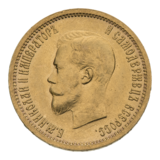


The golden ruble is the monetary unit of the Russian Empire , introduced by the currency reform of 1897 , in connection with the establishment of gold monometallism .
Content
Golden Ruble in the Russian Empire
Introducing the gold standard
In 1897–1899, the Minister of Finance Sergei Witte carried out a monetary reform , marking the introduction of gold circulation in Russia. The bet on gold (unlike the former silver ) was made in view of changes in the world market. Then the industrial countries created a single monetary system, the basis of which became the golden monetary unit.
The silver ruble was replaced by the gold ruble - it was equal to 0.774234 grams of pure gold . In the domestic circulation of money were introduced gold coins of dignity: 5; 7.5; 10 and 15 rubles. So in the Nikolaev coin of 10 rubles worth (in the USSR its equivalent was called a chervonets) of pure gold contained 7.74234 g with a total weight of the coin of 8.6026 g.
For comparison: the gold parity of the main currencies at that time was as follows:
- 1 dollar - 1,50463 grams of pure gold;
- 1 pound sterling - 7.322382 grams of pure gold;
- 1 French franc - 0.290323 g of pure gold;
- 1 German mark - 0.358423 g of pure gold.
In other words, the gold Russian ruble on the content of pure gold in it was, for example, twice as “heavier” than the mark, but twice as “lighter” than the dollar. According to the content of pure gold, the coins have (as of December 31, 2017) the following value: 5 rubles - 10'845.89; 10 rubles - 21'691.78; 7 rubles 50 kopecks - 16'268.83; 15 rubles - 32'537.66.
Gold coins had free circulation along with paper credit tickets. The parallel circulation of gold and paper money was distinguished by stability. She maintained a stable balance of gold reserves and the volume of paper ruble mass. By law, the number of paper money in circulation should not exceed the gold reserve by more than 300 million rubles. The free circulation of gold coins did not cause an excessive demand for them. They even tried to get rid of the "yellow ones" as if they were inconvenient to handle.
The stability of the gold ruble rested on a solid financial foundation. Thus, from 1887 to 1897, the gold reserves of the Russian Empire increased about 2.5 times and exceeded 1 billion rubles. There is also no doubt that the basis for the success of monetary reform was laid by the rapid growth of the country's economy. So, for example, in the 1890s, the growth rate of the country's industry was 10-12 per cent per year. In the last decade of the XIX century, industrial production in Russia has doubled. The transition to a convertible gold ruble became the culmination of these economic achievements.
The end of the gold standard
As soon as July 29, 1914, mobilization was announced in the military districts bordering on Austria-Hungary , Ministry of Finance issued order No. 2096. In accordance with this order, the free exchange of paper money for gold was stopped. The answer of the population was not difficult to predict - the townsfolk immediately hid their gold coins away. All 629 million gold rubles immediately disappeared from circulation. And this is 22.6% of all the money that was in circulation at that time. There was a cash crisis. Especially there was a lack of small bills, the role of which was previously performed by gold coins. This led to the fact that private merchants and instantly appeared speculators, exchanging the bills for small bills, gave out for 100 rubles 85-90.
Golden Ruble in Soviet Russia
Council of People's Commissars decree of October 11, 1922 decided to give the State Bank the right to issue bank notes in gold terms in denominations of 1, 2, 3, 5 and 10 ducats. And by the decree of the Council of People's Commissars of October 26, 1922, the People's Commissariat of Finance was instructed to "proceed with the minting of a gold coin called a chervonts". The decree specifies: the content of pure gold in the coin (1 spool 78.24 parts, or 7.74234 g), its sample (900 parts of pure gold and 100 - ligatures ), the ligature weight of the coin 2 spool 1.6 shares, its diameter 89 points, or 22.6 mm. Thus, the Soviet chervonets had a mass and trial, like a royal 10-ruble coin. This was necessary so that the Soviet chervonets could be accepted for foreign payments. Soviet gold coin was one gold coin minted only in 1923 (not counting trial coins). On its obverse (obverse) is the coat of arms of the RSFSR and the slogan: “ Proletarians of all countries, unite! ", On the reverse - a peasant sower against the background of the plant and the inscription" One chervonets ".
The issuance of chervonets stabilized the ruble, which after some time was transferred to the gold course as 1/10 of a chervonets. Around the same time, silver rubles were issued.
Gallery
Deposit metal receipt of the State Bank 1000 rubles 1895
See also
- Chervonets
- Monetary reform in Russia in 1895-1897
- 1905-1912 state credit cards
- Monetary system of the Russian Empire (1885-1896)
- One ruble (gold coin)
Literature
- Golden ruble // Kazakhstan. National Encyclopedia . - Almaty: Kazakh Encyclopedias , 2005. - T. II. - ISBN 9965-9746-3-2 .