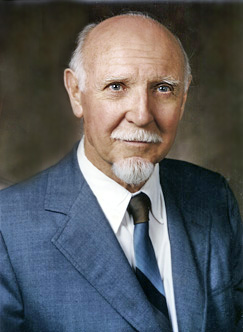
Raymond Bernard Cattell (Cattell) [2] ( born Raymond Bernard Cattell ; March 20, 1905 - February 2, 1998 ) is a British and American psychologist who made a significant contribution to the development of differential psychology in the areas of personality traits, abilities and motivation. The author of one of the most influential personality theories developed in the psychology of the 20th century, the author of the theory of fluid and crystallized intelligences . He was a consistent supporter of multivariate research in psychology. Published 55 books and more than 500 articles. The author of a 16-factor personality model and the creator of the corresponding psycho-diagnostic technique.
| Raymond Bernard Kettel | |
|---|---|
| Raymond Bernard Cattell | |
 | |
| Date of Birth | March 20, 1905 |
| Place of Birth | Hilltop, West Midlands , England , United Kingdom of Great Britain and Ireland |
| Date of death | February 2, 1998 (92 years old) |
| Place of death | Honolulu , Hawaii , USA |
| A country | UK, USA |
| Scientific field | psychology of Personality |
| Place of work | University of Hawaii, University of Illinois at Urbana and Champaign , Harvard University , Clark University , Exeter University |
| Alma mater | University of London , University College London |
| Academic degree | |
| supervisor | |
| Known as | author of a 16-factor personality model, initiator of multivariate research in psychology |
Biography
Raymond Bernard Kettel was born in Staffordshire in 1905. At 16, he entered the Royal College of London University, where he studied chemistry and physics. In 1924, Kettel received a bachelor's degree in chemistry from the University of London. A few months before graduation and graduation with honors, I decided to devote my career to psychology. In 1929 he received a doctorate in psychology from the University of London. As a graduate student, he worked as an assistant with the outstanding psychologist Charles Spearman, who developed the factor analysis method.
From 1932 to 1937, Kettel led the psychiatric clinic of the city of Leicester as a director. In 1937 he was awarded the degree of Doctor of Science at the University of London. After that, Kettel collaborated with Professor E.L. Thorndike at Columbia University College of Education in New York. From 1938, Cattell worked as a professor of psychology at Clark University, and since 1941 - a lecturer at Harvard University. In 1944, Cattell moved to the University of Illinois as a professor-researcher in the field of psychology. There he headed the laboratory for personality research and analysis of group behavior (he held this position for 30 years).
In 1973 Kettel moved to Boulder, where he founded the Institute for the Study of the Foundations of Morality and Self-Realization. Since 1977, he has become a consulting professor at the University of Hawaii, as well as an honorary professor in Illinois.
Kettel died on February 2, 1998 at the age of 92 in his house in Hawaii.
Major works
In the 1940s Kettel has published many books and articles covering studies of various fields - experimental psychology, social psychology and genetics. His main works relate to the field of systematic study of human personality. The most significant work in this direction:
- 1946 - “Description and measurement of personality”,
- 1950 - “Personality: systematic theoretical and factual research”,
- 1957 - “Personal and motivational structural dimension”,
- 1965 - “Scientific analysis of personality”,
- 1982 - “Inheritance of personality and abilities”,
- 1987 - "Beyondism: religion from science."
R. Kettel also conducted interesting psychological research in the field of: humor (1947), musical preferences (1954), leadership (1954), intelligence (1963), psychopathology (1966), creativity (1968), and attitudes toward reactions (1968).
Personality Theory
In Kettel’s definition, personality is a system of traits by which he gives his own classification. In his opinion, a trait is a certain mental entity responsible for the consistency of the observed behavior. Further, he distinguishes between initial and superficial features. The first are the real internal forces of the personality that underlie and subsequently determine the multiple external manifestations. Surface features are open, visible variables occurring on the surface. They are just a product of the interaction of the initial features, therefore they are not so significant. Kettel divides the initial features into those formed by the environment and constitutional (hereditary).
From a modal point of view, a scientist distinguishes between traits: dynamic (leading to action in a certain direction), traits-abilities (determining the effectiveness of achieving a goal) and temperamental (associated with internal motives of personal reactions).
Using information on various traits of the individual, Kettel made a very simple equation characterizing the alleged behavior of a person in a particular situation. It has the form: R = s 1 T 1 + s 2 T 2 + s 3 T 3 + ... + s n T n ,
where T is a certain feature; s is her estimate.
This specification equation makes it possible to predict an individual’s reaction in the future based on the characteristics of his personality evaluated in the present. The equation can be used in testing.
Kettel pays particular attention to a more detailed discussion of dynamic features. He divides them into three groups: attitudes , ergs and feelings .
Attitude is, according to Kettel's definition, a visible external expression of an internal dynamic structure, from which ergs and feelings also stand out. In simple words, the formula of the attitude looks something like this: the interest of a certain intensity in some action relative to a certain object.
Erg can be called a constitutional dynamic baseline, something similar to instinct or an innate tendency. In his studies, Kettel identified 10 ergs: hunger, sex, herding, parental protectiveness, curiosity, flight (fear), pugnacity, acquisition, self-affirmation, and narcissistic sexuality.
Feeling is a dynamic trait formed under the influence of the environment. It resembles an erga, but is not congenital, but acquired. According to Kettel, feelings tend to organize around significant cultural objects, with respect to which more and more attitudes are developed over time and with experience. Kettel’s research revealed feelings related to career, sports, religion, parents, a loved one, as well as his own “I”. Interestingly, the last feeling turned out to be one of the most stable in the research.
The relationship of various levels of dynamic features Kettel presented in the form of a dynamic lattice. It represents a motivational structure, in the first part of which ergs are displayed (basic biological impulses); in the middle - feelings, each of which is interconnected with several ergs; in the third part, the structure of attitudes is presented, which correspond to the lines of certain actions related to designated objects. Each entity is interconnected with several feelings, and through them is an expression of a number of ergs.
The sense of “I” in Kettel’s research is given a special place. He believes that this feeling plays a crucial role in the activity and development of a person’s personality. It affects the satisfaction of all feelings and ergs, therefore, it is a kind of "dominant" feeling.
R. Kettel studied the development of personality both at the level of describing temporary changes in its structure, and at the level of genetics and measuring the influence of the environment. To assess the influence of heredity and environment, the scientist created the MAVA method (multiple abstract analysis of variations). Twins and siblings (brothers or sisters) raised in the same family were studied. This method revealed an interesting tendency on the part of environmental influences to resist manifestations of genetic differences. Kettel attributed this phenomenon to the law of biosocial violence.
Studying the phenomenon of learning, which plays a significant role in the process of personality development, Kettel makes a distinction. He distinguishes between classical, instrumental and integral learning. Classical conditioning involves emotional responses to environmental influences. Instrumental conditioning plays a significant role in the construction of a dynamic lattice. Of particular interest is one of its forms, which Kettel called "cohesive learning." With this teaching, a certain behavior (or attitude) is the way to achieve several goals at once. Integration learning presupposes an individual's desire to maximize overall long-term satisfaction, while expressing individual ergs and suppressing or crowding out the rest.
A significant impact on personality formation is exerted by multiple social institutions. Kettel attached great importance to the sociocultural determinants of behavior. The family has the greatest influence on a person’s personality, then the institutions that are also very significant for the individual are the profession, school, peer group, religion, political party, and also the nation. Their influence proceeds in one of three ways:
1) intentional intention to create a certain type of personality;
2) situational or environmental factors lead to effects not envisaged by society;
3) the individual can determine for himself the need for further personality changes due to important motives.
It is very important to describe and differentiate according to certain parameters various social groups or institutions for further research of both an individual person and a certain social group, as well as the relationship between them. Kettel came up with 28 points regarding the relationship between an individual and the so-called group syntacticity.
Key Concepts
Attitude (Attitude). A specific course of action that the subject wants or wants to implement in a specific situation. Attitude includes a stimulus or situation, interest (intense desire), reaction and object. The origin of a particular attachment is usually traced to the primary, innate impulse, that is, one of the ergs.
Dynamic trait. A trait that activates and directs a person to specific goals. Dynamic features include ergs and semes.
Dynamic calculus (Dynamic calculus). A comprehensive method for determining the strength and direction of attitudes. In the dynamic calculus, ergs and semes are considered as the basis of any motivation; they are included in the behavioral equation, which allows one to calculate the identity of a given individual in a particular situation.
Correlation matrix The total body of data in the mass of variables used in factor analysis.
Crystallized intelligence. On the other hand, he is responsible for the application in the present of previously acquired knowledge. The primary factor B is crystallized intelligence, and for him, Kettel estimated the share of heredity at 60%. For movable intelligence, traits of the second order, the share of heredity is 65%.
The main features (Source traits). Traits that determine behavior, the basic structures that make up a person.
Surface traits. The observed forms of behavior matter only as the starting point from which it is convenient to start the study, or as indicators of the main features.
Moving Intelligence Allows us to learn new material, regardless of whether we have already had to deal with such things.
Sems (Sems [socially shaped ergic manifolds]). "Socially formed conductive erg structures." Learned or acquired dynamic traits, intermediate goals that connect the attitude with the original erg. Semes take their energy from ergs and give the organizations some organization and stability.
State The concept attributed by Kettel to temporary changes in behavior resulting from changes in the environment. Examples of psychological conditions are joy, anger, fear, anxiety. Physiological conditions include heart rate, body temperature, and blood pressure.
Ability (Ability trait). A dynamic personality trait that defines skill and effectiveness in achieving goals.
Temperament trait. The main trait that affects the emotional characteristics of behavior.
Factor A hidden variable obtained by processing data using factor analysis.
Factor loading. The correlation between this item and the factor with which it relates.
Factor analysis. The method used to determine hidden psychological variables of a person or hidden variables in questions of tests that are identified during processing of the correlation matrix.
Trait A relatively constant property or location, that on which a person’s behavior in a particular situation depends.
Erg (Erg). Congenital biological motivation or motive. Ergy in humans is the equivalent of instinct in animals. The term “erg” refers to energy originating from primary impulses, such as sexual desire, hunger, curiosity, anger, etc. Kettel identified 10 main ergs, most of which are also characteristic of mammals.
L-data Vital measurement data.
Q-data. Individual data obtained by filling out questionnaires.
T-data Data obtained using objective tests.
Publications
- Cattell, RB (1983). Structured personality learning theory . New York: Praeger.
- Cattell, RB (1984). The voyage of a laboratory: 1928-1984. Multivariate Behavioral Research, 19 , 121-174.
- Cattell, RB (1990). The birth of the Society of Multivariate Experimental Psychology. Journal of the History of the Behavioral Sciences, 26 , 48-57.
Notes
- ↑ German National Library , Berlin State Library , Bavarian State Library , etc. Record # 118942484 // General regulatory control (GND) - 2012—2016.
- ↑ Kettel // Office of Confiscation - Kyrgyzstan. - M .: Big Russian Encyclopedia, 2009. - P. 619. - ( Big Russian Encyclopedia : [in 35 vols.] / Ch. Ed. Yu. S. Osipov ; 2004—2017, vol. 13). - ISBN 978-5-85270-344-6 .