“Kerch” - destroyer of the Fidonisi type , which belonged to the number of destroyers of the Novik type .
| "Kerch" | |
|---|---|
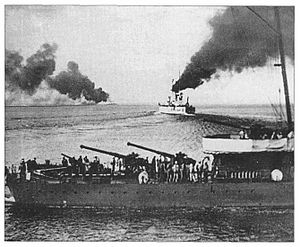 In the foreground - fodder guns EM “Kerch”, in the background - the battleship “Will” . | |
| Service | |
 Russia Russia RSFSR RSFSR | |
| Class and type of vessel | Destroyer |
| Organization | Navy of the Russian Empire RSFSR naval forces |
| Manufacturer | Naval |
| Construction started | October 29, 1915 |
| Launched | May 18, 1916 |
| Commissioned | June 27, 1917 |
| Status | flooded by the crew on June 19, 1918 |
| Main characteristics | |
| Displacement | 1326 t (normal), 1580 t (full) [1] |
| Length | 92.51 m [1] |
| Width | 9.05 m [1] |
| Draft | 3.2 m [1] |
| Engines | 2 Parsons steam turbines, 5 Tornicroft boilers in 3 boiler rooms |
| Power | 28 400 l. from. (on acceptance tests) |
| Mover | 2 propellers |
| Speed | 31.1 knots (for acceptance tests) |
| Crew | 136 people, including 9 officers |
| Armament | |
| Artillery | 4x1 102-mm / 60 guns (ammunition 600 rounds) |
| Flak | from the end of 1917: 2 57-mm AU |
| Mine torpedo armament | 4x3 457 mm TA of the 1913 sample (14 torpedoes of the 1910 sample), 80 min of the 1908 or 1912 sample |
Content
- 1 Service History
- 2 facts
- 3 Commanders
- 4 notes
Service History
Listed on the Black Sea Fleet on July 2, 1915 . Laid on the slipway of the Naval plant on October 29, 1915 , launched on May 18, 1916 . After completion of the mooring tests in early March 1917, he moved from Nikolaev to Sevastopol for final completion and acceptance tests. On May 25, 1917, the destroyer destroyer Kerch was admitted to the 3rd division of the Mine Brigade of the Black Sea Fleet [2] .
In July 1917, the destroyer fleet made 1 combat exit to carry out a mine setting. December 16, 1917 the ship became part of the Soviet Black Sea Fleet. In January 1918 he took part in the establishment of Soviet power in Yalta and Feodosia , in battles against the Romanian forces at the mouth of the Danube . In February, he participated in a punitive expedition to Novorossiysk , and then returned to Sevastopol [2] . After the ultimatum was presented by the German command on April 25, 1918 to the Soviet government about the surrender of the Black Sea Fleet “Kerch” on April 29, 1918, together with part of the ships, left Sevastopol and on May 1 arrived in Novorossiysk .
On June 18, 1918, by decision of the Soviet government, in order to avoid the capture of Black Sea Fleet ships by the German troops, the destroyer destroyer Kerch flooded the battleship Free Russia and the destroyer Fidonisi in the Tsemess Bay , and then left in Tuapse , where the crew was sunk on June 19 at the Kadosh lighthouse, three miles from the entrance to the Tuapse port (at a depth of 27 meters). The ship sank upside down [3] [4] .
An attempt made on November 22, 1929 by EPRON to lift the ship was unsuccessful (the destroyer hull was cut into several parts by pontoon lines). The middle part of the Kerch building (with engine room) was raised by Epron in 1932. After repair, the destroyer turbines for a long time worked at the Tuapse power station. The fragments of the ship’s hull remaining at the bottom, the fodder of which is best preserved, continue to remain unlifted from the seabed [3] [4] .
Facts
The destroyer Kerch, following the Black Sea Fleet ships leaving for Sevastopol, was broadcast, which later became a famous signal to “Ships going to Sevastopol-Shame traitors to the motherland!”
Commanders
- Captain 2nd rank Varenov ( December 20, 1916 - 1917 );
- Kukel V.A. (since April 1918 ) [4] .
Notes
- ↑ 1 2 3 4 Verstyuk A.N., Gordeev S. Yu. Ships of mine divisions. From Novik to Gogland. - M .: War Book, 2006. - S. 116 . - ISBN 5-902863-10-4 .
- ↑ 1 2 Verstyuk A.N., Gordeev S. Yu. Ships of mine divisions. From Novik to Gogland. - M .: Military book, 2006 .-- S. 102 .
- ↑ 1 2 Verstyuk A.N., Gordeev S. Yu. Ships of mine divisions. From Novik to Gogland. - M .: War book, 2006. - S. 111 .
- ↑ 1 2 3 Chernyshov A. A. “Noviki”. The best destroyers of the Russian Imperial Navy. - M .: Collection, Yauza, EKSMO, 2007 .-- S. 216.