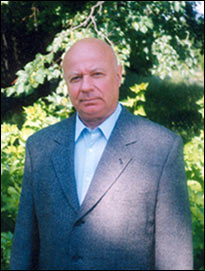
Anatoly Alekseevich Karatsuba (January 31, 1937 , Grozny - September 28, 2008 , Moscow) - Soviet and Russian mathematician . The creator of the first fast method in the history of mathematics - the method of multiplying large numbers [1] [2] ( Karatsuba multiplication ).
| Karatsuba Anatoly Alekseevich | |
|---|---|
 | |
| Date of Birth | January 31, 1937 |
| Place of Birth | The terrible |
| Date of death | September 28, 2008 (71 years old) |
| Place of death | Moscow , Russia |
| A country |  USSR USSR  Russia Russia |
| Scientific field | maths |
| Place of work | Steklov Mathematical Institute , Moscow State University |
| Alma mater | MSU (mehmat) |
| Academic degree | |
| supervisor | Korobov N.M. |
| Famous students | Voronin S.M. , Chubarikov V.N. , Arkhipov G.I. |
| Awards and prizes | Prize to them. P.L. Chebyshev Academy of Sciences of the USSR  Prize to them. I.M. Vinogradova RAS |
Study and work
Anatoly Karatsuba studied in the years 1944-1954 at the secondary school No. 6 of the city of Grozny and graduated with a silver medal. Already in the early years he showed exceptional abilities for mathematics, solving in the elementary grades problems that were given to high school students in the mathematical circle.
In 1959 he graduated from the Faculty of Mechanics and Mathematics of Moscow State University. Lomonosov . In 1962, he became a candidate of physical and mathematical sciences with a thesis "Rational trigonometric sums of a special type and their applications" (supervisor - N. M. Korobov ), and began working at the faculty at Moscow State University. In 1966, he defended his doctoral dissertation, “The method of trigonometric sums and average theorems,” and became a researcher at the Mathematical Institute of the USSR Academy of Sciences (Steklov Mathematical Institute).
Since 1983, he was a leading specialist in the field of number theory in the USSR and Russia, and head of the department of number theory at the Steklov Mathematical Institute (founded in 1983 ), professor at the Department of Number Theory of Moscow State University since 1970, and professor at the Department of Mathematical Analysis of Moscow State University (founded in 1962 ) since 1980 His research interests included trigonometric sums and trigonometric integrals, the Riemann zeta function , Dirichlet characters , finite state machines , and efficient algorithms .
Karatsuba was the supervisor of 15 graduate students who received a Ph.D. seven of them later became doctors of science. Has state prizes and titles.
Prizes and titles
- 1981 : Prize named after P.L. Chebyshev , USSR Academy of Sciences
- June 4, 1999 : Honored Scientist of the Russian Federation
- 2001 : Prize named after I.M. Vinogradov of the Russian Academy of Sciences
Early Computer Science
As a student at Moscow State University Lomonosov, A. A. Karatsuba took part in the seminar of A. N. Kolmogorov and found solutions to two problems posed by Kolmogorov, which gave impetus to the development of the theory of automata and laid the foundation for a new direction in mathematics - the theory of fast algorithms.
Automata
In an article by Edward Moore, “Conspicuous experiments on sequential machines” [3] automatic machine (or machine) defined as having states input characters and output character device. Nine structure theorems are proved. and experiments with . Later such cars began to be called Moore submachine guns . At the end of the article, in the chapter “New Problems”, Moore formulates the problem of improving the estimates he obtained in Theorems 8 and 9:
- Theorem 8 (Moore). Let an arbitrary a machine such that every two of its states are distinguishable from one another, then there is an experiment of length which sets (finds) a state at the end of this experiment.
In 1957, Karatsuba proved two theorems that completely solved Moore's problem of improving the estimate of the length of an experiment in his Theorem 8 .
- Theorem A (Karatsuba). If a there is machine, every two states of which are distinguishable, there is a branched experiment of length not more than by which it is possible to establish (find) a state at the end of the experiment.
- Theorem B (Karatsuba). Exists a machine, each two of whose states are interdependent, such that the length of the shortest experiment establishing the state of the machine at the end of the experiment is .
These two theorems formed the basis of the fourth-year course paper by Karatsuba, “On a Problem from the Theory of Automata,” which was noted with a commendable response (that is, not very high) at the student competition of the Faculty of Mechanics and Mathematics of Moscow State University named after Lomonosov in 1958 . The article was submitted by Karatsuba to the journal Uspekhi Matematicheskikh Nauk in December 1958, and was published only in June 1960 [4] . However, until now, this result of Karatsuba, which later became known as the Moore - Karatsuba theorem, is the only exact (the only exact nonlinear order of estimation) nonlinear result both in the theory of automata and in similar problems in the theory of computational complexity. [one]
Fast Algorithms
Fast algorithms are a field of computational mathematics that studies algorithms for calculating a given function with a given accuracy using as few bit operations as possible. We assume that the numbers are written in a binary number system, the signs of which are 0 and 1 are called bits . One bit operation is defined as writing characters 0, 1, plus, minus, bracket; addition, subtraction and multiplication of two bits. The first formulations of problems on the bit complexity of computation belong to A. N. Kolmogorov . Multiplication complexity defined as the number of bit operations sufficient to calculate the product of two -value numbers using this algorithm.
Multiplying two n -digit numbers in the usual school way “in a column”, we have an upper bound . In 1956, A. N. Kolmogorov hypothesized that the lower bound with any method of multiplication there is also a quantity of order , i.e. it is impossible to calculate the product of two n- digit numbers faster than in operations (the so-called "hypothesis "). The credibility of the hypothesis pointed out by the fact that for the entire existence of mathematics by that time, people were doing multiplication with the complexity of the order , and if there was a faster method of multiplication, then it would probably have already been found.
In 1960, a seminar on the mathematical problems of cybernetics began under the leadership of A. N. Kolmogorov at the Faculty of Mechanics and Mathematics of Moscow State University, where the “hypothesis was formulated ”And a number of tasks were set to assess the complexity of other similar calculations. Anatoly Karatsuba, hoping to get a lower bound for the quantity , found a new method of multiplying two n- digit numbers, now known as Karatsuba multiplication , with complexity rating
and thereby refuting the hypothesis as reported to Kolmogorov after the next meeting of the seminar. At the next meeting of the seminar, this method was told by Kolmogorov himself, and the seminar stopped its work. [5] The first article describing the multiplication of Karatsuba was prepared by Kolmogorov himself, where he presented two different and unrelated results of his two students. [6] Although Kolmogorov clearly stated in the article that one of the theorems (not related to fast multiplication) belongs to Yu. Ofman, and the other theorem (with the first fast multiplication in history) belongs to A. Karatsube, this publication of two authors confused readers for a long time , who believed that both authors contributed to the creation of the fast multiplication method, and even called this method two names. The Karatsuba method was subsequently generalized to the “ divide and conquer ” paradigm, other important examples of which are the binary partitioning method , the binary search , the bisection method , etc.
Subsequently, on the basis of this idea of A. Karatsuba [5] [7] [8] , many fast algorithms were built, the most famous of which are its direct generalizations, such as the Schönhage-Strassen multiplication method [9] , the Strassen matrix multiplication method [10] and fast Fourier transform .
The French mathematician and philosopher Jean-Paul Delaillay called [11] the Karatsuba multiplication method “one of the most useful results of mathematics”.
The algorithm of Anatoly Karatsuba is implemented in almost all modern computers, not only on the software, but also on the hardware level.
Basic Research
In their article “On the Mathematical Works of Professor Karatsuba” [12] , dedicated to the 60th anniversary of A. A. Karatsuba, his students G. I. Arkhipov and V. N. Chubarikov describe the features of the scientific works of A. A. Karatsuba:
| In presenting the works of remarkable scientists, it is natural to highlight some characteristic and vivid features of their work. Such distinguishing features in the scientific activities of Professor Karatsuba are combinatorial inventiveness, thoroughness and a certain completeness of the results. |
The main studies of A. A. Karatsuba have been published in more than 160 scientific articles and monographs. [13] [14] [15] [16]
Trigonometric sums and trigonometric integrals
p -adic method
A. A. Karatsuba built a new -adic method in the theory of trigonometric sums. His estimates of the so-called -sum of the form
led to new boundaries of zeros Dirichlet series modulo equal to a prime power to the derivation of an asymptotic formula for a Waring comparison number of the form
solving the distribution problem of fractional fractions of a polynomial with integer coefficients modulo . A. A. Karatsuba first implements [18] in -adic form of the "investment principle" of Euler-Vinogradov and builds adic analogue - Vinogradov numbers in estimating the number of Waring type comparison solutions.
Let be
moreover
Where - Prime number. A. A. Karatsuba proved that in this case for any natural number exists such that for any any natural number representable in the form (1) for , and when exist such that comparison (1) is unsolvable.
This new approach, found by A. A. Karatsuba, led to a new -adic proof of the mean theorem of I. M. Vinogradov, which plays a central role in the method of trigonometric sums of Vinogradov.
One more element -adic method of A. A. Karatsuba is the transition from incomplete systems of equations to complete ones due to the local -adic change of the unknown. [19] [20]
Let be Is an arbitrary natural number, , and an integer defined by inequalities . Consider the system of equations
A. A. Karatsuba proved that for the number of solutions this system of equations for fair estimate
For incomplete systems of equations in which variables run through numbers with small prime divisors, A. A. Karatsuba applied a multiplicative shift of variables. This led to a qualitatively new estimate of trigonometric sums and a new average theorem for such systems of equations.
Hua Lo-ken problem on the measure of convergence of the special integral of the Terry problem
A. A. Karatsuba’s adic method includes methods for estimating the measure of the set of points with small values of functions through the values of their parameters (coefficients, etc.) and, conversely, estimating these parameters through the measure of the set in the real and adic metrics. This aspect of A. A. Karatsuba’s method was especially pronounced when evaluating trigonometric integrals, which led to the solution of the Hua Loeken problem. In 1979, A. A. Karatsuba, together with his students G. I. Arkhipov and V. N. Chubarikov, completely solved [21] the Hua Lo-ken problem posed in 1937 , which consisted in determining the integral convergence index:
Where Is a fixed number.
In this case, the value of convergence is the value , what converges at and diverges at where arbitrarily small. It was found that the integral converges at and diverges at .
Then a similar problem was solved for the integral
Where - integers satisfying the conditions
A. A. Karatsuboy and his students found that the integral converges if and diverges if .
Integrals and arise when solving the so-called Terry problem (Terry-Escott problem). A. A. Karatsuboy and his students obtained a number of new results related to the multidimensional analogue of the Terry problem. In particular, they found that if - polynomial from variables ( ) type
with zero free coefficient, , - -dimensional vector composed of coefficients then the integral
converges at where Is the largest of the numbers . This result, while not final, gave rise to a new direction in the theory of trigonometric integrals related to the refinement of the boundaries for the convergence index (I.A. Ikromov, M.A. Chakhkiev and others).
Multiple trigonometric sums
In 1966-1980, A. A. Karatsuba created [22] [23] [24] (with the participation of his students G. I. Arkhipov and V. N. Chubarikov) G. Weil’s theory of multiple trigonometric sums, that is, sums of the form
- ,
Where ,
- set of real coefficients . The central point of this theory, as well as the theory of trigonometric sums of I. M. Vinogradov, is the following mean value theorem .
- Let be - integers, , . Let further - -dimensional cube in the Euclidean space of the form
- , ,
- and
- .
- Then for any and for value an assessment takes place
- ,
- Where , , , , and natural numbers such that:
- , .
Теорема о среднем и лемма о кратности пересечения многомерных параллелепипедов лежат в основе оценки кратной тригонометрической суммы, полученной А. А. Карацубой (двумерный случай был получен Г. И. Архиповым [25] ). Если обозначить через наименьшее общее кратное чисел с условием , то при справедлива оценка
- ,
Where — количество делителей числа , but — количество различных простых делителей числа .
Оценка функции Харди в проблеме Варинга
Применяя сконструированную им -адическую форму кругового метода Харди-Литтлвуда-Рамануджана-Виноградова к оценкам тригонометрических сумм, в которых суммирование ведётся по числам с малыми простыми делителями, А. А. Карацуба получил [26] новую оценку известной функции Харди в проблеме Варинга (при ):
Многомерный аналог проблемы Варинга
В своих дальнейших исследованиях по проблеме Варинга А. А. Карацуба получил [27] [28] следующее двумерное обобщение этой проблемы:
Рассмотрим систему уравнений
- , ,
Where — заданные положительные целые числа имеющие одинаковый порядок роста, , but — неизвестные, но также положительные целые числа. Эта система разрешима, если , а если , то существуют такие -е, что система не имеет решений.
Проблема Артина о локальном представлении нуля формой
В исследованиях по проблеме Артина о A. A. Karatsuba’s results on the adic representation of zero by a form of arbitrary degree showed that instead of the previously assumed power growth of the number of variables for a nontrivial representation of zero by the form, this number of variables should grow almost exponentially depending on the degree. A. A. Karatsuba together with his student G. I. Arkhipov proved [29] that for any natural number there is such that for any there is a form degree less , with integer coefficients, the number of variables of which , ,
and having only a trivial representation of zero in 2-adic numbers, and also obtained a similar result for an arbitrary odd simple module .
Short Kloosterman Estimates
A. A. Karatsuba created [30] [31] [32] (1993-1999) a new method for estimating short Kloosterman sums , that is, trigonometric sums of the form
Where runs a lot numbers coprime to number elements in which substantially less , and the symbol denotes a deduction inverse to modulo : .
Until the early 1990s estimates of this type were known mainly for sums in which the number of terms exceeded ( G. D. Kloosterman , I.M. Vinogradov , G. Salier, L. Karlitz , S. Uchiyama, A. Weil ). The exception was special modules of the form where Is a fixed prime, and the exponent increases unlimitedly (this case was investigated by A. G. Postnikov's method of I. M. Vinogradov ). The method of A. A. Karatsuba allows us to estimate the Kloosterman sums, the number of terms of which does not exceed , and in some cases even where - an arbitrarily small fixed number. The last article by A. A. Karatsuba on this subject [33] was published after his death.
Various aspects of A. A. Karatsuba's method have found application in solving the following problems of analytic number theory:
- finding asymptotic forms of sums of fractional fractions of the form
- Where runs consecutive integers with the condition , but runs through prime numbers not dividing the modulus (A.A. Karatsuba);
- finding the lower boundary for the number of solutions of inequalities of the form
- in integers , mutually simple with , (A.A. Karatsuba);
- accuracy of approximation of an arbitrary real number from a segment fractional parts of the form
- Where , , (A.A. Karatsuba);
- refinement of the constant in the Brune-Titchmarsh inequality
- Where - number of primes not exceeding and belonging to arithmetic progression ( J. Friedlander , G. Ivanets );
- lower bound for the greatest prime divisor of a product of numbers of the form:
- , ( D.R. Heath-Brown );
- proof of infinity of primes of the form ( J. Friedlander , G. Ivanets );
- combinatorial properties of a set of numbers , (A.A. Glibichuk).
Riemann Zeta Function
A. Selberg hypothesis
In 1984, A. A. Karatsuba established, [34] [35] [36] that for a fixed with the condition big enough and , gap contains at least real zeros of the Riemann zeta function .
This statement in 1942 was made as a hypothesis by A. Selberg [37] , who himself proved its validity for the case . The estimates of A. Selberg and A. A. Karatsuba are unimprovable in order of growth for .
The distribution of zeros of the Riemann zeta function on short segments of the critical line
A. A. Karatsube also owns [38] a series of results on the distribution of zeros on “short” intervals of the critical line. He proved that the analogue of the Selberg hypothesis is valid for "almost all" intervals , where Is an arbitrarily small fixed positive number. A. A. Karatsuba developed (1992) a new approach to the study of the zeros of the Riemann zeta function on “ultrashort” intervals of the critical line, that is, on the intervals length which grows more slowly than any, even arbitrarily small degree . In particular, he proved that for any given numbers , with the condition almost all gaps at contain at least function zeros . This estimate is very close to that which follows from the Riemann hypothesis .
Zeros of linear combinations of Dirichlet el-series
A. A. Karatsuboy created a new method [39] [40] [41] for studying zeros of functions that can be represented as linear combinations -Dirichlet series . The simplest example of a function of this kind is the Davenport - Heilbronn function, defined by the equality
Where - non-principal character modulo ( , , , , , for anyone ),
For Riemann's hypothesis is false, but the critical line contains, however, anomalously many zeros.
A. A. Karatsuba established (1989) that the gap , contains at least
function zeros . Similar results were obtained by A. A. Karatsuba for linear combinations containing an arbitrary (finite) number of terms; exponent replaced by a smaller number depending only on the type of linear combination.
Zeros of the zeta function and the multidimensional problem of Dirichlet divisors
A. A. Karatsuba has a fundamentally new result [42] in the multidimensional problem of Dirichlet divisors, which is associated with finding the numbers solutions to inequality in natural numbers . For there is an asymptotic formula of the form
- ,
wherein - polynomial degree, the coefficients of which depend on and can be found explicitly, as - the remainder term, all known (until 1960) estimates of which had the form
- ,
Where , - absolute positive constants.
A. A. Karatsuba received a more accurate assessment in which the quantity had order and decreased much more slowly than in previous estimates. The estimate of A. A. Karatsuba is uniform in and ; in particular, the value can grow as it grows (as some degree of logarithm ) (A similar but weaker result was obtained in 1960 by the German mathematician H.E. Richert, whose work remained unknown to Soviet mathematicians until at least the mid-1970s.)
Valuation conclusion based on a number of statements essentially equivalent to the theorem on the boundary of the zeros of the Riemann zeta function obtained by the method of I. M. Vinogradov , that is, the theorem that has no zeros in the field
- .
A. A. Karatsuba established [43] [44] (2000) the feedback of estimates of quantities with behavior near straight . In particular, he proved that if Is an arbitrary non-increasing function with the condition such that for all assessment is in progress
- ,
then has no zeros in the field
( - absolute constants).
Lower bounds for the maximum modulus of the zeta function in small areas of the critical strip and at small intervals of the critical line
A. A. Karatsuba introduced and investigated [45] [46] functions and defined by equalities
Here - a sufficiently large positive number, , , , . Lower estimates and show how large (in absolute value) the values can take on short segments of the critical line or in small neighborhoods of points lying in the critical strip . Happening was previously investigated by Ramachandra; happening where - a sufficiently large constant, trivial.
A. A. Karatsuba proved, in particular, that if the quantities and exceed some fairly small constants, then the estimates
Where - some absolute constants.
Zeta Function Argument Behavior on a Critical Line
A. A. Karatsuboy obtained a number of new results [47] [48] concerning the behavior of a function called the argument of the Riemann zeta function on the critical line (here - increment of an arbitrary continuous branch along the broken line connecting the points and ) Among them are theorems on mean values of a function and its antiderivative on segments of the real line, as well as the theorem that every interval at contains at least
function change points . Earlier similar results were established by A. Selberg for the case of .
Dirichlet characters
Estimates of short sums of characters in finite fields
In the late 1960s. A. A. Karatsuba, engaged in estimating short sums of characters , created [49] a new method that made it possible to obtain nontrivial estimates of short sums of characters in finite fields . Let be Is a fixed integer - irreducible over the field rational numbers polynomial - root of the equation , - field extension , - basis , , , . Let further Is a sufficiently large prime number such that irreducible modulo , - Galois field with basis , - non-principal character of the Dirichlet field . Let finally - some non-negative integers, - many elements Galois fields ,
- ,
such that for any , , the inequalities are satisfied:
- .
A. A. Karatsuba proved that for any fixed , , and arbitrary with the condition
the following estimate is true:
Where , and the constant depends only on and basis .
Estimates of linear sums of characters by shifted primes
A. A. Karatsuba developed a number of new techniques, the use of which, along with I. M. Vinogradov's method of estimating sums with prime numbers, enabled him in 1970 to obtain [50] [51] an estimate of the sum of non-principal values by a simple module on a sequence of shifted primes, namely an estimate of the form
Where Is an integer with the condition , - an arbitrarily small fixed number, , and the constant depends only on .
This statement is a significant strengthening of the estimate of I. M. Vinogradov, which is nontrivial for .
In 1971, at the International Conference on Number Theory, dedicated to the 80th birthday of I. M. Vinogradov , Academician Yu. V. Linnik noted the following:
| The research of I. M. Vinogradov in the field of asymptotic behavior of Dirichlet characters from shifted primes is very important which gave a power reduction compared to already at , where - character module. This assessment is of fundamental importance, since it is deeper than what gives direct application of the extended Riemann hypothesis , and, apparently, in this direction is a truth deeper than this hypothesis (if the hypothesis is true). Recently, A. A. Karatsube managed to improve this estimate. |
This result was carried over by A. A. Karatsuba to the case when runs through the prime numbers of an arithmetic progression, the difference of which grows with the module .
Estimates of character sums from polynomials with a simple argument
A. A. Karatsube belongs [52] [53] to a series of estimates of sums of Dirichlet characters from polynomials of the second degree for the case when the argument of the polynomial runs through a short sequence of consecutive primes. Let, for example, - a sufficiently large prime number, where and - integers satisfying the condition , let it go denotes the Legendre symbol , then for any fixed with the condition and for the amount ,
the following estimate is true:
(here running consecutive primes - number of primes not exceeding , but - constant, depending only on )
A similar estimate was obtained by A. A. Karatsuba for the case when runs through a sequence of primes belonging to an arithmetic progression, the difference of which can grow with the module .
A. A. Karatsuba put forward a hypothesis according to which a nontrivial estimate of the sum at , "Small" compared to remains valid even if replaced arbitrary polynomial degree which is not a square modulo . This hypothesis is not currently proven.
Lower bounds for character sums from polynomials
A. A. Karatsuba constructed [54] an infinite sequence of primes and sequence of polynomials degrees of with integer coefficients such that is not a full square modulo ,
and such that
In other words, for any value turns out to be a quadratic residue modulo . This result shows that A. Weil's estimate
one cannot improve too much and replace the right-hand side of the last inequality with, say, the quantity where - absolute constant.
Sums of characters on additive sequences
A. A. Karatsuboy proposed a new method [55] [56] , which allows one to find very accurate estimates of the sums of values of nonprincipal Dirichlet characters on additive sequences, that is, on sequences consisting of numbers of the form where the variables and independently run through, respectively, some sets and .
The most striking example of results of this kind is the following statement, which finds application in solving a wide class of problems related to summing the values of Dirichlet characters. Let be - an arbitrarily small fixed number, , - a sufficiently large prime number, - non-principal character modulo . Let further and - arbitrary subsets of the complete system of residues modulo satisfying only conditions , . Then there is an estimate:
The method of A. A. Karatsuba allows one to obtain nontrivial estimates of sums of this kind and in some cases when the above conditions on sets and replaced by others, for example: ,
In the case when and represent sets of prime numbers of segments , accordingly, and , , there is an assessment of the form:
Where - number of primes not exceeding , , but Is some absolute constant.
Distribution of power residues and primitive roots in rare sequences
A. A. Karatsuba obtained [57] [58] (2000) nontrivial estimates of the sums of values of Dirichlet characters “with weights”, that is, sums of terms of the form where Is a function of the natural argument. Estimates of this kind are used in solving a wide range of problems in number theory related to the distribution of power residues (non-residues), as well as primitive roots in various sequences.
Let be Is an integer - a sufficiently large prime number, , , where and let finally
(asymptotic expression for see above in the section on the multidimensional problem of Dirichlet divisors). For amounts and quantities extended to values for which numbers are quadratic residues (respectively, non-residues) modulo , A. A. Karatsuba obtained asymptotic formulas of the form
- .
Similarly, for the sum quantities taken across for which will be a primitive root modulo , we obtain an asymptotic expression of the form
- ,
Where - all prime divisors of a number .
The method developed by A. A. Karatsuba was also applied by him to problems on the distribution of power residues (non-residues) in sequences of shifted primes , numbers of the form etc.
Recent Works
In recent years, in addition to research in the field of number theory (see the Karatsuba effect [59] [60] ), he dealt with some problems of theoretical physics [61] , including in the field of quantum field theory . By applying his ATS theorem and some other number-theoretic approaches, he obtained new results [62] [63] in the Janes-Cummings model in quantum optics .
Family and hobbies
His wife is a classmate at the Faculty of Mechanics and Mathematics of Moscow State University Diana V. Senchenko (born 1936), associate professor of the chair of mathematical methods of economic analysis at the Faculty of Economics of Moscow State University . Daughter Catherine (born 1963) - Doctor of Physical and Mathematical Sciences, leading researcher at the Computing Center named after A. A. Dorodnitsyna RAS [64] .
Anatoly Karatsuba has been involved in sports all his life: in the early years, weightlifting and wrestling, then mountaineering, [65] rock climbing, caving and mountaineering. He passed the Crimean walls of Ai-Petri , Kush-Kai , Landslide, Foros and many others, participated in speleo expeditions to the caves Anakopi (New Athos) , Cascade, Nazarov.
See also
- ATS theorem
- Moore Chart
- Karatsuba Multiplication
- Karatsuba effect
Notes
- ↑ 1 2 S.A. Gritsenko, E.A. Karatsuba, M.A. Korolev, I.S. Rezvyakova, D.I. Tolev, M.E. Changa. Scientific achievements of Anatoly Alekseevich Karatsuba. Mathematics and Computer Science, 1. // On the occasion of the 75th birthday of Anatoly Alekseevich Karatsuba . - Sovr. prob. Mat .. - 2012. - T. 16. - S. 7-30.
- ↑ Knut D. The art of computer programming. - 1st ed. - M .: Mir (publishing house), 1977. - T. 2. - S. 315. - 724 p.
- ↑ Moore, EF Gedanken-experiments on Sequential Machines. (neopr.) // Automata Studies, Annals of Mathematical Studies, Princeton University Press, Princeton, NJ ,. - 1956. - No. 34 . - S. 129-153 .
- ↑ Karatsuba, A. A. Solution of a problem from the theory of finite automata (neopr.) // UMN. - 1960. - No. 15: 3 . - S. 157-159 .
- ↑ 1 2 A. Karatsuba. Complexity of calculations // Tr. MIAN. - 1995 .-- T. 211 . - S. 186-202 .
- ↑ Karatsuba A., Ofman Yu. Multiplication of multivalued numbers on automata // Doklady of the USSR Academy of Sciences. - 1962. - T. 145 , No. 2 .
- ↑ Karacuba A. Berechnungen und die Kompliziertheit von Beziehungen (German) // Elektronische Informationsverarbeitung und Kybernetik. - 1975. - Bd. 11 .
- ↑ Knut D. The Art of Programming. - 3rd ed. - M .: Williams , 2007. - T. 2. The obtained algorithms. - 832 s. - ISBN 0-201-89684-2 . .
- ↑ Schönhage A., Strassen V. Schnelle Multiplikation großer Zahlen // Computing. - 1971. - No. 7 . - P. 281-292.
- ↑ Strassen V. Gaussian Elimination is not Optimal // Numer. Math - Springer Science + Business Media , 1969. - Vol. 13, Iss. 4. - P. 354–356. - ISSN 0029-599X ; 0945-3245 - doi: 10.1007 / BF02165411
- ↑ Jean-Paul Delahaye. Mathematiques et philosophie (Fr.) // Pour la Science. - 2000. - N o 277 . - P. 100-104.
- ↑ G.I. Arkhipov; V.N. Chubarikov. On the mathematical works of Professor A. A. Karatsuba // Transactions of Steklov Mathematical Institute . - 1997 .-- T. 218 . - S. 7-19 .
- ↑ Karatsuba A.A. Fundamentals of analytic number theory. (neopr.) // M .: Science. - 1975.
- ↑ Arkhipov G.I., Karatsuba A.A., Chubarikov V.N. Theory of multiple trigonometric sums. (neopr.) // M .: Science. - 1987.
- ↑ Voronin S. M., Karatsuba A. A. The Riemann Zeta Function. (neopr.) // M .: Fizmatlit. - 1994.
- ↑ Karatsuba AA Complex analysis in number theory. (neopr.) // London, Tokyo: CRC. - 1995.
- ↑ Karatsuba, A. A. Estimates of trigonometric sums of a special form and their applications (Russian) // Dokl. USSR Academy of Sciences: journal. - 1961. - No. 137: 3 . - S. 513-514 .
- ↑ Karatsuba, A. A., Waring's problem for comparison modulo equal to the degree of a prime number (Russian) // Tomsk State University Journal. Moscow State University: journal. - 1962. - No. 1: 4 . - S. 28-38 .
- ↑ Karatsuba, A. A. On the Estimation of the Number of Solutions of Some Equations (Neopr.) // Dokl. USSR Academy of Sciences. - 1965. - No. 165: 1 . - S. 31-32 .
- ↑ Karatsuba, A.A. Comparison systems and Waring type equations (neopr.) // Dokl. USSR Academy of Sciences. - 1965. - No. 1: 4 . - S. 274-276 .
- ↑ Arkhipov G.I., Karatsuba A.A., Chubarikov V.N. Trigonometric integrals (Russian) // Proceedings of the Russian Academy of Sciences. The series is mathematical. . - 1979. - T. 43 , No. 5 . - S. 971-1003 .
- ↑ Karatsuba, A.A. Theorems on the mean and total trigonometric sums (Russian) // Izv. USSR Academy of Sciences. Ser. mate. : magazine. - 1966. - No. 30: 1 . - S. 183-206 .
- ↑ Vinogradov I.M., Karatsuba A.A. The method of trigonometric sums in number theory (neopr.) // Transactions of Steklov Mathematical Institute. - 1984. - No. 168 . - S. 4-30 .
- ↑ Arkhipov G.I., Karatsuba A.A., Chubarikov V.N. Theory of multiple trigonometric sums (neopr.) // M .: Science. - 1987.
- ↑ Arkhipov, G.I. Theorem on the average value of the modulus of a multiple trigonometric sum (Russian) // Matem. notes: magazine. - 1975. - No. 17: 1 . - S. 143-153 .
- ↑ Karatsuba, A. A. On the function G (n) in the Waring problem (Russian) // Proceedings of the Russian Academy of Sciences. The series is mathematical. . - 1985. - No. 49: 5 . - S. 935-947 .
- ↑ Arkhipov G.I., Karatsuba A.A. A multidimensional analogue of the Waring problem (unopened) // Dokl. USSR Academy of Sciences. - 1987. - No. 295: 3 . - S. 521-523 .
- ↑ Karatsuba AA Waring's problem in several dimension (neopr.) // Mathem. Forschungs, Oberwolfach, Tagungsbericht. - 1988. - No. 42 . - S. 5-6 .
- ↑ Arkhipov G.I., Karatsuba A.A. On the local representation of zero by form (neopr.) // Izv. USSR Academy of Sciences. Ser. Mat .. - 1981. - No. 45: 5 . - S. 948-961 .
- ↑ Karatsuba, A. A. Analogs of Kloosterman sums (Russian) // Bulletin of the Russian Academy of Sciences. The series is mathematical. . - 1995. - No. 59: 5 . - S. 93-102 .
- ↑ Karatsuba, A. A. Analogs of incomplete Kloosterman sums and their applications (neopr.) // Tatra Mountains Math. Publ .. - 1997. - No. 11 . - S. 89-120 .
- ↑ Karatsuba, A.A. Double amounts of Kloosterman (neopr.) // Matem. notes. - 1999. - No. 66: 5 . - S. 682-687 .
- ↑ Karatsuba, A. A. New estimates of short Kloosterman sums (neopr.) // Mat. notes. - 2010. - No. 88: 3 . - S. 384—398 .
- ↑ Karatsuba, A. A. On the zeros of the function ζ (s) on short intervals of the critical line (Russian) // Bulletin of the Russian Academy of Sciences. The series is mathematical. : magazine. - 1984. - No. 48: 3 . - S. 569-584 .
- ↑ Karatsuba, A.A. Distribution of zeros of the function ζ (1/2 + it) (Russian) // Proceedings of the Russian Academy of Sciences. The series is mathematical. . - 1984. - No. 48: 6 . - S. 1214-1224 .
- ↑ Karatsuba, A. A. On the zeros of the Riemann zeta function on the critical line (neopr.) // Transactions of Steklov Mathematical Institute. - 1985. - No. 167 . - S. 167-178 .
- ↑ Selberg, A. On the zeros of Riemann's zeta-function (neopr.) // Shr. Norske Vid. Akad. Oslo. - 1942. - No. 10 . - S. 1-59 .
- ↑ Karatsuba, A. A. On the number of zeros of the Riemann zeta function lying on almost all short intervals of the critical line (Russian) // Izvestiya RAS. The series is mathematical. : magazine. - 1992. - No. 56: 2 . - S. 372-397 .
- ↑ Karatsuba, A. A. On the zeros of the Davenport – Heilbronn function lying on the critical line (Russian) // Izvestiya RAS. The series is mathematical. : magazine. - 1990. - No. 54: 2 . - S. 303-315 .
- ↑ Karatsuba, AA On Zeros of the Davenport – Heilbronn Function (Neopr.) // Proc. Amalfi Conf. Analytic Number Theory. - 1992. - S. 271-293 .
- ↑ Karatsuba, A. A. On the zeros of arithmetic Dirichlet series that do not have Eulerian products (Russian) // Izvestia RAS. The series is mathematical. : magazine. - 1993. - No. 57: 5 . - S. 3-14 .
- ↑ Karatsuba, A. A. Uniform estimation of the remainder term in the problem of Dirichlet divisors (Russian) // Izv. USSR Academy of Sciences. Ser. mate. : magazine. - 1972. - No. 36: 3 . - S. 475-483 .
- ↑ Karatsuba, AA The multidimensional Dirichlet divisor problem and zero free regions for the Riemann zeta function (English) // Functiones et Approximatio: journal. - 2000. - No. Xxviii . - P. 131-140 .
- ↑ Karatsuba, A. A. On the connection of the multidimensional problem of Dirichlet divisors with the boundary of zeros ζ (s) (Russian) // Matem. notes: magazine. - 2001. - No. 70: 3 . - S. 477-480 .
- ↑ Karatsuba, A. A. On lower bounds for the maximum modulus of ζ (s) in small areas of the critical band (rus.) // Matem. notes: magazine. - 2001. - No. 70: 5 . - S. 796-798 .
- ↑ Karatsuba, A. A. On lower bounds for the maximum modulus of the Riemann zeta function on short intervals of the critical line (Russian) // Izvestiya RAS. The series is mathematical. : magazine. - 2004. - No. 68: 8 . - S. 99-104 .
- ↑ Karatsuba, A. A. Density theorem and behavior of the argument of the Riemann zeta-function (neopr.) // Matem. notes. - 1996. - No. 60: 3 . - S. 448-449 .
- ↑ Karatsuba, A. A. On the function S (t) (Russian) // Proceedings of the Russian Academy of Sciences. The series is mathematical. . - 1996. - No. 60: 5 . - S. 27-56 .
- ↑ Karatsuba, A.A. Sums of characters and primitive roots in finite fields (Russian) // Dokl. USSR Academy of Sciences: journal. - 1968. - No. 180: 6 . - S. 1287-1289 .
- ↑ Karatsuba, A. A. On estimates of the sums of characters (neopr.) // Izv. USSR Academy of Sciences. Ser. Mat .. - 1970. - No. 34: 1 . - S. 20-30 .
- ↑ Karatsuba, A.A. Sums of characters with primes (neopr.) // Izv. USSR Academy of Sciences. Ser. Mat .. - 1970. - No. 34: 2 . - S. 299—321 .
- ↑ Karatsuba, A.A. Sums of characters and primitive roots in finite fields (Russian) // Dokl. USSR Academy of Sciences: journal. - 1968. - No. 180: 6 . - S. 1287-1289 .
- ↑ Karatsuba, A.A. Sums of characters over a sequence of shifted primes and their applications (Russian) // Matem. notes: magazine. - 1975. - No. 17: 1 . - S. 155-159 .
- ↑ Karatsuba, A. A. On lower bounds for sums of characters from polynomials (neopr.) // Mat. notes. - 1973. - No. 14: 1 . - S. 67–72 .
- ↑ Karatsuba, A.A. Distribution of power residues and non-residues in additive sequences (Russian) // Dokl. USSR Academy of Sciences: journal. - 1971. - No. 196: 4 . - S. 759-760 .
- ↑ Karatsuba, A.A. Distribution of values of Dirichlet characters on additive sequences (Russian) // Dokl. USSR Academy of Sciences: journal. - 1991. - No. 319: 3 . - S. 543-545 .
- ↑ Karatsuba, AA Sums of characters with prime numbers and their applications (Eng.) // Tatra Mountains Math. Publ. : journal. - 2000. - No. 20 . - P. 155-162 .
- ↑ Karatsuba, A.A. Sums of characters with weights (Russian) // Bulletin of the Russian Academy of Sciences. The series is mathematical. . - 2000. - No. 64: 2 . - S. 29-42 .
- ↑ Karatsuba, A. A. On a property of the set of primes. (neopr.) // Advances in Mathematical Sciences. - 2011.- T. 66 , No. 2 (398) . - S. 3-14 .
- ↑ Karatsuba, A. A. On a property of the set of primes as a multiplicative basis of a natural series. (Rus.) // Reports of the Academy of Sciences: journal. - 2011. - T. 439 , No. 2 . - S. 1-5 .
- ↑ AA Karatsuba, EA Karatsuba. Physical mathematics in number theory (neopr.) // Functional Analysis and Other Mathematics. - 2010. - DOI : 10.1007 / s11853-010-0044-5 .
- ↑ Karatsuba AA, Karatsuba EA Application of ATS in a quantum-optical model (neopr.) // Analysis and Mathematical Physics: Trends in Mathematics. - 2009 .-- S. 211-232 .
- ↑ Karatsuba AA, Karatsuba EA A resummation formula for collapse and revival in the Jaynes – Cummings model (Eng.) // J. Phys. A: Math. Theor. : journal. - 2009. - No. 42 . - P. 195304, 16 . - DOI : 10.1088 / 1751-8113 / 42/19/195304 .
- ↑ Catherine Karatsuba
- ↑ Bashkirov Vladimir Leonidovich: Berserker Bashkirov. Part one. Archived on October 28, 2012.
Links
- List of scientific papers on the Steklov Mathematical Institute website (Retrieved September 24, 2009)
- Data on scientific interests, education and professional activities (Retrieved September 24, 2009)
- Arkhipov G.I. , Chubarikov V.N. Anatoly Alekseevich Karatsuba