Riemann geometry (also called elliptic geometry ) is one of the non-Euclidean geometries of constant curvature (the others are Lobachevsky geometry and spherical geometry ). If the Euclidean geometry is realized in a space with zero Gaussian curvature , and Lobachevsky is negative, then the Riemannian geometry is realized in a space with constant positive curvature (in the two-dimensional case, on the projective plane and locally on the sphere ).
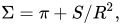
In Riemannian geometry, a straight line is defined by two points, a plane by three, two planes intersect in a straight line, etc., but in Riemannian geometry there are no parallel lines. In Riemannian geometry, as well as in spherical geometry, the statement is true: the sum of the angles of a triangle is more than two lines, the formula Where Is the sum of the angles of the triangle, - radius of the sphere on which the geometry is implemented.


The two-dimensional Riemannian geometry is similar to spherical geometry , but differs in that any two “lines” have not two, as in a spherical, but only one intersection point. When identifying the opposite points of the sphere, we obtain a projective plane whose geometry satisfies the axioms of Riemann geometry.
Namely, consider the scope centered at in three-dimensional space . Every point together with the center of the sphere defines a straight line i.e. some point projective plane . Mapping defines display big circles on (lines in spherical geometry) turn into lines on the projective plane at the same time at one point exactly two points of the sphere pass: together with the point and diametrically opposite point (see picture). Euclidean space motion translating a sphere into itself, some certain transformations of the projective plane which are the movements of the Riemann geometry. In Riemannian geometry, any lines intersect, since this is true for the projective plane, and thus, there are no parallel lines in it.


One of the differences between Riemannian geometry and Euclidean geometry and Lobachevsky’s geometry is that it does not have the natural concept of “point C lies between points A and B ” (this concept is also absent in spherical geometry). Indeed, on the line of the projective plane a large circle is displayed on the sphere , and two diametrically opposite points of the sphere and go to one point . Similarly, points go to one point and points go to one point . Thus, with equal reason, we can assume that the point lies between and and that it does not lie between them (see figure).


Notes
Literature
- Aleksandrov A.D., Netsvetaev N. Yu. Geometry. - M .: Nauka, 1990.
- Alexandrov P. S. What is non-Euclidean geometry. - M .: URSS, 2007.
- Alekseevsky D.V., Vinberg E. B., Solodovnikov A. S. Geometry of spaces of constant curvature. In the book: Results of science and technology. Modern problems of mathematics. Fundamental directions. - M.: VINITI, 1988. - T. 29. - S. 1-146.
- Berger M. Geometry. / Per. with french - M .: Mir, 1984. - Volume II, part V: Internal geometry of a sphere, hyperbolic geometry, space of spheres.
- Efimov N.V. Higher Geometry. - 7th ed. - M .: FIZMATLIT, 2003 .-- 584 p. - ISBN 5-9221-0267-2 .
- Klein F. Noneuclidean geometry. - Any edition.
- Stepanov N.N. Spherical trigonometry. - L. - M., 1948.
- Shafarevich I.R. , Remizov A.O. Linear algebra and geometry. - M .: Fizmatlit, 2009.