Alder is gray , or Alder white , or Eloha ( lat. Álnus incána ) - a woody plant , a species of the genus Alder ( Alnus ) of the family Birch ( Betulaceae ).
| Alder is gray | |||||||||||||||||||||||
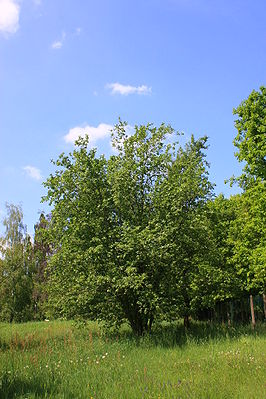 Adult plant | |||||||||||||||||||||||
| Scientific classification | |||||||||||||||||||||||
|---|---|---|---|---|---|---|---|---|---|---|---|---|---|---|---|---|---|---|---|---|---|---|---|
| |||||||||||||||||||||||
| International Scientific Name | |||||||||||||||||||||||
Alnus incana ( L. ) Moench , 1794 | |||||||||||||||||||||||
| Distribution of the species in Eurasia | |||||||||||||||||||||||
| |||||||||||||||||||||||
| Security status | |||||||||||||||||||||||

Latin specific epithet lat. incana means "greyish" [2] .
Botanical description
A tree up to 20 m high or a shrub with a narrow ovoid crown and a trunk with a diameter of up to 50 cm. The trunk is rarely straight and cylindrical, often with longitudinal hollows and humps. One of the fastest growing breeds. Up to 10-15 years it grows quickly, after which the growth slows down. It lives to (40-50 [2] [3] ) 50-60, occasionally up to 100 years [4] .
The root system is superficial, located mainly in the upper soil layer (10–20 cm) [4] . The roots contain nodule growths containing microorganisms that can absorb nitrogen from the air [2] . Forms numerous root suckers and spruce [4] .
Trunk |
Leaves |
Men's earrings |
Women's earrings |
Seeds |
The bark is light gray, always smooth and does not form an outer crusty layer. The shoots are greenish at first, later brown or blackish-gray, not sticky, but covered with gray cannon or felt and light lentils.
Kidney stalked, ovate or ovate-spherical, slightly dulled on top, fluffy. The leaves are arranged in three rows [2] , alternate, oval, oval-lanceolate or ovate-rounded, less often elliptical, 4 (4.5 [3] ) —10 cm long, 3.5-7 cm wide, acute or pointed, rarely blunted, with a rounded or weakly heart-shaped base, acutely bipedulate, young densely-fluffy, not sticky, adults almost naked from above, gray-green from below, without beards in the corners of nerves, on softly hairy or felt petioles 1-2 (3 [3] ) see Young leaves are not sticky [5] .
Apical ear rings , collected from three to five together, sessile or on short fluffy legs, contain for each scale three flowers with four stamens with forked anthers [2] . Pistillate flowers are collected in eight to ten bunches on a common peduncle , sometimes under male catkins, then on the tops of the branches, elliptical, black-brown, about 1.5 cm long, 7-8 cm in diameter, containing two flowers with each scale; pistil with two filiform purple stigmas protruding from behind scales [2] . It blooms in March - April, before the leaves appear, one or two weeks earlier than the alder is sticky [5] .
Fruits - obovate nuts with narrow, membranous wings, 10 mm long and 7-8 mm wide [3] , ripening in cones , twice as lighter than the alder sticky. Fruits ripen in autumn, fall off and are carried by the wind [5] . In 1 kg 1 430 000 nuts; weight of 1000 nuts - 0.5-0.9 g
Fruiting annually, abundant. Seed specimens begin to bear fruit from eight to ten years; coppice from five to seven years [5] .
The number of chromosomes is 2n = 28 [6] .
Dissemination and ecology
In nature, the species range covers almost the entire territory of Europe , Asia Minor , Transcaucasia , Western Siberia and North America [7] . The northern boundary of the range begins in Sweden , passes through the Kola Peninsula , through the entire north of the European part of Russia and through all of Siberia to Kamchatka . It grows in Serbia , Northern Italy and in France . Most of it is in the north and northeast of the European part of Russia [3] .
It grows on the plains in the forest and, rarely, forest-steppe and forest-tundra zone. Forms the so-called sulfur-algae - shrub and low-growth thickets on the marshy edges , marshes , along the banks of rivers, in the cutting areas, fires and abandoned arable land . It is found along streams and rivers along with willows and black alder . It does not form a clear plantation, the question of the primacy or secondary nature of the heathlands along the beams, ravines and the edges of the marshes remains unresolved. Due to abundant fruiting, ease of spreading seeds and good germination, they are quickly inhabited by cuttings, burning, abandoned arable land, forming temporary associations, gradually replaced by primary phytocenoses . Most often, alderfish are formed at the place of spruce and small-leaved forests, the reverse change of alder with spruce occurs within 50-60 years. The grazing of livestock and deforestation in such thickets promotes more rapid vegetative reproduction of alder and a longer existence of its associations. In the Caucasus, it rises up to 2000 m above sea level , occurring singly or in groups in the middle and upper mountain belts, in abandoned arable lands and forest glades [4] .
In Siberia , Transbaikalia and Amur coexist alongside with a close species of the alder fluffy ( Alnus hirsuta ( Spach ) Rupr. ) And is replaced by it [5] .
Soil is less demanding than black alder, although it is rarely found on poor dry sandy soils; swamping tolerates better than black alder. Prefers calcareous, moist soil and free standing, although it often grows in thick plantings [3] . It enriches the soil with nitrogen. Hardy Shade tolerant than aspen and birch hanging , but prefers well-lit habitats.
The most common types of sulfur fodder are sour and snouted on fresh sod-podzolic , strongly or moderately podzolized soils. They occur on the site of spruce tart or blueberry sirloshadnikov . In the sour and snouterous litterlands, there is an intensive restoration of spruce and a quick change of spruce forests. Along the banks of rivers, brooks, in ravines, humidified depressions on humus-gley, loamy and clay soils, in small areas there appear tavolgovye and large parorolskiemolosolshadniki. They occur on the site of coniferous, broad-leaved-spruce and broad-leaved-spruce-black-alder forests and are capable of long-term existence. On sandy and weakly moistened soils, sievesholshadniki occur rarely and are quickly replaced by pine and spruce. Such heelshaws occur on burrs and clearings of cowberry pine forests. More rarely, sedge sulfur-sulphates occur on overmoistened soils. They are short-lived and have an admixture of birch, willow. On short fresh soils of watersheds at the site of the blueberry spruce forests, very short-term bilberry halides, alternating with black algae, Kisnic and Veynik, appear. Cereal coarse grasses occur at the site of abandoned arable land. They are unstable and are replaced by spruce forests [4] .
Gray alder produces many seeds, but only a small part germinates. Vegetative reproduction is more effective with abundant root suckers . Growing fast. He lives 50–70, rarely 150 years [5] .
Economic value and application
Gray alder in forest meliorative plantations is used in the north of the forest-steppe to secure the banks of rivers, slopes and ravines .
The wood is thick, soft, different from the wood of black alder ( Alnus glutinosa ) in more red; used for the production of joinery and turning products, as well as underwater structures [2] . Gray alder wood has a number of useful properties that are important in construction. It practically does not absorb vapors contained in the air and liquids falling on its surface. The wood does not crack and does not dry out under the influence of heat or rapid cooling. The oil contained in the wood exudes a pleasant woody fragrance. In the best stands, the stock of wood reaches 250 m³ / ha [5] .
Firewood from gray alder burns well, but coal does not hold up the heat. Alder firewood was used by Russian peasants for burning soot from chimneys, especially after using birch firewood. Firewood is valued for the production of drawing (drawing) coal and coal used for the manufacture of gunpowder . Alder chips are considered the best for fruit packaging [2] .
Alder gray spring gives the bees a lot of pollen , which is covered with young leaves and shoots. Beekeepers recommend feeding bees with alder pollen before it blooms. To do this, cut the twigs, put in a warm room in a sieve , covered with paper. As soon as the anthers open, gently shake the sieve, and the pollen is poured out on paper. It is mixed with honey and sugar syrup and given to bees [2] .
The leaves go to feed goats and sheep [2] . The buds and the tops of the branches serve to feed the hazel grouses and black grouses during the winter period [2] .
The alder sulfur cones contain alkaloids , tannins , phenol carboxylic acids , flavonoids , fatty oil , triterpenoids , aliphatic alcohols , steroids . The bark contains triterpenoids, tannins. Alder leaves contain provitamin A ( carotene ), vitamin C , phenol carboxylic acids, tannins, anthocyanins .
Preparations of the bark and cones of alder sulfur produce an astringent, anti-inflammatory, hemostatic effect, and fresh leaves are a diaphoretic agent. Preparations of alder cones are used in the treatment of acute and chronic inflammation of the small ( enterocolitis ) and colon ( colitis ) intestines.
In officinal medicine, preparations from alder sulfur are used as an astringent and hemostatic agent, especially for diseases of the gastrointestinal tract , acute and chronic enteritis and colitis. The beneficial effect of decoctions of bark, cones and leaves of alder with articular rheumatism , colds and diarrhea in children has been noted.
Broth bark have antimicrobial action and reduce the risk of allergies , are used in rheumatic polyarthritis and in the case of colds.
Gray alder, like other alder species, enriches the soil with nitrogen [5] .
Diseases and pests
Pathogenic fungi
In the gray alder, several species of the ascomycetes of the Taphrina genus parasitize. Taphrina alni affects female catkins, causes leaf-like growths of their scales; Taphrina epiphylla causes the appearance of “ witch bristles, ” spotting and wrinkling of leaves [8] .
Classification
Taxonomy
The species Alder gray enters the genus Alder ( Alnus ) of the subfamily Birch ( Betuloideae ) of the family Birch ( Betulaceae ) of the order Fagales .
| seven more families (according to the APG II System ) | one more - two kinds | |||||||||||||||
| beech flower order | subfamily Birch | view Alder is gray | ||||||||||||||
| department Flowering, or Angiosperms | Birch family | genus Alder | ||||||||||||||
| another 44 orders of flowering plants (according to the APG II System ) | another subfamily, Leshchinovye (according to the APG II System ) | about 45 species | ||||||||||||||
Synonyms
According to The Plant List for 2013, the synonymy of the species includes [9] :
- Alnus alisoviana mandl
- Alnus alnus ( L. ) Britton , nom. inval.
- Alnus argentata ( Norrl. ) Tzvelev
- Alnus borealis (Norrl.) C.Regel
- Alnus intermedia Schrad. ex regel
- Alnus languinosa Gilib. , nom. inval.
- Alnus minor ( Tourr. ) Chiov.
- Alnus plicata K.Koch
- Alnus tirolensis nyman
- Betula alnus L.
- Betula alnus L. var. incana L. basionym
- Betula incana (L.) Lf
- Betula palustris salisb. , nom. illeg.
- Betula pinnata lundmark
Varieties
Within the framework of the species there are several varieties [7] :
- Alnus incana subsp. incana
- Alnus incana subsp. rugosa ( du roi ) rtclausen
- [ syn. Alnus americana ( Regel ) Czerep. ]
- [ syn. Alnus glauca F.Michx. ]
- [ syn. Alnus rugosa ( Du Roi ) Spreng. ]
- [ syn. Betula rugosa ( Du Roi ) Ehrh. ]
- [ syn. Alnus glauca F.Michx. ]
- Alnus incana subsp. tenuifolia ( Nutt. ) Breitung
- [ syn. Alnus tenuifolia Nutt. ]
Notes
- ↑ About the conditionality of specifying the class of dicotyledons as a higher taxon for the group of plants described in this article, see the section “APG Systems” of the article “Dicotyledons” .
- ↑ 1 2 3 4 5 6 7 8 9 10 11 Neishtadt MI The determinant of plants in the middle zone of the European part of the USSR. Allowance for high school. - M .: GUPI MP RSFSR, 1954. - p. 168-169. - 495 s.
- ↑ 1 2 3 4 5 6 Ovsyannikov G. F. Hardwood. Manual for students and forest specialists. - Vladivostok: OGIZ - Dalkray, 1931. - p. 69-71. - 376 s.
- ↑ 1 2 3 4 5 Sokolov S. Ya., Svyazeva O. A., Kubli V. A. Areals of trees and shrubs of the USSR . - L .: Science, 1977. - T. 1. Tisovye - Kirkazonovye. - pp. 103-104. - 164 s. (inaccessible link)
- ↑ 1 2 3 4 5 6 7 8 Gubanov I. A. , et al. Wild-growing useful plants of the USSR / holes. ed. T. A. Rabotnov . - M .: Thought , 1976. - p. 92. - 360 p. - ( Reference guides geographer and traveler ).
- ↑ The numbers of chromosomes of flowering plants in the flora of the USSR: Aceraceae - Menyanthaceae / ed. A.L. Tahtajyan. - L .: Science (Leningrad. Dep.), 1990. - p. 231. - 509 p. - ISBN 5-02-026556-X .
- ↑ 1 2 According to the GRIN website (see the plant card).
- ↑ Karatygin I.V. Taffrin, Protomician, Exobasidium, Microstromium orders. - SPb. : "Science", 2002. - pp. 27-28. - (Determinant of Russian mushrooms). - ISBN 5-02-026184-X .
- ↑ Alnus incana (L.) Moench is an accepted name (English) . The Plant List (2013). Version 1.1. Published on the Internet; http://www.theplantlist.org/ . Royal Botanic Gardens, Kew and the Missouri Botanical Garden (2013).
Literature
- Gubanov, I.A., et al. 430. Alnus incana (L.) Moench - Gray Alder // Illustrated determinant of plants in Central Russia. In 3 t . - M .: T-in scientific. ed. KMK, In-t technologist. Ex., 2003. - T. 2. Angiosperms (dicotyledons: otloplepestnye). - p. 28. - ISBN 9-87317-128-9 .
- Komarov VL Genus 365. Alder - Alnus Mill. // Flora of the USSR : in 30 t. / Ch. ed. V.L. Komarov . - M. L .: Publishing House of the Academy of Sciences of the USSR , 1936. - V. 5 / ed. Toma V.L. Komarov. - p. 316-317. - 762, XXVI p. - 5175 copies
- Neishtadt M. I. The determinant of plants in the middle zone of the European part of the USSR. Allowance for high school. - M .: GUPI MP RSFSR, 1954. - p. 168-169. - 495 s.
- Ovsyannikov G. F. Hardwood. Manual for students and forest specialists. - Vladivostok: OGIZ - Dalkray, 1931. - p. 69-71. - 376 s.
- Sokolov S. Ya., Stratonovich A. I. Genus 2. Alnus Mill. - Alder // Trees and shrubs of the USSR. Wild, cultivated and promising for introduction. / Ed. Toma S. Ya. Sokolov . - M. - L .: Publishing House of the Academy of Sciences of the USSR , 1951. - T. II. Angiosperms. - pp. 350-351. - 612 s. - 2500 copies
Links
- Gray Alder: photos and description
- Alnus incana : information about the taxon in the Planterium project (a determinant of plants and an illustrated atlas of species).