Phoneutria-Brazilian Wandering Spider (Banana) (lat.) - a genus of spiders of the family of runners ( Ctenidae ). In the Guinness Book of Records from 2010, this genus was recognized as containing the most poisonous members of the family [1] [2] , although it has a rather limited distribution.
| Phoneutria |
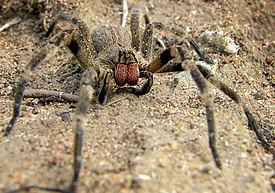
Phoneutria nigriventer |
| Scientific classification |
|---|
| No rank : | Bilateral symmetrical |
| Infrastructure : | Araneomorphic Spiders |
|
| International scientific name |
|---|
Phoneutria Perty , 1833 |
| Type view |
|---|
Phoneutria fera Perty, 1833 |
| Kinds |
|---|
- Phoneutria bahiensis Simó & Brescovit, 2001
- Phoneutria boliviensis ( FO Pickard-Cambridge , 1897)
- Phoneutria eickstedtae Martins & Bertani, 2007
- Phoneutria fera Perty, 1833
- Phoneutria keyserlingi (FO Pickard-Cambridge, 1897)
- Phoneutria nigriventer ( Keyserling , 1891)
- Phoneutria pertyi (FO Pickard-Cambridge, 1897)
- Phoneutria reidyi (FO Pickard-Cambridge, 1897)
|
|
Their natural range covers the tropical part of South and Central America [3] .
As of the beginning of 2012, this genus contains eight species. The last, eighth type of Phoneutria bahiensis was identified in 2001 [4] :
- Phoneutria bahiensis Simó & Brescovit, 2001 - rainforest of the Atlantic coast of Brazil.
- Phoneutria boliviensis (FO Pickard-Cambridge, 1897) - Central, South America.
- Phoneutria eickstedtae Martins & Bertani, 2007 - Brazil
- Phoneutria fera Perty, 1833 - Ecuador, Peru, Brazil, Suriname, Guyana.
- Phoneutria keyserlingi (FO Pickard-Cambridge, 1897) - tropical forest of the Atlantic coast of Brazil.
- Phoneutria nigriventer ( Keyserling , 1891) - Brazil, northern Argentina, induced in Uruguay.
- Phoneutria pertyi (FO Pickard-Cambridge, 1897) - tropical forest of the Atlantic coast of Brazil.
- Phoneutria reidyi (FO Pickard-Cambridge, 1897) - Venezuela, Peru, Brazil, Guyana.
Spider venom of this genus contains a powerful neurotoxin known as PhTx3 . This neurotoxin is potentially of therapeutic value, but in a toxic concentration it causes loss of muscle control, followed by respiratory arrest, which leads to paralysis and eventually suffocation. A bite of moderate pain, poison causes instant infection of the lymphatic system, getting into the circulatory system in 85% of cases leads to heart failure. Patients feel severe rigor mortis, in men, sometimes poisoning causes priapism . There is an effective antidote to Phoneutria poison, and therefore, the recorded number of deaths due to bites from these spiders is small [2] .
The amount of poison lethal for a 20-gram mouse is 6 μg intravenously and 134 μg subcutaneously (compared to 110 μg and 200 μg in the southern black widow ( Latrodectus mactans )).
