Warty honeyfish , or scaly honeyfish [1] ( lat. Xanthomyza phrygia ) - an endangered species of birds from the family of honeyfish . They live in Australia . Genetically close to serous honey pumps .
| Warty honey sucker |
 |
| Scientific classification |
|---|
| No rank : | Bilateral symmetrical |
| Gender: | Warty honey suckers |
|
| International scientific name |
|---|
Xanthomyza phrygia ( Shaw , 1794 ) |
| Security status |
|---|
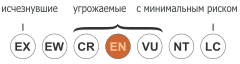
Endangered speciesIUCN 3.1 Endangered : 22704415 |
|
Content
Warty honey suckers were widespread in eastern Australia. Currently, the populations of these birds are scattered, large colonies are found in Northeast Victoria and the central coast of New South Wales .
- Length 20-24 cm, wingspan 30 cm.
- The weight of males is 41–45.5 g; females are 33–45 g.
- The head, neck, upper chest and beak are black, and the lower back and chest are pale lemon in color with a black wavy pattern. Feathers are brown, with bright yellow edges around the eyes with a dark pink or cream shade. In the chicks, the plumage is paler.
- Males are larger and darker than females
- Warty honey suckers feed on nectar , small insects and spiders .
- Life expectancy is about 10 years.
- Individuals reach puberty after 1 year of life. The female makes a nest from the bark of eucalyptus , as well as from grass or small twigs, and lays 2-3 cream-colored eggs. Chicks hatch after 14 days. Both parents feed the chicks, periodically (about 20 times per hour) leaving the nest in search of food. Two weeks after the birth of the chicks, parents usually leave their offspring.
Due to deforestation (the habitat of these birds), the development of agriculture and urbanization of the eastern part of Australia, the species became threatened with extinction. Currently live only approx. 1,500 individuals, and their number is constantly decreasing. The species is listed in the Red Book of Australia in 1999 and in the Red Book of Queensland in 1992.
- BirdLife International (2004). Xanthomyza phrygia. 2006. IUCN Red List of Threatened Species. IUCN 2006. www.iucnredlist.org. Retrieved on 11 May 2006. Database entry includes justification for why this species is endangered
- ↑ Boehme R. L. , Flint V. E. The Bilingual Dictionary of Animal Names. Birds. Latin, Russian, English, German, French / Ed. ed. Acad. V. E. Sokolova . - M .: Rus. lang., "RUSSO", 1994. - S. 392. - 2030 copies. - ISBN 5-200-00643-0 .