This article includes a description of the term “total energy.”
The Hamiltonian function , or Hamiltonian, is a function depending on generalized coordinates , momenta, and possibly time , describing the dynamics of a mechanical system in the Hamiltonian formulation of classical mechanics .

or
-
- Where - a complete set of generalized pulses describing this system ( - the number of degrees of freedom),
- - A complete set of generalized coordinates.
- Where - a complete set of generalized pulses describing this system ( - the number of degrees of freedom),




In quantum mechanics and quantum field theory, the Hamiltonian, or the Hamilton operator , which determines the time evolution of the system, corresponds to the Hamiltonian function in classical physics and is its generalization, quite straightforward in principle, but in some cases not entirely trivial (in principle, the quantum Hamiltonian can be obtained substitution of quantum operators of coordinates and momenta into the Hamilton function, however, due to the fact that such operators do not always commute, it may not be immediately obvious that the correct variant is chosen and arising from this).
In the formalism of the Feynman integral over trajectories in quantum mechanics and quantum field theory , just the classical Hamiltonian function is used.
Hamilton's function - participates in the Hamiltonian form of the principle of least (stationary) action , the canonical Hamilton equations (one of the possible forms of the equation of motion in classical mechanics) and the Hamilton – Jacobi equation , being the basis of the Hamiltonian formulation of mechanics .
For conservative systems , the Hamilton function is the total energy (expressed as a function of coordinates and momenta), that is, in the classical sense, the sum of the kinetic and potential energies of the system.
The Hamilton function is related to the Lagrangian through the Legendre transform as follows:
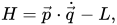
Where - the generalized momentum of the particle, and - its generalized speed.


Physical sense
The Hamilton function is essentially a local dispersion law expressing the quantum frequency (frequency of oscillation of the wave function) through the wave vector for each point spaces [1] :
So, in the classical approximation (at high frequencies and the modulus of the wave vector and a relatively slow dependence on ) this law quite obviously describes the motion of a wave packet in terms of Hamilton’s canonical equations , some of which interpreted as a group velocity formula derived from the dispersion law, while others It is quite natural - as a change, in particular a rotation, of the wave vector during the propagation of a wave in an inhomogeneous medium of a certain type.
Notes
- ↑ Since energy and momentum are frequency and wave vector, differing from them only by a universal constant factor, which can be chosen as a unit in a suitable system of units.
Literature
- Landau L. D., Lifshits E. M. Mechanics, Volume 1. (Edited by L. P. Pitaevsky). 4th ed. — 2007.— 224 p., 2,000 copies, ISBN 978-5-9221-0819-5