Torre del Greco ( Italian: Torre del Greco , Neap. Torre d''o Grieco, Torre 'o Grieco ) is a city in Italy , located in the Campania region of the province of Naples .
| City | |
| Torre del greco | |
|---|---|
| Torre del greco | |
| A country |  Italy Italy |
| Provinces | Naples |
| Chapter | Gennaro malinconico |
| History and Geography | |
| Square | 30 km² |
| Center height | |
| Timezone | UTC + 1 , in summer UTC + 2 |
| Population | |
| Population | 88 894 people ( 2007 ) |
| Density | 2963 people / km² |
| Digital identifiers | |
| Telephone code | (+39) 081 |
| Postcode | 80059, 80040 |
| Car code | |
| ISTAT Code | 063084 |
| comune.torredelgreco.na.it (ital.) | |

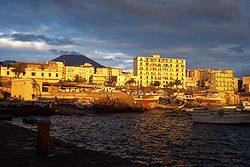
The patron saint of the city is St. Januarius .
Content
Geographical position
The city lies between the volcano Vesuvius and the Gulf of Naples .
Neighboring communes: Boskotrekase , Ercolano , Torre Annunziata , Trekase .
History
During the Roman Empire, in the Torre del Greco, presumably a suburb of ancient Herculaneum , the villas of the Roman patricians were located. In 79, the eruption of the volcano Vesuvius destroyed this village.
About 700 years on the site of Torro del Greco there was a village of Turris- Octava ( Latin Turris Octava, Turris de Octava ).
In 880, the territory of the city was inhabited by Saracens . The name Torre del Greco was first mentioned in 1015 . According to legend, it was given to the city either in honor of a hermit who lived in a tower, or in honor of a special wine brought from Greece.
Torre del Greco was part of the possessions of the Kingdom of Naples until King Alphonse V of Aragon transferred it to the Caraf family.
In 1631, Torre del Greco was again destroyed by the eruption of Vesuvius.
In 1699, the inhabitants of the city bought it for 106,000 ducats from their landlord Marquis of Monfort, and since then the city has flourished, developing as a seaside trading and fishing port. At the same time, a tradition arose to make jewelry from coral.
In 1794, the historic center of Torre del Greco was buried under a 10-meter layer of lava.
During the French rule of King Murat, Torre del Greco, with its 18,000 inhabitants, was the third largest city in the Kingdom of Naples after Naples and Foggia .
Starting from the XVI century, wealthy families and the nobility of Italy began to build their summer residences here. The most remarkable of them is the Palazzo Materazzo, which served as a dance school in the 70s of the 20th century . After the earthquake of 1980, she was captured by the poor, homeless.
In the late 19th and early 20th centuries, the city was a popular summer resort for wealthy Italians. In those years, Torre del Greco was famous for its cafes and restaurants, especially the Grand Café Palumbo in the Art Nouveau style . Among the famous Italians who spent their summers here every year was the comedian Toto . The city owed its popularity to beautiful beaches, picturesque farms, vineyards and proximity to Mount Vesuvius. From here the route began for tourists climbing the mountain, and later a funicular was built, delivering people from the city to the crater of the volcano.
During the Second World War , a German ammunition depot was located in the city, as a result of which he repeatedly bombed himself.
After the Second World War, tourism quickly fell into disrepair, with the advent of a large number of cars, the funicular ceased to be used, and therefore the main reason for visiting the city fell away. In addition, urbanization and population growth have destroyed the charm of this place, and tourist flows have moved to Sorrento and the Amalfi coast. Now a little reminds of the time of its former prosperity.
The main branch of the city’s economy remains the production of products and ornaments from mother of pearl and coral , in particular cameos . About 1,000 people are employed in this industry; corals are mainly sourced from Asia.
Demographics
Population dynamics:
Twin Cities
- Montesarcio , Italy
Attractions
- The ruins of Roman buildings, including the so-called Villa Sora ( 1st century ), are probably the property of the Flavian dynasty .
- Zoccolanti Monastery with 28 frescoes describing the life of St. Francis of Assisi .
- Church of the Holy Cross, whose baroque bell tower burned down in lava flows in 1794 .
- Church of St. Michael, built in the 17th century .
- Villa delle Ginestre, where the poet Giacomo Laopardi stayed .
- Coral Museum.
Famous Countrymen
- Albanese, Francesco (1912-2005) - Italian tenor
- Accardo, Salvatore (1941) - Italian violinist, conductor
- Zingarelli, Nicolo Antonio (1752-1837) - composer
- Honorato, Antonio (1964) - composer and guitarist
Links
- torredelgreco.na.it/ Official site of Torre del Greco (inaccessible link) (Italian)
- World Earth. Eruption of Vesuvius (inaccessible link) (Russian)