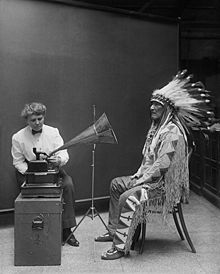

Bureau of American Ethnology The Bureau of American Ethnology was established by law in the United States Congress in 1879 with the goal of transferring archives, records and materials relating to the American Indian population from the United States Department of the Interior to the Smithsonian Institution . However, from the very beginning, the founder and director of the bureau, John Wesley Powell ( en: John Wesley Powell ), promoted the broader mission of the bureau: "organize anthropological research in America." Under the leadership of Powell, the Bureau began not only to conduct large-scale ethnographic and archaeological research, but also to organize exhibitions and collect anthropological samples for the National Museum of the United States. In addition, the Bureau has become the official repository of documents relating to Indians collected by geological expeditions. The bureau has a large library, archive, and a collection of photographs (including such as Edward Curtis ).
In 1965, the bureau merged with the Smithsonian Institution's Department of Anthropology to form the Smithsonian Office of Anthropology as part of the US National Museum (now the National Museum of Natural History (Washington) ). In 1968, the archives of the Office were reorganized into the National Anthropological Archives.
The Bureau was staffed by many prominent archaeologists and anthropologists in the United States, including Frank Cushing , Jesse Walter Fewkes , Alice Cunningham Fletcher , John Peabody Harrington , William Stertevant , and his grants were received by Franz Boas , Francis Densmore, Garrick Mollery, Washington Matthews , Cyrus Thomas and T. Waterman.
One of the merits of the Bureau is the proof that the builders of numerous mounds in the United States were precisely Indians, and not any other peoples (Vikings, peoples from the Book of Mormon, etc., as many believed in the mid-19th century). The voluminous work on the review of mounds, which was published by Cyrus Thomas in 1894, put the final point in the dispute.
Literature
- Fagan, Brian M. Ancient North America . Thames & Hudson. New York 2005
- Judd, Neil Merton. The Bureau of American Ethnology; a partial history . Norman: University of Oklahoma Press, 1967.
- Thomas, Cyrus. Report on the mound explorations of the Bureau of Ethnology. pp. 3-730. Twelfth annual report of the Bureau of Ethnology to the Secretary of the Smithsonian Institution, 1890-91, by JW Powell, Director. XLVIII + 742 pp., 42 pls., 344 figs. 1894.
Links
- List of Publications of the Bureau of American Ethnology
- National Anthropological Archives, Smithsonian Institution
- Digitized copies of the BAE Annual Reports at Gallica
- Bureau of American Ethnology, Bulletin 161: Seminole Music , Frances Densmore
- Register to the Papers of the Bureau of American Ethnology (link unavailable from 03/14/2014 [1965 days] - history , copy ) , National Anthropological Archives, Smithsonian Institution