The battle of Miriokefal , also the battle of Miriokefalon , Greek. Μάχη του Μυριοκέφαλου ; tour. Miryokefalon Muharebesi, Düzbel Savaşı [1] ) - the battle between the Byzantine Empire and the Seljuks of the Koni Sultanate , who captured Asia Minor after the victory at Manzikert . The battle took place on September 17, 1176 in the region of Phrygia . At the battle of Miriokefal , the Seljuk Turks organized an ambush in one of the mountain gorges near the Miriokefalon fortress under the leadership of the Koni ( Roman ) Sultan Kylych-Arslan II and completely defeated the army of the Byzantine Emperor Manuel I Komnin . This defeat nullified the acquisition of Byzantium in a successful attack against the Turks defeated at the Battle of Philomelion (present Akshehir ) in 1117 .
| The Battle of Miriokefal | |||
|---|---|---|---|
| Main Conflict: Byzantine-Seljuk Wars | |||
 | |||
| date | September 17, 1176 | ||
| A place | Miriokefalon, near Lake Beysehir | ||
| Total | The complete victory of the Seljuks | ||
| Opponents | |||
| |||
| Commanders | |||
| |||
| Forces of the parties | |||
| |||
| Losses | |||
| |||


Content
The course of the battle and the number of parties
The Byzantine army was estimated at 25,000 soldiers (although medieval sources have estimates from 40 to 200,000).
The Byzantine army included allied detachments of Hungarians (from a relative and ally of Emperor Bela III , King of Hungary), detachments of mercenaries from Western Europe, the Balkans and the Black Sea region, and small military contingents of the Principality of Antioch [2] .
The number of Seljuks is estimated very differently. Their number ranges from 10 to 40 thousand soldiers, including a significant number of light infantry (in the sources of that era - from 100 thousand to 400 thousand).
The fact of numerical superiority of the enemy forced the Seljuk Turk Sultan to resort to an ambush. In addition, a large part of the Byzantine army was a servant of siege weapons and a convoy; their presence was due to the strategic plan of the campaign - the capture of the cities of the Turks, instead of battles with them [2] .
The Byzantine avant-garde was the first to meet the troops of the Sultan Kylich-Arslan , but passed through the pass with almost no loss (according to other sources, the Byzantines did not know about the presence of the Turks before the attack). Behind the vanguard, the main forces entered the gorge. By the time two Byzantine units left the gorge, the rear ones slowed down and broke the line.
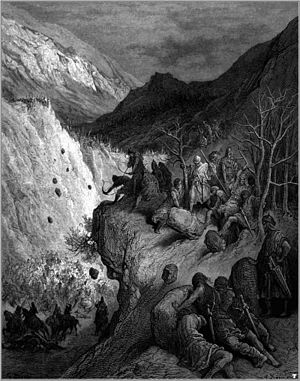
The Turks launched an attack, firing from bows and dropping stones down on the Byzantine troops. The main blow fell on the right wing. The troops were gathered from different nationalities, as a result of a panic.
After the defeat of the division, the Turks concentrated their attack on the train; soon the siege guns along with the wagons created congestion in the narrow places of the gorge. Panic swept the entire army of Christians. The left wing division was also attacked and suffered significant losses. One of its leaders, John Kantakuzin, was killed in battle, as was Baldwin of Antioch [2] . To top it all off, some Seljuk units left the valleys and hit the rear of the Byzantines. The panic reached a terrible level, the whole mass of the Byzantines rushed forward in disorder, to where the emperor was and where the advanced divisions had camped.
Suddenly, a dust storm began, visibility worsened, and the battle almost ended, but the general flight of the Byzantines continued. In the end, Manuel Komnin was able to restore discipline and organize his forces in defensive formations outside the gorge.
The Byzantines spent the night reflecting further attacks by the Seljuks. Emperor Manuel was considering leaving the troops, but because of criticism he decided to stay. The next day, the Byzantine camp was surrounded by Turks, but Kılıç-Arslan limited himself to a shootout. The emperor ordered a counterattack and, as a result, the Byzantine army was able to retreat in an organized manner [2] .
Battle Results
The Byzantines, left without means of attack on Iconium , were not able to continue the campaign. In addition, the sultan sent an ambassador to the emperor. At his suggestion, the Byzantine army could retreat unhindered during the destruction of the border fortresses of Dorile and Saber [2] . The Byzantines did not fulfill this promise, which led to new conflicts. The battle of Hielion , however, ended with the victory of the Byzantine army in 1177 .
Despite the fact that most of the army and the emperor himself was able to avoid death, the defeat at Miriocefalon undermined the position of the Byzantine Empire in Asia Minor, and indirectly in the Balkans and throughout the eastern Mediterranean .
After the defeat of the Byzantines, the influx of nomadic Turks into Asia Minor increased even more. Indigenous people: ( Greeks , Hellenized Slavs , Armenians and Kurds ) were subjected to increasingly Turkization and Islamization.
Despite some short-term revival of Greek statehood in the western part of Asia Minor under the Nicene Empire in 1204-1261 and its preservation in a truncated form until 1461 (the Trebizond Empire ), the decline of the Greek language and the Orthodox religion began on the peninsula.
Notes
- ↑ Muharrem Kesik, "At Üstünde Selçuklular", Timaş Yayınları , İstanbul, 2011 s. 105-107, 126, 148, 159, 247
- ↑ 1 2 3 4 5 N. Choniat. The story begins with the reign of John Comnenus . - Volume 1, Book 6
Literature
- Nikita Chonyat , A story beginning with the reign of John Comnenus . [1] .