The Abkhaz Catholicosate is a church-canonical and administrative-territorial structure on the territory of Abkhazia , established by the Antiochian Patriarchate in the VIII century on the basis of the Abazgian diocese of the Patriarchate of Constantinople that already existed from the beginning of the 4th century . The Catholicosate was de facto an autocephalous church .
| Abkhaz Catholicosate | |
|---|---|
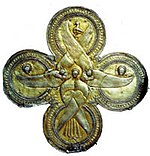 | |
| General information | |
| Founders | Patriarch of Antioch Theophylact Catholicos-Archbishop John |
| Mother church | Antioch Patriarchate |
| Autocephaly | first half of the eighth century |
| Guide | |
| Centre | Pitsunda , Abkhazia |
| Primate Residence | Pitsunda |
| Worship | |
| The calendar | Julian |
The Abkhaz Orthodox Church declared itself the successor of the Abkhaz Catholicosate, however, to date, it has not been recognized by other local Orthodox churches.
History
The tendency towards the sovereignty of Abazgiya from Byzantium that emerged in the first half of the 8th century, which led to the formation of the Abkhazian kingdom , prompted a desire to formalize independence also in church terms. In the middle of the VIII century, the authorities of Abkhazia sent a large church delegation to Antioch with the aim of bringing their Abkhaz Catholicos to Abkhazia. At the Council of Antioch, led by Patriarch Theophylact , it was decided to ordain a bishop and elevate one of them, named John, to the rank of Catholicos , and put the bishop as the other. Catholicos John and his successors were to “remember the patriarch of Antioch during the service”, that is, the independence granted to the Abkhaz Church in the first half of the 8th century consisted in the right to elect and ordain Catholics as a council of local bishops. Upon his return to Abkhazia, Catholicos John, the city of Pitsunda, was chosen as the place of his episcopal chair.
This period is characterized by the widespread spread of Christianity in Abkhazia.
The merger of the Abkhaz and Kartli kingdoms was completed in the 12th century under David IV the Builder , when the Tbilisi Emirate was finally liquidated and the state capital was transferred from Kutaisi to Tbilisi . At the same time, church unification took place: the Catholicos of Mtskheta extended his spiritual authority to all of Georgia, including the Abkhaz Church, as a result of which he received the title of Catholicos-Patriarch of all Georgia . But in the middle of the XIII century, as a result of the conquest of Georgia by the Mongols, the united Georgian state split into two - the eastern one headed by King David Ulu and the western one with King David V Narin , which also led to church division. In 1290, the Abkhaz Catholicosate was first mentioned in a letter from King David VI.
In 1390, Catholicos Arsenius was elevated to the Pitsunda throne. Catholicos Arseniy was a native of Western Georgia and ended up on the throne of the Abkhaz Catholics thanks to the military campaign of the Mingrelian ruler Vamekh Dadiani to Djigetia (Adygea) and Abkhazia in 1390 .
In the second half of the 16th century , the chair of the Abkhaz Catholicos moved from Pitsunda to the Gelati Monastery in Western Georgia. Since that time, the Catholics began to be called the “Catholicos of Abkhazia and Imereti”, from the 17th century “Imereti and Abkhazian”.
The last Abkhaz Catholicos Maxim II, from the princely family of Abashidze , was forced to reside in Russia due to political disagreements with the Imereti king David . King David, on the contrary, thought about the political independence of his state, using the support of Turkey. On the way to Palestine, Catholicos Maxim II died in Kiev-Pechersk Lavra in 1795 . With the death of this Catholicos, the Abkhaz Catholicosate ceased to exist. Locum Tenens of the Department of Abkhaz Catholicos: Metropolitan Dosifey (Tsereteli) and Metropolitan Euthymius (Shervashidze) , were removed from Imereti in 1819 .
Notes
Links
- A brief outline of the history of the Abkhaz Orthodox Church
- Protocol of the meeting of the diocesan meeting of the Sukhum-Abkhaz diocese of September 15, 2009
- “Abkhazian (West Georgian) Catholicosate” // Orthodox Encyclopedia, Volume 1, Moscow, 2000, 67-72: