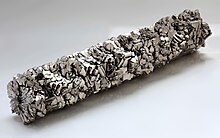
The iodide method is a method for producing metals of high purity. Designed in 1925 by Anton van Arkel and Jan de Boer .
The method is based on the ability of metals to form volatile compounds with iodine , decomposing which, it is possible to obtain a material free of impurities ( titanium , zirconium , hafnium ).
Content
- 1 History
- 2 Description
- 3 Application
- 4 Gallery
- 5 See also
History
Description
Raw metal with the addition of a certain amount of iodine is placed in a sealed chamber. The area of the chamber where this mixture is located is heated to a temperature of 400 - 600 ° C (depending on the metal being cleaned), at this temperature a metal iodide is formed, which at this temperature is in a gaseous state . Then the metal iodide vapor enters the chamber zone heated to the decomposition temperature of the iodide (1300 - 1700 ° C). In it, iodide decomposes with the release of pure metal on the walls of the chamber. The iodine remaining after decomposition falls back into the low temperature zone, interacts with a new portion of the metal, and the cycle repeats until there are impurities in the low temperature zone that do not interact with iodine.
The high temperature necessary for the decomposition of iodide can be created by passing an electric current through a wire fixed in the chamber. In this case, the metal is not deposited on the walls of the vessel, but on the wire, forming a kind of crystalline "ingot".
Application
Gallery
Titanium
Zirconium
Hafnium
Vanadium
See also
- Pyrometallurgy