Ulrika Eleonora ( Swede. Ulrika Eleonora ; January 23, 1688 - November 24, 1741 ) - Queen of Sweden , who ruled from 1718-1720. Daughter of Charles XI and Ulrika Eleanor of Denmark , younger sister of Charles XII .
| Ulrike Eleanor | |||||||
|---|---|---|---|---|---|---|---|
| Ulrika eleonora | |||||||
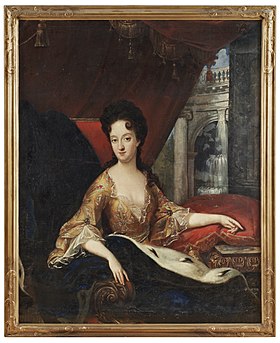 Portrait of Queen Ulrike Eleanor. Artist David von Kraft | |||||||
| |||||||
| Coronation | March 17, 1719 | ||||||
| Predecessor | Karl XII | ||||||
| Successor | Fredrick I | ||||||
| |||||||
| Birth | Royal Palace in Stockholm , Sweden | ||||||
| Death | Stockholm , Sweden | ||||||
| Burial place | Riddarhholm Church , Stockholm | ||||||
| Kind | Palatinate-Zweibrucken | ||||||
| Father | Karl XI Swedish | ||||||
| Mother | Ulrika Eleanor of Denmark [1] | ||||||
| Spouse | Fredrik of Hesse-Kassel | ||||||
| Children | not | ||||||
| Religion | |||||||

Content
Biography
Ulrika Eleanor was born on January 23, 1688 in the Stockholm castle. As a child, Ulrike Eleanor received much less attention than her older sister Gedwig Sofia .
In 1714, the engagement of Ulrika Eleanor with Friedrich of Hesse-Kassel took place , and a year later, on March 24, 1715, their wedding. By this time, the princess, by virtue of circumstances, had become the person whose opinion had to be reckoned with. Charles XII was then in Turkey , and after the death in 1708, Gedwig Sofia Ulrike Eleanor remained the only representative of the Swedish royal family, except for her father's mother Gedwig Eleanor Holstein-Gottorp .
In late 1712 - early 1713, the king intended to make Ulrike Eleanor the temporary regent of the state, but this plan was not implemented. Nevertheless, the royal council, trying to get her support, convinced the princess to attend her meetings. At the very first meeting with her presence, held on November 2, 1713, a decision was made to convene the Riksdag .
Some members of the Riksdag called for the appointment of the princess as regent of the state, but Arvid Horn and the Royal Council opposed this, fearing that a change in government would only increase the number of difficulties. Subsequently, the Princess, with the approval of Charles XII, signed all documents emanating from the council, with the exception of those that were presented personally to the king.
When Ulrika Eleanor in December 1718 found out about the death of her brother, she showed complete composure and forced her to turn to herself as a queen. The council did not oppose this. Soon, she ordered the arrest of Georg Heinrich Goertz’s supporters and canceled the orders issued from his pen. During the convocation of the Riksdag on December 15, 1718, she announced her desire to abolish autocratic power and return the state to the old form of government.
The highest military leadership of Sweden advocated the non-recognition of inheritance law, the abolition of absolutism and the election of Ulrika Eleanor as Queen. Similar views prevailed among the members of the Riksdag. Ulrika Eleanor tried in vain to find support in the royal council and was forced to declare that neither she nor anyone else (here meant her nephew Duke Karl Friedrich Holstein-Gottorp , son of Gedwig Sofia ) was not entitled to the Swedish throne.
After the princess refused the inheritance rights to the throne, she was proclaimed queen on January 23, 1719, with the reservation that she would subsequently sign the form of government that the estates intended to draw up. On February 19, she put her signature on the form of government, which gave most of the power to the Riksdag. On March 17, 1719, a coronation took place in Uppsala .
The new queen failed to cope with the difficult situation in which her kingdom found herself. Her influence fell due to disagreements that arose with President of the Office A. Gorn. She did not have a relationship with his successors Sparre and Krunelm.
Ulrika Eleanor, upon entering the throne, wanted to share it with her husband, however, because of the stubborn resistance of the nobility, she was forced to abandon her intention. The autocracy of the queen, the inability to adapt to the new constitution, as well as the strong influence exerted on her by her husband, gradually led government officials to think about changing the monarch .
Friedrich of Hesse, the Queen’s husband, also worked actively in this direction, drawing closer to A. Gorn, who was elected Lantmarshal on the Riksdag in 1720. When Ulrika Eleanor, still hoping for a joint rule, filed a petition to the estates about this, her proposal this time was met with disapproval. In a new message dated February 29, 1720, she abdicated the throne in favor of her husband, with the proviso that in the event of his death she would again accept the crown. On March 24, 1720, Frederick of Hesse-Kasselsky was proclaimed king of Sweden under the name of Frederick I.
Although Ulrika Eleanor until the last moment was interested in public affairs, after 1720 she was suspended from participating in them, indulging in reading and charity. However, during the trip abroad of Fredrick I in 1731 and his illness in 1738, she took control of herself and at the same time showed all her best qualities.
Ulrika Eleanor died on November 24, 1741 in Stockholm , leaving no descendants.
Notes
- ↑ Forsten G.V. Ulric-Eleanor the Younger // Brockhaus and Efron Encyclopedic Dictionary : in 86 volumes (82 volumes and 4 additional). - SPb. , 1890-1907.
- ↑ 1 2 Encyclopædia Britannica
- ↑ 1 2 FemBio
Literature
- Ulrika Eleanor // Uzi - Fidel. - M .: Soviet Encyclopedia, 1956. - S. 196. - ( Great Soviet Encyclopedia : [in 51 vols.] / Ch. Ed. B. A. Vvedensky ; 1949-1958, vol. 44).
- Nordisk familjebok. - B. 30. - Stockholm, 1920.