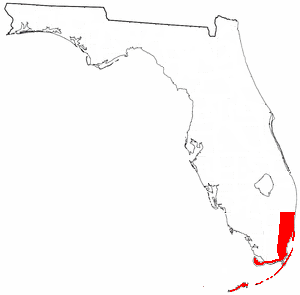
Tequesta , a Tequesta , is an extinct Native American tribe that lived on the Atlantic coast in the south of modern Florida by the time the first Europeans arrived. Their territory covered modern Broward and Miami Dade counties, and also included the Keys archipelago. In the 16th century, tekesta founded a settlement on Cape Sable, the extreme tip of the Florida Peninsula. Their main settlement, also called Tekesta, was apparently located at the mouth of the Miami River, on the coast of Biscayne Bay. Tekesta lived mainly by picking fruits, mushrooms and roots, fishing and hunting.
After European colonization, the number of tekesta rapidly declining as a result of wars, diseases, the conversion of many Indians to slavery and forced relocations. By the beginning of the 19th century, the tribe had only a few members and soon afterwards disappeared.
Content
Origin
Archaeological sites of the Glades culture that existed on the territory of the Texest tribe's habitat testify to the continuous development of an indigenous ceramic tradition dating back to about 500 AD. e. and before contact with Europeans. [one]
The test also includes the Miami Circle , an archaeological site in Miami [2] .
Language
The tongue of the test, apparently, was closely related to the language of the Calus tribe in the southwest of the Florida coast, as well as the Mayaim , who lived near Lake Okeechobee in the central part of the Florida Peninsula. From the languages of these tribes survived no more than a dozen words. [3]
Notes
- ↑ Florida Office of Cultural and Historical Programs. P. 89
- ↑ The Miami Circle - Office of Cultural, Historical and Information Programs - Consulté le 27 mai 2007
- ↑ Austin
Literature
- Austin, Daniel W. (1997). "The Glades Indians and the Plants they Used. Ethnobotany of an Extinct Culture. ” The Palmetto , 17 (2): 7 −11. [1] - accessed December 4, 2005
- Brickell Point - Home of the Miami Circle (State of Florida site) - accessed December 4, 2005
- Bullen, Adelaide K. (1965). "Florida Indians of Past and Present." In Ruby L. Carson & Charlton Tebeau (Eds.), Florida from Indian trail to space age: a history (Vol. I, pp. 317-350). Southern Publishing Company.
- Escalente Fontaneda, Hernando de. (1944). Memoir of do. d'Escalente Fontaneda respecting Florida . Smith, B. (Trans.); True, DO (Ed.). Miami: University of Miami & Historical Association of Southern Florida.
- Goddard, Ives. (2005). The indigenous languages of the Southeast. Anthropological Linguistics , 47 (1), 1-60.
- Hann, John H. (1991). Missions to the Calusa . Gainesville: University of Florida Press.
- Hann, John H. (2003). Indians of Central and South Florida: 1513-1763. University Press of Florida. ISBN 0-8130-2645-8
- State of Florida Office of Cultural and Historical Programs. "Chapter 12. South and Southeast Florida: The Everglades Region, 2500 BP-Contact." Historic Contexts . Version of 9-27-93. Downloaded from [2] on March 27, 2006
- Sturtevant, William C. (1978). "The Last of the South Florida Aborigines." In Jeral Milanich & Samuel Proctor (Eds.). Tacachale: Essays on the Indians of Florida and Southeastern Georgia during the Historic Period . Gainesville, Florida : The University Presses of Florida. ISBN 0-8130-0535-3
- Tebeau, Charlton W. (1968). Man in the Everglades (pp. 37-45). Coral Gables, Florida : University of Miami Press. Library of Congress Catalog Card Number: 68-17768
- The Tequesta of Biscayne Bay - accessed December 4, 2005
- Wenhold, Lucy L. (Ed., Trans.). (1936). A 17th century letter of Gabriel Diaz Vara Calderón, Bishop of Cuba, describing the Indians and Indian missions of Florida . Smithsonian miscellaneous collections 95 (16). Washington, DC: Smithsonian Institution.