English oak , or summer oak , or ordinary oak , or English oak ( lat. Quércus róbur ) - a typical species of the genus Oak ( Quercus ) of the Beech family ( Fagaceae ); large tree , reaching a height of 30-40 m, forming broad-leaved forests ( oak forests ) in the south of the forest and in the forest-steppe zones .
| English oak | |||||||||||||||||||||||
|---|---|---|---|---|---|---|---|---|---|---|---|---|---|---|---|---|---|---|---|---|---|---|---|
 General view of an adult tree Belgium | |||||||||||||||||||||||
| Scientific classification | |||||||||||||||||||||||
| |||||||||||||||||||||||
| International scientific name | |||||||||||||||||||||||
Quercus robur L. , 1753 | |||||||||||||||||||||||
| Synonyms | |||||||||||||||||||||||
| |||||||||||||||||||||||
| Area | |||||||||||||||||||||||
| |||||||||||||||||||||||
| Security status | |||||||||||||||||||||||

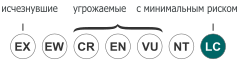
The species is listed in the Red Book of the International Union for the Conservation of Nature and has the status of “ Under Least Threat ” (LC) in it.
Content
- 1 Name
- 2 Botanical Description
- 3 Botanical taxonomy: subspecies
- 4 Distribution
- 4.1 Famous trees
- 5 Pests and diseases
- 5.1 Pathogenic mushrooms
- 5.2 Pathogenic bacteria
- 6 Chemical composition
- 7 Economic value and application
- 7.1 In medicine
- 7.2 In green building and decorative gardening
- 7.2.1 Garden forms and cultivars
- 8 Collection, processing and storage
- 9 Harvesting seed
- 10 See also
- 11 Notes
- 12 Literature
- 13 Links
Title
Species epithet "petiolate" this species received for the long stalks that distinguish it from other species.
Botanical Description
A large, usually heavily branched tree with a huge crown and a powerful trunk. It reaches a height of 20-40 m. It can live up to 2000 years, but usually lives 300-400 years. Height growth stops at the age of 100-200 years; an increase in thickness, although insignificant, lasts a lifetime [2] . Probably the oldest representative should be considered Stelmuzhsky oak with a trunk circumference of 13 m in Lithuania . His age, according to various estimates, is from 700 to 2000 years.
The root system consists of a very long rod root; from six to eight years, lateral roots begin to develop, which also go deep into the ground.
The crown is thick, tent-like or wide-pyramidal, asymmetrical, sprawling, with strong branches and a thick trunk (up to 3 m [3] in diameter). In young trees, the trunk is irregular, articulated, with age it becomes straight and cylindrical. In closed stands, crowns are smaller and trunks are more slender (up to 1 m in diameter [3] ).
The bark is dark gray, blackish, thick. Young oak trees have gray, smooth bark. In the 20-30th year, more or less deep cracks form on the crust. In trees that have grown freely, the bark is up to 10 cm thick.
Young shoots are fluffy, brown or reddish-gray, shiny, with brown spots and slightly oblong lentils.
The kidneys are blunt-pentahedral, 5 mm long and 4 mm wide, lateral buds slightly smaller and spaced; flakes numerous, five-row, rounded, brown, glabrous, and only ciliate on the edge. All kidneys are usually ovoid, almost spherical, light brown, rounded or bluntly pointed at the apex, leaf scar with 7-15 traces. The apical kidneys are surrounded, for the most part, by several lateral ones.
From top to bottom: crown shape, male inflorescences, fruits |
The arrangement of leaves is alternate, on top of branches in the form of bunches. Leaves are oblong, oblong-obovate, downward narrowed or heart-shaped, often with ears, obtuse or notched at the apex, pinnate lobed, large (40-150 mm long, 25-70 mm wide), with four to seven lobes, firm, almost leathery, dark green above, shiny, yellowish or green below, with much more prominent lighter veins, bare on both sides, with short petioles up to 10 mm long, always falling in winter. The blades are dull, rounded, the cutouts between them are shallow.
From top to bottom: leaf buds, autumn foliage |
Dioecious flowers . Flowering begins in trees aged 40 to 60 years, along with the blooming of leaves - usually in May. Monoecious plant . Stamen flowers are collected in long hanging earrings 20-30 mm long, with ten or more flowers, two or three together or singly on the tops of last year's shoots or at the bottom of young shoots. Each flower sits remotely from another, therefore, a flower stalk is clearly visible between them, has a five- or seven-parted, fringed, membranous, green perianth along the edges, as well as five to six or more (up to 12 [3] ) stamens with short threads and large yellow anthers . Female flowers are usually located on young shoots higher than male ones, collected in small two or three together on a separate reddish stalk, have a six-parted, reddish perianth along the edges, surrounded by hairy green, reddish scales at the top, representing the future plus. The ovary is three-lobed, red, the stigma is threadlike, slightly protruding outward. Ovaries in the ovary are formed only after pollination, including three, with two testicles in each. Only one acorn usually develops from each ovary. Acorns hang in pairs, less often - one at a time — five on a stalk up to 80 mm long.
Flower Formulas : ; [4] .
Fruit - a nut ( acorn ) naked, brownish-brown (1.5–3.5 cm long and 1.2–2 cm in diameter [3] ), on a long (3–8 cm) peduncle. The acorn is placed in a saucer, or a cup-shaped bowl - a plushka (0.5-1 cm long). The fruits ripen in September - October.
Two forms of common oak are known - early and late. In the early ("summer oak") leaves bloom in April - May and fall in the winter, and in the late ("winter oak") they bloom two to four weeks later. At the same time as the leaves bloom, the oak blooms. Pollinated by the wind. Leaves fall later than many other trees in late September - October. On young winter oak plants, the leaves turn brown in autumn, but sometimes remain on the tree for the whole winter [3] .
Acorns have good germination, spread by birds, mainly jays . Up to eight to ten years old, seedlings grow slowly, later the average growth in height is 30–35 cm per year, and at times - 1–1.5 m per year. In the middle of summer, secondary ("Ivanov") shoots start to grow. Height growth continues to 120-200 years. Renewal is also provided by stalk. Most modern oak forests are of overgrown origin. Oak early develops a powerful root system, which allows it to use a large amount of soil and withstand the windfall. Single standing trees begin to bear fruit from 40-60 years old, in closed stands even later [3] .
- Genome
The number of chromosomes is 2n = 24. The genome consists of approximately 1.5 billion base pairs and contains approximately 50 thousand genes . In 2012, a project was launched in France to fully decrypt the genome of oak oak; in 2015, the decoding of the genome was completed [5] [6] . There are also forms with the genome 2n = 22 and 2n = 36 [7] .
Botanical taxonomy: subspecies
- Quercus robur subsp. brutia ( Ten. ) O.Schwarz
- Quercus robur subsp. imeretina ( Steven ex Woronow ) Menitsky
- Quercus robur L. subsp. robur
Distribution
Widely distributed in Western Europe and the European part of Russia , found in northern Africa and western Asia . The northern border of the range passes through southern Finland and the north of the Leningrad region , while on the western coast of Norway , due to the influence of the Gulf Stream , it reaches the 65th parallel . As you move east, the border of the range shifts sharply to the south, and in Siberia is currently not found in natural conditions. The eastern limits of the range of oak oak are the watershed of the Volga and Ural rivers ( General Syrt Upland), as well as the valleys of the Yuryuzani and Sylva rivers [8] . It is widely used in forest protection afforestation [3] .
Introduced in northeast North America .
Common oak is one of the main forest-forming species of deciduous forests in Europe, as well as communities of the European forest-steppe ; grows next to hornbeam , ash , linden , maple , elm , beech , birch , spruce , fir , pine and some other trees. In the middle forest zone does not form large tracts.
In the taiga zone it grows along river valleys, to the south on watersheds in mixed forests with spruce; in the zone of deciduous forests and forest-steppe forms oak forests or oak forests with an admixture of linden, maple, elm; in the steppe zone - along ravines, gullies, in floodplains. A rather heat-loving breed, therefore it does not go far north and high into the mountains. Suffers from late spring frosts, does not tolerate shading from above, but lateral shading stimulates the growth of undergrowth. Demanding on soil fertility, the best stands are on powerful gray forest loamy soils and degraded chernozems . The wood stock in them is 250–600 m³ / ha [3] .
English oak - the official flower emblem of the Swedish province of Blekinge [9] .
Famous Trees
The life span of the oak oak is 400-500 years, but trees are known that are up to 1000 and even 1500 years old. According to life expectancy, oak is one of the first places in the plant world [3] .
Among the oaks there are many famous trees. The most famous: Kaiser Oak , Zaporozhye Oak , Tsar-Oak , Stelmuzhsky Oak , Oak "Athlete of Tauris" , Oak Chapel , Oak Tamme-Lauri , Oak Mayor ( Sherwood Forest ). The age of such trees is several centuries - for example, the Grunwald oak [10] , growing in the city of Ladushkin in the Kaliningrad region, lives more than 800 years, and the Granite oak - the sights of Bulgaria - for more than 1700 years.
Pests and Diseases
Pathogenic Mushrooms
On the oak oak parasitic parasitic fungus Taphrina caerulescens , causing spotting and death of the leaves. This fungus is also found on other species of oak [11] .
In the southeast of the range and in the forest belts of the Volgograd region, from the end of the 20th century, mass drying of adult trees was noted due to the defeat of another ascomycete - Ophiostoma roboris Georg. et Teod. . It can also be affected by powdery mildew of oak , autumn honey agaric and sulfur-yellow tinder .
Pathogenic bacteria
On the territory of Eastern Europe , the following major bacterial diseases were noted in the oak oak:
- Bacterial dropsy. In this disease, the bark and wood quickly (within 1-2 seasons) “get wet” and die, the leaves become covered with brown spots of irregular shape and do not fall for a long time in winter. Abundant brown mucus is released from heavily affected trunks. The causative agent is Erwinia multivora .
- Transverse cancer. On young branches, elliptical growths form, which increase over time and often cover a branch or trunk around a circle. Infected trees do not die, but trunks and branches break off at the sites of destruction. The causative agent is not exactly identified, most often found Pseudomonas quercina [12] .
Chemical Composition
The bark contains 10-20% of the tannins of the pyrogallic group, gallic and ellagic acids , quercetin ; sugar , fats are also present. Acorns contain up to 40% starch , 5-8% tannins, protein substances, sugars, fatty oil - up to 5%. Quercetin and quercetrin , as well as pentosans, were found in the leaves. The content of tannins in wood is 4–6% [3] .
Economic Significance and Application
English oak - woody, medicinal, phytoncidic , food, melliferous, dyeing, fodder, ornamental and phytomeliorative plant.
From top to bottom: wood - longitudinal and transverse cuts; bonsai |
Bark and oak wood are a source for one of the best tanning agents . For the tanning industry, oak bark at the age of 15-20 years is considered the best. Since its bark is a beautiful tanning agent, it is used directly as a tanning material, and tannic extracts are made from wood. In practice, the bulk of tannins is obtained from waste from the woodworking industry, which usually amount to at least 20% [3] . With a large mass, oak wood is one of the main sources for the production of tannins. First-class tannin extracts obtained from oak are the basis of modern tannery production [3] .
Oak wood has a beautiful color and texture. It is dense, strong, resilient, well preserved in air, in the ground and under water, moderately cracking and warping, easily pricked, resistant to decay and domestic fungus.
Strong and durable oak wood has long been used in shipbuilding, furniture industry, in the construction of mine ("mine rack") and hydraulic structures (bridges, mills), residential buildings, for the production of parquet, sleepers, doors, frames, for the manufacture of rims, runners, plywood and planed veneer, turning and carved products, details of horse-drawn carts: drawbars, shafts, stains, wheels. Oak wood does not have a particular smell; barrels for cognac are made from it, wine (the tannins contained in oak wood give the drink a peculiar taste and aroma), beer , alcohol , vinegar , oil [3] .
Oak wood is also used to make coffins . The custom to bury the dead in wooden tombs, borrowed by Christianity from the beliefs of Slavic and other Indo-European tribes, was spread by him throughout almost all of Northern Europe (both Eastern and Western). It was established that in these territories the burial of the dead in decks, log houses or coffins made of various types of wood, including oak, was typical at one time. In this regard, oak wood is already acquiring a ritual character in some way (hence the comic expression “give oak”, in the sense of “die”, “die”). Echoes of these traditions have come down to our days in the usual painting of pine (or from other cheap coniferous species) coffins “under the oak” [13] .
“ Bog oak ” is especially appreciated in furniture production. Under the influence of iron salts contained in water, oak wood darkens and hardens.
Non-woody oak wood goes for firewood, provides excellent fuel with high calorific value [3] .
Common Oak - spring pollen. Bees collect a lot of highly nutritious pollen on it, in some years they collect nectar from female flowers. But on the oak, dew and pad often appear. In places where oak occupies large arrays, bees collect a lot of honey dew and paddy, from which they produce honeydew honey unsuitable for winter eating. In order to avoid mass death of bees during wintering, such honey is pumped out.
Oak brooms in a Russian bath are valued on a par with birch.
Oak leaves contain the quercetin pigment , which, depending on the concentration, dyes wool and felted products in yellow, green, greenish yellow, brown and black. From the bark receive a light-resistant durable colorant for carpets and tapestries [3] .
Oak acorns are a highly nutritious feed of domestic pigs , however, cases of poisoning by acorns (especially green) of other domestic animals are known. The most sensitive to poisoning cows (especially dairy) and horses , the less sensitive sheep . Single oak trees bear fruit annually; in the plantations, abundant fruiting is repeated after 4-8 years, and less often in the north of the range than in the south. Individual trees give up to 40-100 kg of acorns. The yield of acorns in the oak forest is 700-2000 kg / ha [3] .
Acorns containing up to 40% starch , crushed into flour, were added to bread in hungry years; bitter taste due to the large amount of tannin limits their food use [3] [14] .
Acorns serve as food for many wild animals, including commercial ones; they are also used for fattening domestic pigs [3] . Cattle are often grazed in oak plantings, which causes great damage to the normal growth and development of young plants.
In the old days, ink was prepared from painful growths on oak leaves caused by gall midges - "ink nuts".
Galls on the plants of the oak oak caused by nut growers (from left to right): Andricus kollari , Andricus fecundator , Andricus grossulariae , Andricus lignicola | ||||||||||
In medicine
As medicinal raw materials use oak bark ( lat. Cortex Quercus ). Raw materials are harvested from young shoots during the sap flow from April to June. They dry it by spreading it in a thin layer in well-ventilated rooms, as well as in the sun [15] .
The bark has astringent, anti-inflammatory, antiseptic and hemostatic properties. A decoction of the cortex is used to rinse the mouth and throat with gingivitis , stomatitis , tonsillitis , halitosis and inflammation of the mucous membrane of the pharynx and larynx, in the form of baths, rinses and compresses are used to treat burns, frostbite, ulcers and other skin diseases, for foot baths when sweating legs, for washing bleeding hemorrhoidal nodes , drink with diarrhea, dysentery , poisoning with alkaloids and salts of heavy metals , gastrointestinal bleeding, heavy menstruation [3] .
Fresh chopped leaves are applied to ulcers and wounds for their healing.
Dried oak seeds, crushed into powder, are used for diseases of the bladder , for diarrhea.
A coffee substitute is made from acorns, which is not only nutritious, but also a therapeutic agent for gastrointestinal diseases , rickets , anemia and scrofula in children. It is also useful for nervous patients with excessive menstrual bleeding.
In veterinary medicine, oak bark is widely used as a remedy for indigestion.
In green building and ornamental gardening
Ordinary oak is used in green building as an ornamental and phytoncide plant when creating suburban groves, alleys, curtains, single stands in parks and forest parks. Such decorative forms of common oak are known: with a pyramidal crown and a shape in which foliage falls 15-20 days later than in ordinary.
Ordinary oak is recommended as the main species in forest reclamation plantations, in forest shelter belts, in erosion plantations along gullies and ravines, on washed away soils. It can be planted along irrigation canals, since its root system does not drain the walls of the canals and does not destroy their cover.
Garden forms and cultivars
From left to right: 'Filicifolia', 'Concordia', 'Fastigiata' | ||||||||||
Collection, processing and storage
The bark of common oak for medical purposes is harvested mainly during sap flow (April - May), removing it from young branches and thin trunks (up to 10 cm in diameter) in cutting areas or thinning . To remove the bark, annular incisions are made every 30 cm, which are connected by longitudinal cuts, after which the bark is easily removed. Dry under a canopy with good ventilation. The yield of dry raw materials is 40-50%. Dry bark is packed in bales weighing 100 kg. Store in a dry, well-ventilated area. Shelf life is five years.
The fruits of oak (acorns) are harvested in autumn under the trees after falling. They are dried in the attics under an iron roof or under awnings with good ventilation, spreading in one layer on paper or fabric and periodically mixing. Dried in ovens, ovens or dryers. Acorns are cleared of leathery fertility and seed peel. The raw material consists of individual cotyledons. It is packed in 60 kg bags. Store in a dry, well-ventilated area. Shelf life is not set.
The raw materials for obtaining tannic extracts from oak tree are hemp, roots, as well as waste from logging and woodworking industry in the form of logs in the bark or without bark. For tanning skins, oak bark is harvested from young trees (up to 20 years of age). On older trees, a crust forms, which is completely unsuitable and even harmful when used for tanning. You can harvest bark at any time of the year, but it is better during the period of sap flow (April - May) during the main felling and thinning . The bark removed from trunks and branches is dried under a canopy with good ventilation. The relative humidity of dry bark should not exceed 16%.
Seed Harvesting
Ripening and harvesting time is September - October [16] . The maximum storage time (without special equipment) is 1 year. The optimal conditions for storing acorns until spring are 0 degrees Celsius in a ventilated room or by digging in the snow. [17]
See also
- SPNA “ Oak grove in the vicinity of the village of Shemakha ” [18] .
- Pushkin Oak
Notes
- ↑ For the conventionality of specifying the class of dicotyledons as a superior taxon for the plant group described in this article, see the APG Systems section of the Dicotyledonous article .
- ↑ Neystadt M.I. Allowance for high school. - M .: GUPI MP RSFSR, 1954. - S. 169—171. - 495 p.
- ↑ 1 2 3 4 5 6 7 8 9 10 11 12 13 14 15 16 17 18 19 Gubanov I.A. et al. Wild useful plants of the USSR / ed. ed. T.A. Rabotnov . - M .: Thought , 1976. - S. 95–97. - 360 p. - ( Reference guides to the geographer and traveler ).
- ↑ Serbin A.G. et al. Medical botany. Textbook for university students. - Kharkov: Publishing House of the NFaU: Golden Pages, 2003. - S. 134. - 364 p. - ISBN 966-615-125-1 .
- ↑ French scientists deciphered the oak genome for the first time in world practice // TASS , May 15, 2015.
- ↑ Le genome du chêne séquencé // INRA, 10.5.2015 (fr.)
- ↑ English oak (summer, ordinary) - Quercus robur
- ↑ Semerikov L.F. Population structure of woody plants using oak species as an example in the European part of the USSR and the Caucasus / Res. ed. S. A. Mamaev. - M .: Nauka, 1986 .-- S. 48 .-- 140 s.
- ↑ Svenska landskapsblommor : [ arch. 09/29/2017 ]: [ Swede. ] . - Naturhistoriska riksmuseet , 1996 .-- 22 oktober. - Date of appeal: 04.04.2018.
- ↑ ITAR-TASS .
- ↑ Karatygin I.V. Orders Tafrin, Protomycium, Exobazidium, Microstromacy. - SPb. : “Science”, 2002. - P. 40. - (Key to mushrooms in Russia). - ISBN 5-02-026184-X .
- ↑ Gvozdyak R.I., Yakovleva L.M. Bacterial diseases of forest tree species / Resp. ed. Bilay V.I .; Institute of Microbiology and Virology. D. K. Zabolotnogo Academy of Sciences of the Ukrainian SSR. - Kiev: Naukova Dumka, 1979. - S. 28-36. - 244 p. - 850 copies.
- ↑ Yatsenko-Khmelevsky A.A., Kobak K.I. Anatomical structure of wood of the main forest-forming species of the USSR / Leningrad. forestry technician. Acad. them. S. M. Kirov. - L: RIO LTA, 1978. - S. 26-27. - 64 p. - 1000 copies.
- ↑ The Oxford Companion to Food / Alan Davidson, Tom Jaine. - Oxford University Press , 2014 .-- S. 197—198. - ISBN 978-0-19-104072-6 .
- ↑ Blinova K.F. et al. Botanical-Pharmacognostic Dictionary: Ref. allowance / Under (inaccessible link) ed. K.F. Blinova, G.P. Yakovleva. - M .: Higher. school, 1990. - S. 186. - ISBN 5-06-000085-0 .
- ↑ According to EOL. See Body Card.
- ↑ Zakharov V.P., Grigoriev A.Yu. How to plant your oak grove . MESP (2002).
- ↑ Oak grove in the vicinity of the village of Shemakha , Site of the information and analytical system “Specially Protected Natural Territories of Russia”.
Literature
- Altimyshev A. Medicinal wealth of Kyrgyzstan (natural origin). - Frunze: Kyrgyzstan, 1976. - S. 105-106. - 352 p.
- Gubanov I.A. et al. 436. Quercus robur L. - English oak // Illustrated identifier of plants in Central Russia. In 3 t . - M .: T-in scientific. ed. KMK, Institute of Technology. ISS., 2003. - T. 2. Angiosperms (dicotyledonous: dicotyledonous). - S. 34. - ISBN 9-87317-128-9 .
- Koturanov D. L. Experience and prospects for the artificial restoration of oak forests in central Russia . Abstract. diss. ... cand. agricultural farm. sciences. M., 2005.
- Neishtadt M. I. The determinant of plants of the middle band of the European part of the USSR. Allowance for high school. - M .: GUPI MP RSFSR, 1954. - S. 169—171. - 495 p.
- Ovsyannikov G.F. Hardwood. A manual for students and forest professionals. - Vladivostok: OGIZ - Dalkray, 1931. - P. 83. - 376 p.
- Sokolov S. Ya. Genus 6. Quercus - Oak L. // Trees and shrubs of the USSR. Wild, cultivated and promising for introduction. / Ed. volumes S. Ya. Sokolov . - M. - L .: Publishing House of the Academy of Sciences of the USSR , 1951. - T. II. Angiosperms. - S. 468-474. - 612 p. - 2500 copies.
- Chemarina O. V. Study of the structure of the populations of oak in Tula settlements in connection with its selection. Abstract. diss. ... cand. agricultural farm. sciences. - M .: MLTI, 1977 .-- 28 p.
- Shirnin V.K. Selection for wood quality: On the example of pedunculate oak and other species in the Central Black Sea Region . Diss. ... doctor farm. sciences. - Voronezh, 1999 .-- 302 p.
- Єlіn Yu. Ya., Zerova M. Ya., Lushpa V.I., Shabarova S.I. Dari lisiv. - K .: Harvest, 1979 (Ukrainian)
Links
- Oak // Great Soviet Encyclopedia : [in 30 vol.] / Ch. ed. A.M. Prokhorov . - 3rd ed. - M .: Soviet Encyclopedia, 1969-1978. (Retrieved December 7, 2009)
- Siberia will give oak: Altai foresters put up valuable breed in growth
- Oaks from Bialowieza Forest (biggest oak cluster with the monumental sizes in Europe )
- A 400-year-old oak tree in Veliky Novgorod received a “security certificate” / ITAR-TASS (November 13, 2013).