Marbury [1] [2] v. Madison [k 1] ( English Marbury v. Madison ) - a judicial precedent that extended the competence of the US Supreme Court to judicial review ( English judicial review ) of decisions of other branches of government. In a decision in this case, the court for the first time in US history recognized parliamentary law as inconsistent with the Constitution, thus creating a precedent for future such decisions. The consequence of this decision was the implementation in practice of the principle of checks and balances between the three branches of government, within the framework of which the Supreme Court could examine the legislative acts of Congress with a view to compliance with the Constitution and even repeal these laws if they contradicted the main law. With this decision began the establishment of judicial control in the United States [3] [4] .
| Marbury vs. Madison | |
|---|---|
 US Supreme Court US Supreme Court | |
| The debate took place on February 11, 1803 Closed February 24, 1803 | |
| Full title | William Marbury v. James Madison, Secretary of State of the United States |
| A source | 5 US 137 ( more ) 1 Cranch 137; 2 L. Ed. 60; 1803 US LEXIS 352 |
| Decision | |
| Section 13 of the Law on the Judiciary of 1789 does not comply with the constitution, as it is aimed at expanding the jurisdiction of the Supreme Court beyond the limits allowed by the Constitution. Congress does not have the power to enact laws that are contrary to the constitution, and federal courts have the power to decide whether the law is consistent with the constitution. | |
| Opinions | |
Circumstances
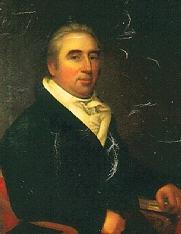

The case began with the appeal of William Marbury, appointed by President John Adams to the Justice of the District of Columbia Justice , to the Supreme Court with a request to oblige Secretary of State James Madison to issue a patent (a document confirming the appointment of a judge to the post). According to Marbury, the state authorities delayed the issuance of the patent, which prevented him from exercising his powers. The court, chaired by John Marshall, refused the request, citing the fact that the provision of the Judiciary Act of 1789 , which served as the basis for his statement, was contrary to the Constitution, and thus the Supreme Court was not authorized consider this case [1] [5] [6] [7] .
Historical background
This case was clearly political in nature, as Presidential elections were won in the fall of 1800 by Republican Democrat Thomas Jefferson , and previous President John Adams belonged to his opponents, the federalists, and did not delegate his authority until the inauguration of Jefferson in March 1801. This period of time was used by him to strengthen the influence of the federalists in the judiciary thanks to the adoption of the Law on the Judicial System of 1801, according to which the powers of the District Court of the District of Columbia were excluded from the US Supreme Court, forming new judicial districts, and the President was granted the right to appoint world judges [1] .
The “ Judiciary Act of 1801 ” ( English Judiciary Act of 1801 ) introduced the following amendments to the previously existing “ Judicial Act of 1789 ” ( English Judiciary Act of 1789 ):
- Increased by ten the number of judicial districts
- Increased the number of appeal districts from 3 to 6
- Increased the number of judges in courts of appeal
- Gave the President the right to appoint federal judges and justices of the peace
- Reduced the number of judges of the Supreme Court from 6 to 5.
On March 3, the day before the end of his presidency, Adams appointed 42 federal judges from among the federalists to the courts created by the 1801 court law and the new Chief Justice, who was appointed by J. Marshall [1] . Among the judges he appointed was William Marbury , a wealthy landowner from Maryland . A convinced federalist, Marbury actively participated in the political life of his native state and was a supporter of Adams [8] [9] . Marybury was appointed to the District Court of the District of Columbia for five years. [10] The jurisdiction of the world court included the consideration of civil disputes, the subject of which did not exceed $ 20 in value.
On March 4, the appointments were approved by the Senate en masse. For final approval in the position of judges, patents had to be issued, the obligation to file and distribute patents was vested in John Marshall, despite the fact that by this time he had been appointed Supreme Judge [1] [11] [9] .
Marshall sent all but four patents to the end of President Adams' term [1] [9] . He had no doubt that the remaining patents would be issued by his successor and made a mistake [12] . Shortly after taking the oath, President Jefferson instructed Levy Lincoln (according to other Secretary of State J. Madison [1] ), the interim Secretary of State, to retain the remaining patents. Jefferson believed that they did not have legal force [13] due to apparent political bias [1] .
The new Republican Democratic Congress passed a new law on the court, repealing the changes introduced by the law on the court of 1801 ( English Judiciary Act of 1801 ). In addition, he left only one session of the Supreme Court instead of two, canceled the hearings scheduled for June 1801 in order to delay the consideration of the constitutionality of the new law [14] [15] .
One of the four judges whose patents were not filed and filed properly was William Merbury, who appealed to the US Supreme Court to issue an order obliging him to be granted a patent for the position of justice of the peace, substantiating his claims with the provisions of Section 13 of the Judicature Act 1789 of the year. John Marshall found himself in a delicate situation: in the case of satisfying the requirements, his personal and political partiality was clearly visible, since it was he who granted the patents,; on the other hand, a court decision refusing to satisfy the requirements would be vulnerable to the law. John Marshall found a way out that he found a contradiction of the provisions of the Law on the Judiciary to the norms of sections 2 and 3 of the US Constitution, which did not provide for his consideration of cases as a court of first instance on the requirements filed by Marbury, thus refusing to satisfy the requirements [1] [ 9] .
Excerpts from Applied Laws
In all cases concerning ambassadors, other official representatives and consuls, as well as in cases in which the state is a party. The Supreme Court has original jurisdiction. In all the other cases mentioned above, the Supreme Court has appeal jurisdiction in matters of both law and fact, with such exceptions and in accordance with the rules established by Congress.
- US Constitution, Article III, Section 2, Clause 2 [16]
The Supreme Court also has jurisdiction over appeals from district and state courts in the cases referred to later in this law and has the power to issue writ of prohibition to district courts ... and court orders to officials ... to any court or public officials who have been appointed by the United States.
- Law on the Judiciary of 1789, Article 13
There are three ways in which a case can be brought before the Supreme Court. Two of them are related to the appellate jurisdiction of the Supreme Court. On a limited range of issues, the Supreme Court is a court of first instance .
Marbury, based on the fact that the Law on the Judiciary of 1789 made the Supreme Court the first instance to satisfy applications for the issuance of orders to an official ( English writ of mandamus ), filed a petition directly to the Supreme Court. To consider the case, the Supreme Court must be the court of first instance. Therefore, before accepting the case for consideration, the court had to resolve several issues:
- Is article III of the Constitution an exceptional list of issues on which the Supreme Court has the right to act as a court of first instance?
- If article III of the Constitution is an exclusive list, but the United States, in spite of this, supplements it, does the relevant Congress law have legal force?
- Who has the right to solve the previous question?
Having answered the last, third, question, the Supreme Court determined the essence and boundaries of judicial supervision [17] .
Solution
On February 24, 1803, the Supreme Court issued a unanimous (4-0) verdict stating that although Marbury has the right to hold the position of judge, the Supreme Court does not have the power to force Secretary of State Madison to confirm his appointment.
The decision was drafted by President John Marshall and addressed three main issues:
- Does Marbury have the legal right to a patent pending?
- Are there legal remedies in the law that Marbury could take?
- Will the issuance of a Marybury court order as a measure of judicial protection be the right measure to protect a violated right? [7] [18]
Marshall immediately answered positively to the first two questions, noting that a refusal to issue a letter of appointment is a violation of Marbury’s legal right: “The United States government is often respected as the rule of law, not people. The right to this high profile will undoubtedly be lost if it turns out that the judicial system does not provide protection against violation of the rights enshrined in law. ”Thus, one of the key principles on which this case is built is that judicial protection should be provided for . The Marshall further describes two key types of executive decisions: political, in which a public servant has the freedom to maneuver, and administrative, when an employee is legally obligated to take certain actions. The Marshall concludes that the issuance of the Marbury letter of appointment is a purely administrative function required by law, and therefore the law provides him with judicial remedies (against failure to perform this function).
In analyzing the second question, Marshall turned to a quote from William Blackstone 's Commentary on the Laws of England, which stated:
it is a general and indisputable rule that, where there is a legal right, there is also a legal remedy for legal action or petition whenever this right is invaded
- [7]
The federal court has the right to consider not only cases in its own jurisdiction, but also in the jurisdiction of lower courts when considering appeals [19] . If the court does not have the authority to consider the claim, it should not make a decision - accordingly, before considering the merits of the case, the federal court should determine the jurisdiction [20] . However, Judge Marshall in this decision did not argue the jurisdiction of the claim and immediately proceeded to consider issues. According to the adopted rule of “circumvention of constitutionality” (if the law allows such an interpretation that does not affect constitutional issues, it is necessary to accept this interpretation), the courts raise constitutional issues only if necessary. In this case, the jurisdiction of the claim was just such a constitutional issue [21] .
When considering the third question, Marshall divided it into two parts - whether the court order would be the right measure to restore the legal right of Marbury, and if so, whether this order should be issued by the Supreme Court. Immediately noting that a court order to an official is, by definition, the right judicial measure to force a public servant of the United States (in this case, the Secretary of State) to perform the actions required of him (in this case, issue an appointment), the Marshall devoted the main part to the second question: whether this order should come from the Supreme Court.
After analyzing the Law on the Judiciary of 1789, Marshall came to the conclusion that he gives the Supreme Court the right to issue orders to officials. He then examined Article III of the US Constitution, which defines the jurisdiction of the Supreme Court as a first instance and appeal court. Marbury argued his claim that the Constitution defines only the main jurisdiction, which Congress has the right to supplement. Marshall did not accept this argument and decided that Congress did not have the power to change the jurisdiction of the Supreme Court as a first instance. Accordingly, Marshall concluded that the Law on the Judiciary of 1789 was in conflict with the Constitution.
Thus, the question arose of what happens when the legislative act of Congress is contrary to the Constitution. Marshall decided that the acts of Congress that were in conflict with the Constitution were not laws, and therefore the courts were obliged to follow the Constitution, thus confirming the principle of judicial supervision of legislative acts. In support of this position, Marshall considered the essence of a written codified Constitution - it would have no meaning if the courts could ignore it. “What is the meaning of the restriction of power, and what is the point of accepting these restrictions in writing, if they could be circumvented at any time by all those whom it was intended to limit?” [22] The very essence of the judiciary requires that these restrictions be considered by the court. In the process of considering cases, the courts must decide which laws are applicable in the given case - therefore, if the laws contradict each other, the court must choose which one to apply [23] . Finally, Marshall took the oath of justice of the judge, which requires them to comply with the Constitution, as well as Article VI, Section 2 of the Constitution (the “Rule of Law Section”), which puts the Constitution in the first place before the laws of the United States.
It is absolutely certain that the competence and duties of the judiciary includes an explanation of what the law is. Those who apply the rules to specific cases must clarify and interpret each rule. If two laws contradict each other, then the courts must decide on the application of each of them.
If the law is contrary to the constitution and the law and the constitution apply in a particular case, the court must decide whether to apply the law while ignoring the constitution or whether the constitution should be applied while ignoring the law. The court must establish which of the conflicting norms should be applied in a particular case. This approach is the main task of the judiciary.
If the courts take into account the constitution, and the constitution is superior to any act of the legislature, then the constitution (and not the ordinary act) should be applied in a case to which both acts are applicable - both the constitution and the ordinary act.
Those who dispute the principle that the constitution should be considered as a supreme law in court should recognize that courts should turn a blind eye to the constitution and see only the law.
Such a doctrine undermines the very foundations of all written constitutions.
- [2]
Based on these arguments, the court denied the lawsuit and court order to the official, since “Section 13 of the Judicial System Act of 1789, passed by Congress in 1789, which gave the Court the power to issue such court orders, is unconstitutional and therefore has no legal force ” [24] .
Comments
- ↑ Sometimes “Marbury v. Madison ”translates as“ Ma Rbury vs. Madison ”, or“ Marbury versus Madison ”( Shavarin, 2010 , p. 206)
Notes
- ↑ 1 2 3 4 5 6 7 8 9 Constitutional control in foreign countries. Textbook / Ans. ed. V.V. Maklakov. - M: Norma, 2007 .-- S. 95-98. - 656 p. - ISBN 978-5-468-00116-5 .
- ↑ 1 2 US Supreme Court: Case of Marybury v. Madison (extract) // Constitutional Control in Foreign Countries. Textbook / Ans. ed. V.V. Maklakov. - M: Norma, 2007. - S. 101-104. - 656 p. - ISBN 978-5-468-00116-5 .
- ↑ Shavarin, 2010 , p. 206.
- ↑ D.K. Yaroslavtseva. The first years of the US Supreme Court // Vyatka Vestnik. - 2015. - No. 6. - S. 120-123. - ISSN 2541-7606 .
- ↑ Federal Judicial History, The Judiciary Act of 1801— Historical Note 2 Stat. 89
- ↑ Judiciary Act of 1801
- ↑ 1 2 3 Nikolaev B.V., Emelin M. Yu. The concept of legal doctrine in the US legal system // News of PSU. V. G. Belinsky. - 2012. - No. 28. - S. 143-146. - ISSN 1999-7116 .
- ↑ Mark Carlton Miller. The View of the Courts from the Hill: Interactions Between Congress and the Federal Judiciary . - University of Virginia Press, 2009 .-- P. 44.
- ↑ 1 2 3 4 S.A. Khaustov. The role of the Supreme Court in the US government // Vestnik MGIMO. — 2010. — № 3. — С. 179-186. — ISSN 2541–9099 .
- ↑ Ch.4, Sec. 4 , Judiciary Act of 1801
- ↑ Smith, Jean Edward. John Marshall: Definer of a Nation. — New York : Henry Holt & Company; New York, 1996. — P. 524. — ISBN 978-0-8050-1389-4 .
- ↑ Sec. 3d, Marbury v. Madison ,AMDOCS: www.vlib.us.
- ↑ Pohlman, HL Constitutional Debate in Action: Governmental Powers. — Lanham : Rowman & Littlefield, 2005. — P. 21. — ISBN 0-7425-3593-2 .
- ↑ Federal Judicial History, The Judiciary Act of 1802— Historical Note 2 Stat. 156
- ↑ The Supreme Court in United States history, Volume 1. By Charles Warren. Little, Brown, 1922. p 222
- ↑ Конституция Соединённых Штатов Америки в переводе О. А. Жидкова, изд. Московского Университета. Электронная библиотека Исторического факультета МГУ им. M.V. Lomonosova
- ↑ David P. Currie. The Constitution in Congress: The Federalist Period 1789–1801 . — University of Chicago Press, 1997. — P. 53.
- ↑ — Lecture: starting at time 16:16, these three questions are described by the teacher almost verbatim to this article, and this school video is in regards to judicial review .
- ↑ Bender v. Williamsport Area Sch. Dist. , 475 US 534, 541 (1986) (quoting Mitchell v. Maurer , 293 US 237, 244 (1934)); accord Steel Co. v. Citizens for a Better Env't , 523 US 83, 94 (1998)
- ↑ See Irving v. United States , 162 °F.3d 154, 160 (1st Cir. 1998) (en banc), admonishing that the federal courts «have an affirmative obligation to examine jurisdictional concerns on their own initiative» even if the parties have neglected them; Berner v. Delahanty , 129 °F.3d 20, 23 (1st Cir. 1997), noting «that a court should first confirm the existence of rudiments such as jurisdiction . . . before tackling the merits of a controverted case»).
- ↑ Supreme Court History: The Court and Democracy, Marbury v. Madison , pbs.org, retrieved 2/12/07
- ↑ 5 US (1 Cranch) at 176.
- ↑ 5 US (1 Cranch) at 177.
- ↑ Marbury v. Madison . In Encyclopædia Britannica.
Literature
- M.S. Shavarin. Constitutional and legal aspect of the separation of powers in the USA // Proceedings of the Institute of State and Law of the Russian Academy of Sciences. - 2010. - No. 6. - ISSN 2073-4522 .