The hypothetical Greek-Armenian language (also known as Helleno-Armenian ) is correlated with the assumption that the Armenian , Greek and, possibly, Phrygian languages had a common ancestor that existed after the disappearance of the Proto-Indo-European language (PIE). This can be compared to a large extent with the Italo-Celtic group . The hypothetical proto-Greek-Armenian stage in the development of both languages dates from the beginning of the 3rd millennium BC. e. , only slightly different from the late PIE or Greco-Aryan.
History of the Armenian language |
|---|
 |
| Pre-written period |
| Armenian hypothesis Greek-Armenian proto-language Greco-Armenian-Aryan hypothesis Proto-Armenian language |
| Writing period |
| Ancient Armenian language (V — XI centuries) Middle Armenian (XI — XVII centuries) New Armenian language (from the 17th century) |
| Armenian writing |
| Armenian alphabet History of the alphabet Daniel letters Armenian punctuation Armenian paleography |
| Heritage |
| Armenian literature Ancient Armenian historiography Ancient Armenian translations |
| Armenian studies |
Content
History
The author of this hypothesis is the Danish linguist Holger Pedersen (1924), who noted that the number of lexical matches between Greek and Armenian is greater than the number of matches between Armenian and other Indo-European languages . Antoine Meye (1925, 1927), having studied morphological and phonological correspondences, suggested that the source languages from which the Greek and Armenian originated were dialects in geographical areas located adjacent to the territory of distribution of their source language. The Meier hypothesis gained fame after the publication of his book ( Meillet. Esquisse , 1936). Solta ( Solta , 1960) does not go that far, theoretically postulating the existence of the Proto-Greek-Armenian period, but concludes that, in the sense of vocabulary and morphology, the Greek language is obviously closer to the other than the Armenian. Hamp ( Hamp , 1976: 91) supports the Greek-Armenian hypothesis and brings closer the time “when we should talk about Hellenic-Greek” (implying the assumption of the Greek-Armenian proto-language). Clackson (1994: 202), on the basis of evidence in favor of the existence of a Greco-Armenian subgroup, tends to include Armenian in the Greco-Aryan family. In the work of Gamkrelidze and Ivanov , several isoglosses are also distinguished, separating Greek and Armenian from Indo-Iranian dialects (distinguished during the collapse of the Greco-Armenian-Aryan community) [1] .
It is indisputable that Armenian is an Indo-European language, but its history is unclear. In any case, the Armenian language has many layers of borrowed words and shows traces of prolonged language contact with Greek and Indo-Iranian languages . Nahlekh, Warnow, Ring and Evans (2005), using various methods of establishing phylogeny , found that five procedures (maximum parsimony, maximum similarity, pairwise union and Gray and Atkinson methods) confirm the existence of the Greco-Armenian subgroup [2] [3] .
The role of the Phrygian language
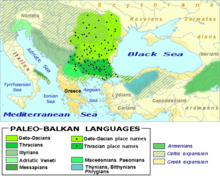
An indirect role in this hypothesis is played by the poorly studied Phrygian language due to the fact that the ancient authors pointed to the kinship of Phrygians and Armenians. If Greek is well studied from an early time, which allows reconstructing the proto-Greek (from the end of the 3rd millennium BC), then the history of the Armenian language is vague. It is strongly associated with Indo-Iranian languages, in particular, it has the phonetic phenomena of the satem group .
So, the Phrygian language is a separate group in the Indo-European language family [4] . Phrygian is closest to the ancient Greek and ancient Macedonian languages. It has more features in common with ancient Greek than with other Indo-European languages, in particular [5] [6] [7] [8] :
- the presence of the suffix -eyo- ;
- participles with the suffix -meno- ;
- the use of augmentation ;
- the ending -as in the nominative case of the nouns declension to -ā- masculine;
- lexical elements, for example, autos “the same”, pant- “all”, kako- “evil, bad”.
Criticism
Some scholars [9] [7] [8] , believe that allegations of the Phrygian proximity to the Thracian and Armenian do not find confirmation in the language material. In addition, the Armenian language differs from the Greek and Phrygian phonetic characteristics. So, Greek and Phrygian belong to the languages of the Kentum branch, and Armenian to the Satem group. New comparative studies show that the Armenian language is most closely related to the Indo-Iranian and Baltic Slavic languages [10] , and the similarities in the development of Armenian with Greek and Phrygian are random and independent from each other [11] .
See also
- Armenian hypothesis
- Proto-Armenian language
Notes
- ↑ Gamkrelidze T.V., Ivanov Vyach. Sun Indo-European language and Indo-Europeans. Tb., 1984. Part 2.P. 899
- ↑ Russell D. Gray and Quentin D. Atkinson, Language-tree divergence times support the Anatolian theory of Indo-European origin, Nature 426 ([[November 27 | November 27]] [[2003]]) 435–439 (inaccessible link) . Date of treatment September 11, 2009. Archived May 20, 2011.
- ↑ Luay Nakhleh, Tandy Warnow, Donald Ringe, Steven N. Evans - 2005 - A Comparison of Phylogenetic Reconstruction Methods on an IE Dataset Archived April 16, 2009 on the Wayback Machine
- ↑ Neroznak V.P. Phrygian language // Linguistic Encyclopedic Dictionary. - 1990 .-- S. 563 .
- ↑ Vavroušek P. Frýžština // Jazyky starého Orientu. - Praha: Univerzita Karlova v Praze, 2010 .-- S. 128-129. - ISBN 978-80-7308-312-0 .
- ↑ Fortson B. Indo-European language and culture. An Introduction. - Padstow: Blackwell Publishing, 2004 .-- P. 403.
- ↑ 1 2 JP Mallory, Douglas Q. Adams. Encyclopedia of Indo-European culture. - London: Fitzroy Dearborn Publishers, 1997 .-- P. 419. - ISBN 9781884964985 .
- ↑ 1 2 Brixhe C. Phrygian // The Ancient Languages of Asia Minor. - New York: Cambridge University Press, 2008 .-- P. 72.
- ↑ Vavroušek P. Frýžština // Jazyky starého Orientu. - Praha: Univerzita Karlova v Praze, 2010 .-- S. 129. - ISBN 978-80-7308-312-0 .
- ↑ Kim Ronald I. Greco-Armenian. The persistence of a myth // Indogermanische Forschungen. - 2018 .-- 123. Band. - S. 247-271.
- ↑ Kim Ronald I. Greco-Armenian. The persistence of a myth // Indogermanische Forschungen. - 2018 .-- 123. Band. - S. 247-271.
Literature
- James Clackson , The Linguistic Relationship between Armenian and Greek , Publications of the Philological Society, 30, Blackwell (1994), ISBN 0-631-19197-6 .
- Eric P. Hamp , in Davis and Meid (eds.) FS Palmer, Innsbruck (1976)
- R. Schmitt, 'Die Erforschung des Klassisch-Armenischen seit Meillet (1936)', Kratylos 17 (1972), 1-78.
- Holst, Jan Henrik, Armenische Studien , Wiesbaden: Harrassowitz (2009).
- A. Meillet in BSL 26 (1925), 1-6
- A. Meillet in BSL 27 (1927), 129-135.
- A. Meillet, Esquisse d'une grammaire comparée de l'arménien classique , Vienna (1936)
- H. Pedersen , sv 'Armenier' in Ebert (ed.), Reallexikon der Vorgeschichte , Berlin (1924).
- GR Solta , Die Stellung des Armenischen im Kreise der Indogermanischen Sprachen , Vienna (1960)