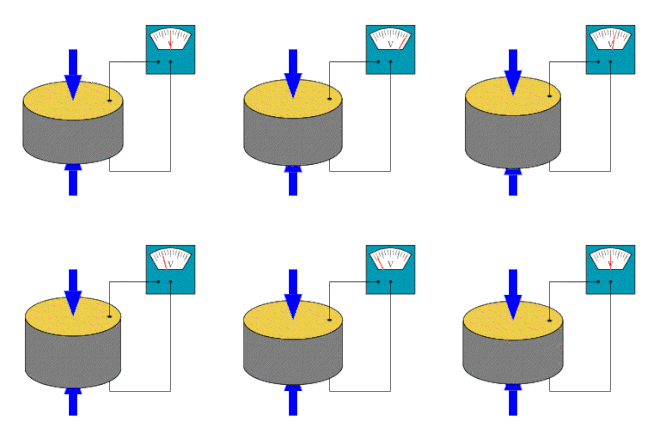
Piezoelectricity is the effect of a substance (crystal) producing an electric force when the shape changes.
Content
Description and properties
Piezoelectrics are crystals (piezocrystals) that have (are endowed) with the property of compressing to produce an electric charge (direct piezoelectric effect ) or the inverse property of changing the shape under the influence of electric voltage: compress / expand, twist, bend (reverse piezoelectric effect).
Piezoelectricity was discovered by the brothers Jacques and Pierre Curie in 1880-1881. [one]
Actuators - convert electrical energy into mechanical energy.
Sensors (sensors, generators), on the contrary, convert mechanical energy into electrical energy.
There are single-layer, two-layer, and multilayer piezocrystals .
Single-layer - under the influence of electricity change in width, length and thickness. If they are stretched or squeezed, they generate electricity.
Double-layer - can be used as single-layer, can bend or lengthen. The “flexors” create the greatest amount of displacement relative to other species, and the “expanders”, being more resilient, develop much greater force with much less displacement.
Multilayer - develop the greatest strength with minimal displacement (change of shape).
History
In the 1950s and 1960s in the USSR, piezoelectricity was studied by the All-Union Scientific Research Institute of Piezoelectric Mineral Raw Materials , which published annual scientific papers.
Literature
- Lemmlein G.G. Guide to the manufacture of piezoelectric crystals. L .: Publishing house of the USSR Academy of Sciences. 1931.55 p.
- Lemmlein G.G., Tsinober L.I. Some features of the morphology of crystals of artificial quartz // Materials on the study of artificial quartz. M .: Gosgeoltekhizdat, 1962.S. 13-30. (Proceedings of the All-Russian Research Institute of Piezooptic Mineral Raw Materials; Issue 6.)
Notes
- ↑ Ioffe AF. Pierre Curie (Russian) // Uspekhi Fizicheskikh Nauk . - Russian Academy of Sciences , 1956. - V. 58 , No. 4 . - S. 572-579 .