In probability theory, two random events are called independent if the occurrence of one of them does not change the probability of the occurrence of the other. Similarly, two random variables are called independent if the known value of one of them does not provide information about the other.
Content
- 1 Independent events
- 2 Independent Sigma Algebras
- 3 Independent random variables
- 3.1 Definitions
- 3.2 Properties of independent random variables
- 3.3 n-ary independence
- 4 See also
Independent Events
We assume that a fixed probability space is given 
Definition 1. Two events 
- Probability of occurrence
does not change the probability of an event
.
Remark 1. In the event that the probability of one event, let’s say 

i.e. conditional probability of an event
Definition 2. Let there be a family (finite or infinite) of random events 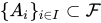


Definition 3. Let there be a family (finite or infinite) of random events 

Remark 2. Joint independence obviously implies pairwise independence. The converse is generally not true.
Example 1. Let three balanced coins be thrown. We define the events as follows:
-
: coins 1 and 2 fell on the same side;
-
: coins 2 and 3 fell on the same side;
-
: coins 1 and 3 fell on the same side;
It is easy to verify that any two events in this set are independent. Yet the three are collectively dependent, for knowing, for example, that events and occurred, we know for sure that also happened. More formally: . On the other hand, .
Independent Sigma Algebras
Definition 4. Let two sigma-algebras on the same probability space. They are called independent if any of their representatives are independent among themselves, that is:
- .
If instead of two there is a whole family (possibly infinite) of sigma-algebras, then pairwise and joint independence is determined for it in an obvious way.
Independent Random Variables
Definitions
Definition 5. Let a family of random variables be given. , so that . Then these random variables are pairwise independent if the sigma-algebras generated by them are pairwise independent . Random variables are independent in the aggregate , if such are the sigma-algebras generated by them.
It should be noted that in practice, if this is not taken out of context, it is considered that independence means independence in the aggregate .
The definition given above is equivalent to any of the following. Two random variables independent if and only if :
- For any :
- For any Borel functions random variables are independent.
- For any limited Borel functions :
Properties of Independent Random Variables
- Let be - distribution of a random vector , - distribution and - distribution . Then independent if and only if
Where denotes the (direct) product of measures .
- Let be - cumulative distribution functions respectively. Then independent if and only if
- Let random variables discrete . Then they are independent if and only if
- Let random variables together are absolutely continuous, i.e. their joint distribution has a density . Then they are independent if and only if
- ,
Where - density of random variables and respectively.
- Let random variables - independent and have the final dispersion . Then they are not correlated .
- Any set of randomly independent random variables is pairwise independent, but not all pairwise independent sets are independent in the aggregate. The latter demonstrates an example with a coin toss , cited by Bernstein S. N.
n-ary independence
Generally for any can talk about -ar independence. The idea is similar: a family of random variables is -ar independent if any subset of its power is independent in aggregate. -ary independence was used in theoretical computer science to prove the theorem on the MAXEkSAT problem.
See also
- Work
- Tonelli-Fubini Theorem
- Borel's Lemma - Cantelli
- The law of zero or Kolmogorov unit
- Copula