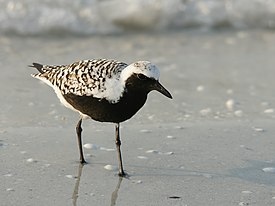
Body length from 26 to 29 cm, weight 170-320 g. Wingspan from 56 to 63 cm. Plumage of an adult male during the mating season: the underside of the body, the sides of the neck, sides of the head and forehead are black, the under tail is white, the back side is black with sharp white transverse streaks. The female is somewhat brownish from the back, and there are white marks on the lower side of her body. In autumn, at the tules, the underside of the body is whitish, and the top is brownish with golden yellow mottles. The short beak and eyes are dark, the legs are gray. There is a back, fourth finger, absent in other plovers.
Behavior
Tules runs fast, making sudden stops and looking around at the same time. He grabs prey, for the most part held openly on the surface of the soil, as well as in grass or moss, then runs on. He catches aquatic animals from the surface of the water, takes from the bottom of shallow tundra lakes, and at wintering he collects marine invertebrates remaining in puddles of water after low tide.
The voice is mournful, but rather melodious: “tuu-li-tuu-li” or “tuirli”. Life expectancy is 18 years.
Tules is a solitary bird and lives mainly in the Arctic tundra of Eurasia from the Kanin Peninsula to Chukotka and in the tundra of North America. It occurs on the coast of Central Europe during migration. Winters in Africa, South Asia, Australia, Central and South America.
Maturity occurs in two years. Thules is a monogam. As a rule, it nests separately and keeps the whole family in the nesting area until the chicks grow up. A nest in an open, dry area in a pit barely lined with pieces of lichens, branches of rosemary and polar willow. There are 4 eggs in the clutch, from slightly pinkish to brownish or olive in color with blackish-brown spots. The male and female incubate the clutch for 23 days, at the end of the incubation period, the female sits mainly on the nest, and the male keeps near the nest on any elevation. After 5-6 weeks, the chicks become independent.
It feeds on worms , crustaceans , gastropods , mollusks , insects and their larvae , sometimes seeds and berries.