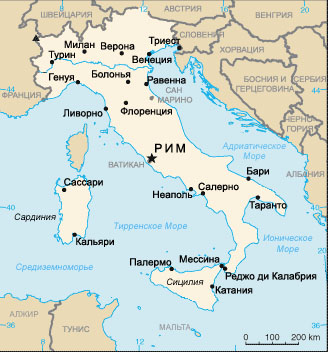
The dominant houses of Italy are the late medieval and Renaissance dynasties that ruled the states, including the city-states that existed on the territory of modern Italy. In some cases, the management system was not monarchical, but oligarchic, therefore noble families that retained power over the state did not have titles and investors .
Most of these families played a large role in the history of Italy, as well as in the history of Italian art, being customers, patrons and collectors of many works of art [1] , court life at their courts gave a powerful impetus to the development of culture [2] .
The list does not include foreign dynasties, with the help of the conquests of the territories that occupied a number of territories - the Habsburgs, the Anjou House, and so on.
Content
- 1 Duchies, counties, etc.
- 1.1 Bologna
- 1.2 Verona
- 1.3 Mantova
- 1.4 Milan
- 1.5 Monferrat
- 1.6 Parma
- 1.7 Rimini and Urbino
- 1.8 Florence and Tuscany
- 1.9 Ferrara and Modena
- 2 Republics, etc.
- 2.1 Venice
- 2.2 Genoa
- 2.3 Rome
- 2.4 Siena
- 3 See also
- 4 notes
- 5 Bibliography
Duchies, counties, etc.
Bologna
| Dynasty | Title | Coat of arms | Has appeared | Faded away | Note |
|---|---|---|---|---|---|
| Bentivoglio | rulers of Bologna | XIV century |
Verona
| Dynasty | Title | Coat of arms | Has appeared | Faded away | Note |
|---|---|---|---|---|---|
| Nogarola | counts | X century | XX century | ||
| Scaligers | podesta | XI century | XIV century |
Mantova
| Dynasty | Title | Coat of arms | Has appeared | Faded away | Note |
|---|---|---|---|---|---|
| Borromeo | |||||
| Gonzaga | C 1433 - Marquises (Margraves), since 1530 - Dukes of Mantua | 13th century | XVIII century |
Milan
| Dynasty | Title | Coat of arms | Has appeared | Faded away | Note |
|---|---|---|---|---|---|
| Visconti | Dukes of Milan | 12th century | XV century | 1 pope | |
| Della torre | 12th century | XIV century | |||
| Sforza | Dukes of Milan | XIV century | XVI century |
Monferrat
| Dynasty | Title | Coat of arms | Has appeared | Faded away | Note |
|---|---|---|---|---|---|
| Paleologists | Marquise of Monferrat | The dynasty of Byzantine origin, which held the city in the XIV-XVI centuries |
Parma
| Dynasty | Title | Coat of arms | Has appeared | Faded away | Note |
|---|---|---|---|---|---|
| Farnese | Dukes of Parma and Piacenza | 13th century | XVIII century | 1 pope |
Rimini and Urbino
| Dynasty | Title | Coat of arms | Has appeared | Faded away | Note |
|---|---|---|---|---|---|
| Della rover | Dukes of Urban | 2 popes | |||
| Malatesta | rulers of Rimini | ||||
| Montefeltro | rulers of Urbino and Rimini |
Florence and Tuscany
| Dynasty | Title | Coat of arms | Has appeared | Faded away | Note |
|---|---|---|---|---|---|
| Albizzi | XIV century | XV century | |||
| Aldobrandini | XV century | 1 pope | |||
| Barberini | XI century | XVIII century | 1 pope | ||
| Malaspina | From 1568 the princes of Massa and Carrara, from 1633 the dukes | XI century | XVIII century | ||
| Medici | Dukes of Florence, Grand Dukes of Tuscany | XIV century | XVIII century | 4 popes [3] . See also: List of rulers of Tuscany | |
| Pazzi | |||||
| Salviati | |||||
| Strozzi |
Ferrara and Modena
| Dynasty | Title | Coat of arms | Has appeared | Faded away | Note |
|---|---|---|---|---|---|
| Este | Margraves, Dukes of Modena and Reggio | X century | XIX century | See Rulers of Ferrara and Modena |
Republic, etc.
Venice
Venice, being a republic, did not have a single ruling dynasty, which retained power for several generations. However, a number of aristocratic families had the strongest influence on state policy; and from among them doges were often chosen.
| Dynasty | Title | Coat of arms | Has appeared | Faded away | Note |
|---|---|---|---|---|---|
| Giustiniani | |||||
| Dolphins | X century | 1 doge | |||
| Dandola | X century | 4 Doge | |||
| Contarini | 8 Doges | ||||
| Cornaro | |||||
| Mocenigo | 8 Doges | ||||
| Morozini | X century | 4 Doge | |||
| Orseolo | 3 Doge | ||||
| Ottoboni | 1 pope |
Genoa
Genoa, being a republic, did not have a single ruling dynasty, which retained power for several generations. However, a number of aristocratic families had the strongest influence on state policy; and from among them doges were often chosen.
| Dynasty | Title | Coat of arms | Has appeared | Faded away | Note |
|---|---|---|---|---|---|
| Adorno | |||||
| Doria | |||||
| Grimaldi | One of the branches still rules Monaco. | ||||
| Spinola | |||||
| Fieski | |||||
| Frigoso |
Rome
Rome was not ruled by a single dynasty, but a number of aristocratic families kept generations under control of its policy, and popes were often chosen from their ranks.
| Dynasty | Title | Coat of arms | Has appeared | Faded away | Note |
|---|---|---|---|---|---|
| Altieri | princes di Oriolo | 12th century | 1 pope | ||
| Borgia | 2 popes | ||||
| Caetani | X century | 2 popes | |||
| Column | XI century | 1 pope | |||
| Crescentia | X century | 12th century | 2 popes | ||
| Odeskalki | 13th century | 1 pope | |||
| Orsini | 12th century | 5 roman popes | |||
| Pumphiles | X century | 1 pope |
Siena
Genoa, being a republic, did not have a single ruling dynasty, which retained power for several generations. However, a number of aristocratic families had the most powerful influence on state policy.
| Dynasty | Title | Coat of arms | Has appeared | Faded away | Note |
|---|---|---|---|---|---|
| Borghese | 13th century | 1 pope , a family in Rome since the 16th century | |||
| Chigi | 1 pope | ||||
| Piccolomini | 2 popes |
See also
- List of Kings of Italy
- Italian city states
- Historic States of Italy
Notes
- ↑ Charles M. Rosenberg. The Court Cities of Northern Italy: Milan, Parma, Piacenza, Mantua, Ferrara, Bologna, Urbino, Pesaro, and Rimini . - Cambridge University Press, 2010-06-21. - 477 p. - ISBN 9780521792486 .
- ↑ Edward Burman. Italian Dynasties: Great Families of Italy from the Renaissance to the Present Day. - 1989.
- ↑ George L. Williams. Papal Genealogy: The Families and Descendants of the Popes . - McFarland, January 1998 .-- 280 p. - ISBN 9780786403158 .
Bibliography
- Sergio Bertelli. The Courts of the Italian Renaissance. 1986
- Edward Burman. Italian Dynasties: Great Families of Italy from the Renaissance to the Present Day. 1989
- Charles M. Rosenberg. The Court Cities of Northern Italy: Milan, Parma, Piacenza, Mantua, Ferrara, Bologna, Urbino, Pesaro, and Rimini. 2010