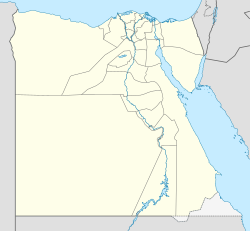
Umm al-Qa'ab ( DMG : Umm el-Qa`āb, Umm el Ga'ab ; Arabic. أم القعاب , etc. Pqr [1] ) - the most ancient royal necropolis in Egypt , located 1.5 km south West of Abydos . In the necropolis, the tombs of pre-dynastic rulers and kings of the first and second dynasties were discovered.
| Umm al-kaab | |
|---|---|
| Arab. أم القعاب | |
 Ceramic-strewn necropolis of Umm al-Qa'b | |
| A country | Egypt |
| Region | Abydos |
| Coordinates | |
| Established | Negad |

The name is literally translated from Arabic as “Mother of the sacrificial vessel” [2] . The name comes from the huge number of fragments of ceramics left from the pilgrims.
The tombs located here belong to the late rulers of the Pre-Dynastic period (c. 3000 - 2700 BC). Along with Filas and Mendes is considered the site of the tomb of Osiris .
Content
- 1 History
- 2 Description
- 3 Important burials
- 3.1 Dynastic tombs
- 3.2 I dynasty
- 3.3 II dynasty
- 4 notes
- 5 Literature
History
A necropolis for high-ranking Egyptians appeared here during the I-II Negadas . During the period of III Negady, the burial of Pharaoh Scorpio I (Uj) took place here [3] . This laid the foundation for the royal burials in the necropolis of Umm al-Qa'ab until the 3rd dynasty .
In the Ancient Kingdom, the necropolis was under the auspices of the Abidian deity Hentiamenti, who lost its importance with the spread of the cult of Osiris during the V dynasty . Subsequent years, Osiris bore the additional name of Hentiamenti. In the Middle Kingdom, events were recorded that, according to the ancient Egyptians, marked the imminent coming of Osiris to the land. Since then, pilgrims have drawn to the necropolis.
In 1885, Emil Amelino discovered the tomb and continued excavations until 1899. In the years 1899-1901, Flinders Petrie worked here; in 1912-1919 - Edouard Naville and Eric Piet , since 1977 - the German Archaeological Institute in Cairo under the leadership of Werner Kaiser .
Description
The necropolis is divided into two parts: a cemetery and a valley adjacent to Shunet al-Zebib (from the Arabic "raisin barn") two kilometers to the north. According to recent excavations, a necropolis existed during the Negad period (c. 3500 - 3000 BC). There are many large and small burials of this period. During the 1st dynasty, the area was reserved for the burial of the pharaohs; in the 2nd dynasty , only two rulers were buried. In each burial, from which only funerary mines were mainly preserved, there is a stele with the name and title of the post.
In the last century, in the tomb of Jer , a granite so-called “Bed of Osiris” was found, which was later dated to the XIII dynasty [4] . Today it is on display in the Egyptian Museum of Cairo . The tomb of Jer was considered the tomb of Osiris ( eg. Mahat ) [5] and influenced the emergence of the cult of Osiris [6] . During the Middle Kingdom, the necropolis was restored, and under the New Kingdom pilgrims flocked here, who brought clay vessels (about 8 million pieces), which gave the name today.
Important graves
Dynastic Tombs
- Uj is an unknown ruler, possibly Scorpio I [3] .
- B1 / B2 - Iri-Khor [7]
- B7 / B8 / B9 - Ka
I Dynasty
Known as “Cemetery B”.
- B17 / B18 - Narmer [8]
- B10 / B15 / B19 - Khor Aha [9]
- O - Jer [10]
- Z - Waji [11]
- Y - Mernate [12]
- T - Den [13]
- X - Ajib [14]
- U - Semerhet [15]
- Q - Kaa [16]
Dynasty II
The last two pharaohs of the dynasty:
- P - Peribsen [17]
The shell found here contains the first known full hieroglyphic inscription.
- V - Hasekhemui [18]
Notes
- ↑ Rainer Hannig. Großes Handwörterbuch Ägyptisch - Deutsch (2800 bis 950 v. Chr.): Hannig-Lexica 1 . - Zabern Philipp von GmbH, 2015-07. - S. 1145. - 1500 s. - ISBN 9783805349352 .
- ↑ Vgl. Michael Müller Umm el-Qaab (German) // Kemet. - Berlin, 2000. - No. 2 . - S. 15–19 .
- ↑ 1 2 Dreyer, Günter. Umm el-Quaab I. Das prädynastische Königsgrab Uj und seine frühen Schriftzeugnisse (German) // Archäologische Veröffentlichungen. - Mainz, 1998. - No. 86 .
- ↑ Anthony Leahy. The Osiris “Bed” Reconsidered // Orientalia. - 1977. - T. 46 , no. 4 . - S. 424-434 . - DOI : 10.2307 / 43074781 .
- ↑ Heinrich Schäfer. 2 // Die Mysterien des Osiris in Abydos unter König Sesostris III. nach dem Denkstein des Oberschatzmeisters I-cher-nofret im Berliner Museum. - Leipzig: Hinrichs, 1904. - T. 4. - S. 28–29.
- ↑ Sir William Matthew Flinders Petrie, Francis Llewellyn Griffith. 1 // The royal tombs of the first dynasty, 1900-1901 . - Sold at the offices of the Egypt exploration fund, 1900. - S. 7. - 212 p.
- ↑ Abydos Tomb of King Iry-Hor . www.ucl.ac.uk. Date of treatment November 24, 2017.
- ↑ Abydos, tomb B 17/18 . www.ucl.ac.uk. Date of treatment November 24, 2017.
- ↑ Welcome . www.ucl.ac.uk (2000-2003). Date of treatment November 24, 2017.
- ↑ Abydos Tomb O (English) . www.ucl.ac.uk (2000-2003). Date of treatment November 24, 2017.
- ↑ Abydos Tomb Z . www.ucl.ac.uk. Date of treatment November 24, 2017.
- ↑ Abydos Tomb Y www.digitalegypt.ucl.ac.uk (2000-2003). Date of treatment November 24, 2017.
- ↑ Abydos Tomb T (English) . www.digitalegypt.ucl.ac.uk (2000-2003). Date of treatment November 24, 2017.
- ↑ Abydos Tomb X . www.ucl.ac.uk. Date of treatment November 24, 2017.
- ↑ Abydos Tomb U (English) . www.digitalegypt.ucl.ac.uk (2000-2003). Date of treatment November 24, 2017.
- ↑ Abydos Tomb Q (English) . www.digitalegypt.ucl.ac.uk (2000-2003). Date of treatment November 24, 2017.
- ↑ Abydos Tomb P . www.digitalegypt.ucl.ac.uk. Date of treatment November 24, 2017.
- ↑ Abydos Tomb V (English) . www.digitalegypt.ucl.ac.uk (2000-2003). Date of treatment November 24, 2017.
Literature
- Émile Amèlineau: Nouvelles Fouilles d'Abydos 1 und 2. 1895-1904.
- AJ Arkell: The Prehistory for the Nile Valley. 1975.
- Günter Dreyer ua: Umm el-Qaab - Nachuntersuchungen im Frühzeitlichen Königsfriedhof 7./8. Vorbericht , in: Mitteilungen des DAI . Kairo 52, Mainz 1996, ISBN 3-8053-1861-8 .
- Günter Dreyer: Umm El-Quaab I-Das prädynastische Königsgrab Uj and seine frühen Schriftzeugnisse. Mainz 1998, ISBN 3-8053-2486-3 .
- Wolfgang Helck, Eberhard Otto: Lexikon der Ägyptologie. 7 Bände. 1975-1992.
- Gabriele Höber-Kamel: Abydos - Religiöses Zentrum der Auferstehung , in: Kemet, Heft 2, Berlin 2000, ISSN 0943-5972 S. 4-9.
- Michael A. Hoffman: Egypt Before the Pharaos. The Prehistoric Foundations of Egypt Civilization. 1979, ISBN 0880294574 .
- Michael Müller: Umm el-Qaab , in: Kemet, Heft 2, Berlin 2000, S. 15-19
- Henri Édouard Naville: The Cementeries of Abydos 1. 1914.
- Flinders Petrie : The Royal Tombs of the First Dynasty. Part I. London 1900.
- Hermann Alexander Schlögl: Das alte Ägypten . Beck, München 2008, ISBN 3-406-48005-5