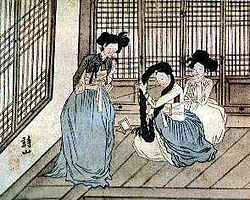


Kisen ( cor. 기생 ? , 妓 生? ), Kino ( cor. 기녀 ? , 妓女? ) Is an entertainer in Korea . The first syllable of the word means “artist, songwriter”, the second - “life”. They were courtesans , trained in music, dancing, singing, poetry, maintaining conversation - all that was necessary for entertaining upper-class men at banquets and parties. They served food and drinks, provided intimate services for money, but were not prostitutes as such.
Having first appeared in the time of Koryo (X-XIV centuries), Kisen were actually state serfs. Professional activity was preceded by serious training.
Kisen played an important role in Korean society. During the wars, they performed not only their direct duties, but also provided medical assistance to the wounded and looked after the sick. Kisen left a noticeable mark in Korean literature, both as heroines of works and as their authors.
History
The official history of Korea hides the facts related to kisen. Mention of them is found occasionally in documents such as " Koryos " or " Joseon Wanjo Sillok ." Kisen are also often the heroes of the " jokes " of late Joseon. Even now, the official history of Korea hardly tells about kisen. For example, Lee Giback's “New History of Korea” does not contain a line about them.
Appearance
It is believed that the kisen culture was introduced to Korea from China. Such women were called iji there .
There are several versions about the time of the appearance of kisen. One theory is that kisen appeared in the state of Silla among wonhwa , the female predecessors of the Hwarans . However, there is little in common between the wonhwa of Silla and the kisen of Joseon. For example, Wonhwa were selected from the aristocracy, while Kisen were lower class women.
Other theories trace kisen traces in early Koryo . At that time, many residents of the former state of Baekje wandered around the country. The first king of Koryo, Tajo , considered these vagabonds dangerous for his government and issued a decree on turning them into state slaves. It is likely that the first kisen were from these former tramps.
Koryo
Despite disputes about the time of origin, the formation of kisen as a class occurred in Koryo , 935–1394 . They were first mentioned at the beginning of the XI century. At that time, they mainly engaged in music, medicine and sewing clothes, and the role that kisen began to play later was played by court entertainers.
Due to the increase in the number of kisen during the reign of King Myeongjon, the state began to maintain accounts (called kijok ) kisen. Around the same time, the government attempted to establish educational institutions for Kisen. These academies, known as , first appeared in documents during their abolition under King Hyunjon in 1010 . However, they were rediscovered during the reign of King Chunnel . The koban taught the music of the tanga and sogak styles .
Girls trained in kebans were intended solely for court entertainment. Their role in the internal affairs of the royal court was exceptionally high. They entertained both the king and dignitaries - these duties remained during the Joseon period. In addition, beginning with the reign of King Mungion , they took part in official state ceremonies.
Joseon
Koryo was the forerunner of the Joseon Dynasty , 1394-1910. At this time, the Kisen Institute reached its peak, despite attempts by the government to abolish it.
The state religion in Joseon was Confucianism , and many Confucian statesmen reacted very negatively to women who had any profession, including kisen, and made repeated attempts to ban them, but without much success. One such proposal was made during the reign of Sejon , but the king preferred to keep kisen as a class.
During the short and brutal reign of Yongsangun , 1494 - 1506 , kisen became the embodiment of the excesses of the royal court. Yongsangun treated girls solely as sources of pleasure. About a thousand girls were brought to the royal palace, many of whom were paid from the state treasury. He was the first to introduce hierarchy among the kisen, dividing them into “heavenly” with whom he slept, and “earthly”, which performed other functions.
In 1650, all kisen were declared state serfs. Kisen, assigned to serve government agencies, were known as kwangs . By law, they were not able to provide sexual services to superiors, but the facts of coercion into proximity by public servants were frequent. Kisen was often divided into those who were forced to sleep with the heads of institutions, and those who escaped such a fate. Such a division can be found in the popular ballad Legend of Chhunhyang .
The Cape Reform of 1895 officially abolished the Joseon class system and slavery in general. Since then, nominally kisen have become free. However, in practice, many of them remained in the position of slaves many years later. In addition, most of the freed girls simply had nowhere to go and nothing to earn a living from. Over the next decade, many of them left to work in Japan.
Modern Kisen
In the 20th century, especially during Japanese rule, many of the kisen fell to the level of ordinary prostitutes .
Some of the so-called kisen houses continue to operate in South Korea , although they have little to do with the traditional kisen culture.
Social Status
In the time of Koryo and Joseon, the social status of kisen was called chonmin , it was the lowest rank in society at that time, kisen was equated with serfs. The status was hereditary, so the daughter of kisen also became her. Starting from Koryo, the government of each district kept a register of all kisen in it. It was possible to cease to be kisen only if a representative of the nobility married her, but this was rare.
Many kisen were poetesses who left a vast legacy in the form of sijo verses. Poetry themes are common for unhappy women: it’s a broken heart, longing and parting. Many poems sound to famous people to spend the night with them. The sijo style in Korean literature is mainly associated with kisen, while women of the Yanban status specialized in Kasa style poetry.
In the census, Kisen was a separate item. They had a higher status than slaves, although they belonged to the same social rank of cheonmin .
Career
Education usually began at the age of eight. The career of most Kisen was very short: reaching a peak at 16-17 years old, it usually ended at 22 years old. Very few could continue their craft at an older age (although by law the retirement age for them was 50 years). The best fate for kisen was to become the mistress of a wealthy aristocrat or merchant, but very few men of that time dared to take such a step, so most kisen became waitresses or servants in taverns and pubs.
In the late Joseon period, a trehrang system was developed for kisen: the highest rank, Hansu (행수, 行 首) danced and sang for representatives of the highest nobility. Hans was forbidden to work in the entertainment industry after reaching the age of thirty. However, they were allowed to work in another profession, dressmakers or domestic workers, up to the age of fifty. Most kisen of the royal court were hansu , they were also called sonsan (선상). Hensu of each district was brought up and looked after other kisen.
The middle class was ISU (二 首), entertainers who provide, among other things, paid sex services. Kisen of the lowest rank, samsa (삼수, 三 首) was forbidden to perform Hansu songs and dances. This system lasted until the end of the 19th century.
How Kisen Becomes
Women became kisen in different ways. Some of them inherited their status from mothers, others were sold to training centers by their parents, who, due to poverty, could not support a large family. Most of these families were of Cheonmin rank, but sometimes ruined free people sold their daughters. Sometimes, but rarely, even an impoverished aristocracy ( Yanbans ) allowed such acts.
The state was interested in kisen getting the proper education: during the Koryo period, kyoban schools were opened throughout the country to teach them. The main emphasis was on music and dancing.
Under the late Joseon trehrang system, specialized schools for kisen of the first rank were opened. The course lasted three years, during which the girls studied poetry, dance, music and art. The most famous school was located in Pyongyang . This system also existed during Japanese colonial rule : during this period such schools were called .
Lifestyle
Since kisen were actually state slaves, their life was strictly controlled. Above them stood special servants, known by the name of Khojanov . Khojanam was charged with registering kisen, they also made sure that the girls did not run away. Kisen should have been examined by the Khojan twice a month. In addition, from time to time kisen attended additional courses, usually in music and dance.
However, the state was not able to intervene in the work of kisen. Control over them was usually held by senior kisen of the Hansu rank. If there were problems between the client and the girls, they would deal with the hansu .
In addition, most kisen had a kibu ("kisen husband"), which provided protection for the girls, like modern pimps . Mostly kibu were former soldiers or government employees.
Kisen houses during the Joseon Dynasty were usually located in the center of cities, often near the market. In most cases, the location was chosen so that a good view appeared around, the courtyards of the houses were carefully swept and decorated.
Politics and Diplomacy
Kisen played an important role in state policy. They were obliged to serve the embassies of China and Japan and accompany them on trips around the country.
Thanks to their occupation, kisen were some of the most knowledgeable people of their time. It was they who conveyed to the government information about the upcoming attack of the rebel army of Hong Kyung Rae on Jeonju in the early 19th century .
Many kisen were in the army garrisons, especially on the turbulent borders with Manchuria . Here they did homework in cooking, making clothes, and also provided recreational and sexual services.
During the Seven Years' War, at the end of the 16th century, the kisen often rendered their services to the governors of the Japanese army. At the same time, out of patriotic motives, many of them tried to kill their Japanese customers or find out important information from them.
Some kisen were active participants in the liberation movement at the beginning of the 20th century . Sometimes they raised other women of the country to the struggle and took the lead in the independence movement. About 50 kisen took part in a demonstration in support of the First March Movement in 1919 .
Regional Differences
The number of kisen in Korea did not exceed several thousand. They were distributed throughout the country, in large cities, their numbers reached several hundred. They were also located at roadside stations and hotels.
The number of kisen varied in different regions of the country. During Joseon, the city with the largest number of kisen (about a thousand) was Seoul (at that time it was called Hanson ). Many of them worked at the royal court and helped artists at major festivals. The most talented and beautiful girls left to work from the provinces to the capital, while the less successful girls, on the contrary, were sent back.
A large number of kisen also lived in the old capitals of Kesong and Pyongyang . Kisen Pyongyang was considered the most skillful and beautiful. The Pyongyang Kisen School was considered one of the best in the country and continued to work almost until the end of the period of Japanese colonial rule . Pyongyang Kisen could repeat from memory Kwan San Yun Ma , an 18th-century poem by composer Sin Kwan Su .
Other areas of concentration existed around military bases, especially on the northern border of the country. For example, during the time of King Sejong in the 15th century, about 60 kisen were seconded to a military base in Yongbyon . At military bases, the role of kisen was not primarily entertaining - they mainly performed the usual female work.
Kisen from other regions also had their own characteristics. For example, Kisen Jinju was famous for performing sword dancing . Kisen from Jeju Island was known for the art of jigit . In many cases, the remarkable kisen skills reflected regional characteristics. Kisen of the Gwandon region on the east coast, famous for its beautiful views, remembered by heart the poem of Kwan Ton Pölöl Kok , glorifying the nature of the region. Kisen of the Honam region in the southwest studied the art of pansori , and the girls from the city of Andon knew the Great Doctrine by heart.
Mention in literature and art
Kisen began to play an important role in Korean literature - both in folk and elite - starting in the middle of the Joseon Dynasty. Kisen appear as heroines in stories, for example, Chunghiang and in many other works.
In folk art, the kisen appear at the end of the Joseon Dynasty. Their images are typical of the famous artist of the beginning of the 19th century He Won , whose works are devoted both to the life of the Cheonmins and to erotic motifs.
In the 20th century, Kisen appeared in the art of both South and North Korea . A new vision of popular kisen stories, both literary, such as Chunghiang, and historical, continues to penetrate popular Korean literature and cinema.
For example, the main role in the film “Ignited by Painting” , or “Strokes of Fire” (Chwi-hwa-seon, 2002) was given to kisen, the beloved of the protagonist - the famous artist Zhang Seung Opa (1845-1899).
The life and work of one of the most famous kisen and poetesses of the era of Joseon Hwang Jin Yi (1506-1544) are dedicated to the 2006 Hwang Jin-yi television series (starring Ha Ji Won ) filmed in South Korea and feature film of 2007 (starring Song Hye-gyo ).
In 2011, the well-known South Korean director Song Moon Kwon shot the serial episode "History of Kisen" (Shin Gisaeng Dyeon / New Tales of Gisaeng).
Famous Kisen
- Lee Me Chan , Poet Poet.
- Hong Ran .
- Solme was known for her mind.
- Hwang Jin Yi , a musician from Qason .
- Non Ke , famous for killing a Japanese general during the Battle of Chinju .
- Ke Vol Hyang , encroached on the life of Japanese General Konishi Yukinaga in Pyongyang .
- Man Hyang or Ham Hyun
- Chun Chol from Jungju
- Yu Chi from Hwangju
- Э Му .
- Ким Ча Я , считается последней кисэн в Южной Корее, прошедшей классический курс обучения.
See also
- Культура Кореи
- История Кореи
- Проституция в Южной Корее
- Ойран , таю , гейши и качу
- Группа «Киппым»