Endometrial carcinoma (also cancer of the uterine body , Latin Carcinoma corporis uteri ) is a cancer developing in the epithelial layer of the uterine body [2] .
| Endometrial carcinoma | |
|---|---|
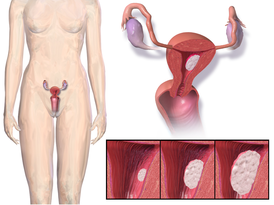 Localization and progression of endometrial carcinoma | |
| ICD-10 | C 54.1 |
| ICD-10-KM | |
| ICD-9 | |
| ICD-9-KM | |
| Omim | |
| Diseasesdb | 4252 |
| Medlineplus | 000910 |
Content
- 1 Risk Factors
- 2 Symptoms and signs
- 3 Diagnostics
- 3.1 Stage Definition
- 4 Literature
- 5 notes
Risk Factors
There are certain risk factors that are more likely to lead to the development of uterine cancer. Among them:
- Excessive growth of endometrial cells (endometrial hyperplasia). Hyperplasia is not yet cancer, but can sometimes be malignant. Common signs of this condition are: prolonged and heavy menstruation, spotting between menstruation and bleeding after menopause. Endometrial hyperplasia is a common condition in women after 40 years of age [3] .
- Obesity. Obese women have a greater risk of developing endometrial cancer.
- A burdened reproductive and menstrual history: women who have never had children, either menstruated before age 12, or continued after 55 years.
- Reception of hormonal contraceptives based only on estrogen, without a history of progesterone.
- Reception of tamoxifen (for the purpose of prevention or treatment of breast cancer) in the anamnesis.
- A history of radiation therapy of the pelvic organs.
- A burdened family history: women whose mothers, sisters or daughters had cases of endometrial cancer are at risk, as well as women with a hereditary form of colon cancer (Lynch syndrome).
Symptoms and signs
The most common symptom of uterine cancer is abnormal spotting from the vagina. The discharge may be watery with an admixture of blood, then go into bleeding. Genital bleeding after menopause is a pathology.
Also, symptoms and symptoms of endometrial carcinoma can be pain and difficulty urinating, pain during intercourse, and pain in the pelvic area. These symptoms can be caused by both endometrial cancer and other diseases [3] .
Diagnostics
Stage Definition
Endometrial carcinoma from a surgical point of view can be classified using the FIGO cancer detection system.
- Stage I
- IA: the tumor is located only in the endometrium
- IB: tumor invasion on less than half of the myometrium
- IC: tumor invasion of more than half of the myometrium
- Stage II
- IIA: damage to the cervical only cylinder
- IIB: invasion of the cervical stroma
- Stage III
- IIIA: the transition of the tumor to the serous membrane and appendages ( fallopian tubes and ovaries ), or malignant cells are present in the peritoneal fluid
- IIIB: there are metastases in the vagina
- IIIC: metastases in the iliac para umbilical or paraaortic lymph nodes
- Stage IV
- IVA: invasion of the bladder and rectum
- IVB: distant metastases, including to the intra-abdominal and inguinal lymph nodes
Literature
- Bohman J.V. Guide to Oncogynecology. - Ripol Classic, 1989.
- Kozachenko V.P. Oncogynecology: a guide for doctors // M: Medicine. - 2006 .-- T. 560.
- Pavlova T. D. Oncogynecology: a training manual for doctors of oncogynecologists and obstetrician-gynecologists // Kharkov: Caravel. - 2006.
- Practical gynecological oncology: selected lectures. - TOMM Center, 2008.
- Polyakova V.A. Oncogynecology. A guide for doctors // M .: Medical book. - 2001 .-- S. 73-91.
Notes
- ↑ Monarch Disease Ontology release 2018-06-29sonu - 2018-06-29 - 2018.
- ↑ General Information About Endometrial Cancer . National Cancer Institute (April 22, 2014). Date of treatment September 3, 2014.
- ↑ 1 2 Cancer of the uterus - euroonco.ru