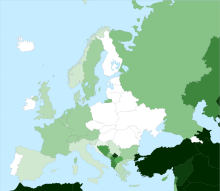
Islam in France is the second most adherent and important religion of France and the first in terms of growth. The most important religious object of Muslims in France is the Paris Cathedral Mosque, founded in 1926 and now controlled by the Algerian authorities.
Content
History of Islam in France
Muslims came to France from Spain in 717 , occupying Aquitaine and Narbonne in 719 . In France, in 732, a historical battle of Poitiers took place . The advance of Muslims to the north was stopped by Frankish troops under the command of Karl Martell . Over the next seven and a half centuries, Islamic possessions in Europe were limited to Spain, where the Reconquista began.
In 888, the Arab colony Fraxinet was founded in southern France, which lasted almost 100 years.
In the future, for a long time there were practically no Muslims in France. In the XIX - early XX centuries, territories with a significant Muslim population - Algeria , Tunisia , Morocco - were annexed to France territories. A massive influx of Muslims into France proper occurred during the First World War , when a large number of immigrants from North Africa were recruited to protect the country. Some of them after the conclusion of peace remained in France. In 1926, the Paris Cathedral Mosque was opened in memory of Muslim soldiers who died in the First World War [2] .
In January 2015, in Paris, a terrorist attack occurred on the office of the editorial office of the French satirical weekly Charlie Hebdo (Russian "Charlie Ebdo"). As a result of the shooting, 12 people died and 11 were wounded. The main suspects of the terrorist act, brothers Said and Sheriff Kuashi, were killed on January 9 by French special forces during a special operation [3] .
A few months later, in April 2015, according to the French National Union of Bookstores, sales of books on Islam in the first quarter of 2015 increased 3 times compared to the same quarter of 2014. According to the director of Philosophie magazine Fabrice Herschel: “The French are asking more and more questions, and they are less and less satisfied with the answers they receive from the media” [4] .
Mosques
According to the head of the Council of Muslims of France, Dalil Abu Bakr, at the beginning of 2015, 2,200 mosques were operating in France. In his opinion, the existing number of mosques did not satisfy the spiritual needs of 7 million Muslims in France. In this regard, the Council of Muslims demanded to increase the number of mosques in France. This requirement was supported by the Minister responsible for the reform of state institutions, Thierry Mando and the Council of Bishops of France. For his part, Florian Filippo, vice-president of the far-right National Front Party, said that France has a sufficient number of Muslim religious buildings, indicating that mosques are breeding grounds for extremism [5] .
Religion and Secular Society
Since the 80s of the 20th century, more and more widespread manifestations of Islamic religiosity on the part of immigrants and their children have been characteristic of France, and this was especially evident in schools where Muslim girls came in traditional Muslim headscarves - hijabs . Back in 1989, in one of the Parisian schools, two 14-year-old girls refused to change their hijabs to secular clothes, as required by the charter of the educational institution. Since then, thousands of followers have appeared in them, many of whom for the sake of their religious convictions generally abandoned secular education.
In July 2003 , a government commission was established on the relationship between religion and the state. A wide campaign has begun against the hijab, the "visual symbol of the suppression of women." Muslim women faced a difficult choice: either to sacrifice a religious demand, or to stop studying.
In December 2003 , French President Jacques Chirac, in a televised address to the French nation, said: “ Secularization is one of the main achievements of the French Republic. It is a key element of social interaction and unity of the nation. The Republic opposes everything that separates, cuts off and excludes. The law unites heterogeneous, because it equalizes the rights of all people, refusing to discriminate on the basis of sex, origin, color or religion. We must be vigilant in order to prevent a dangerous rollback in time. " .
Large Muslim Social Organizations in France
Currently in France there are several large Muslim public organizations. Since 1983, the Union of Islamic Organizations of France has been operating, which since 2014 has been included by the UAE authorities in the list of terrorist groups [6] .
In 2003, the French Council for Muslim Religious Affairs was formed, in which Moroccan delegates dominate the 2013 election, but its head is the imam of the Paris Cathedral Mosque [7] . In 2006, with the support of Morocco , the Association of French Muslims was created [7] . Both organizations are connected to each other.
Foreign Islamic Financing in France
The Muslim community in France receives some funding from abroad. Moreover, often between the authorities of other countries there is a kind of "rivalry" for the right to support Muslim institutions. For example, the Paris Cathedral Mosque since 1982 has officially received support from the Algerian authorities [2] . In addition, Algeria allocated funds for the construction of mosques in Tours and Toulouse , and a mosque in Marseille, and also paid for the training of French imams [8] . King Mohammed VI of Morocco allocated funds to complete the construction of the mosque in Blois , the mosque in Strasbourg and Saint-Etienne [8] .
Protests
In January 2004 , mass anti-government demonstrations of Muslims took place in France, protesting against the planned adoption of the law on the secular nature of society, which was to prohibit schoolchildren in public schools from wearing clothing that symbolizes their religious affiliation. Muslim Sikhs joined the demonstrations of Muslims, who also believe that their religious feelings were insulted.
Demonstrations, in which tens of thousands of people took part, were held under the slogans: “Hijab and burqa - my choice!”, “Chirac, you won’t take my charm off!” Simultaneous protests were held in many countries of Europe and the world. Representatives of foreign Muslim organizations made warnings against France.
However, demonstrations and protests could not prevent the adoption of the law on the secular nature of society on March 15, 2004 . [9] According to the law, state institutions and schools are now forbidden to wear any signs demonstrating religious affiliation - large crosses, hijabs, turbaned shirts, Jewish bales or Sikh turbans. Judging by opinion polls, the law was supported by two-thirds of the population of France.
Continuing the struggle against the policies of the French government and parliament, Islamic activists brought it to the pan-European level. In July 2004, an international conference was held in London with the participation of 250 delegates from 14 countries, where it was decided to launch a political campaign to lobby the interests of Muslims in the European Parliament .
The ban on the wearing of religious symbols, adopted in France, was condemned, among others, by the mayor of London, Ken Livingstone , who believes that the new law represents a step towards religious intolerance [10] .
On August 20, 2004, two French journalists were captured by the Islamic Army in Iraq . The rebels demanded in exchange for the hostages to repeal the law. [9]
Notes
- ↑ Pew Forum , 2011-01 Archived on March 23, 2012. report Archived on February 9, 2011.
- ↑ 1 2 Salkina M. Institutionalization of Islam in France // International processes. - 2016. - T. 14. - No. 2 (45). - S. 116
- ↑ The Kouache brothers died in an assault in the city of Dammarten, media reported . RIA Novosti (January 9, 2015).
- ↑ Islamic literature sales tripled in France IslamNews (April 4, 2015). Date of treatment April 6, 2015.
- ↑ French government: The lack of mosques contributes to the radicalization of Muslims , IslamNews (April 8, 2015). Date of treatment April 8, 2015.
- ↑ Salkina M. Institutionalization of Islam in France // International processes. - 2016. - T. 14. - No. 2 (45). - S. 117 - 118
- ↑ 1 2 Salkina M. Institutionalization of Islam in France // International processes. - 2016. - T. 14. - No. 2 (45). - S. 117
- ↑ 1 2 Salkina M. Institutionalization of Islam in France // International processes. - 2016. - T. 14. - No. 2 (45). - S. 115
- ↑ 1 2 Belov, Shkurenko, 05/17/2010 , p. 25.
- ↑ Petrov, Alexander Hijab delayed action . Independent Newspaper (July 21, 2004). Date of treatment April 6, 2015.
Literature
- Belov E., Shkurenko O. 10 quarrels of infidels with Islam // Ogonyok . - 05/17/2010. - No. 19 . - S. 25 .
- Muslims in France Aleksey Kudryavtsev (Published in the Russian Federation “Russia and the Muslim World”, 2002, No. 11, pp. 155-168)