Samoteria [1] ( Latin Samotherium , from the Greek Σάμος and θηρίον - an animal from the island of Samos ) is a genus of extinct mammals from the giraffe family that lived in the Miocene - Pliocene ( 13.82–2.58 Ma ago) from the South and East Europe to China and Africa [2] .
| † Samoteria |
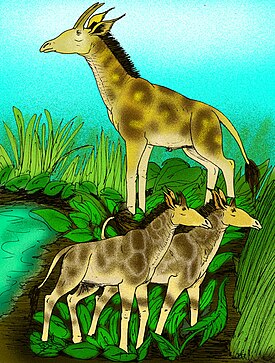
Reconstruction |
| Scientific classification |
|---|
| No rank : | Bilateral symmetrical |
| Subfamily : | † Palaeotraginae |
|
| International scientific name |
|---|
Samotherium Forsyth Major , 1888 |
Geochronology13.82-2.58 Ma | million years | Era | F-d | Era |
|---|
| | Th | TO
but
th
n
about
s
about
th | | 2,588 | | | 5.33 | Pliocene | N
e
about
g
e
n | | 23.03 | Miocene | | 33.9 | Oligocene | P
but
l
e
about
g
e
n | | 55.8 | Eocene | | 65.5 | Paleocene | | 251 | Mesozoic |
◄ Nowadays◄ Cretaceous-Paleogene extinction |
|---|
|
The first fossil remains were first discovered on the island of Samos in the Aegean Sea . Later, the remains were found on the territory of Moldova , Ukraine , Kazakhstan , Mongolia and Africa.
Large mammal, up to 3 meters long and more than 2 meters high at the withers. Had a moderately long neck and elongated limbs. The hind legs were longer than the front.
They lived in the savannahs and valley forests.
According to the Paleobiology Database website, as of May 2018, 5 extinct species are included in the genus [2] :
- Samotherium africanus Churcher, 1970
- Samotherium boissieri Forsyth Major, 1888
- Samotherium neumayri Radler & Weihofer, 1890
- Samotherium sinense Schlosser, 1903
- Samotherium tafeli Kilgus, 1922
