The storm of Ganja ( azerb. Gəncənin işğalı ) is an assault by the Russian Empire on the fortress of the city of Ganja of the Ganja Khanate (north-west of present-day Azerbaijan ), which occurred on January 3 (15), 1804 .
| Storming Ganja | |||
|---|---|---|---|
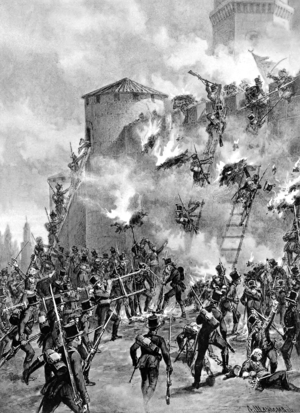 "The capture of the fortress of Ganja by storm on January 3, 1804." Hood. Adolph Charlemagne . The figure shows raining down on storming lights, made from rolled up cloaks, soaked in oil [1] | |||
| date | January 3 (15), 1804 | ||
| A place | Ganja , Ganja Khanate | ||
| Total | Russian victory | ||
| Opponents | |||
| |||
| Commanders | |||
| |||
| Forces of the parties | |||
| |||
| Losses | |||
| |||


The Ganja Khanate was favorably located on the right bank of the Kura River to the mouth of the Alazan River . In the east and southeast it bordered on the Karabakh Khanate , and in the south on the Erivan Khanate . In the west, the Dzegam river separated the possessions of the khanate from the Shamshadil Sultanate , and in the north, the Kura River - from Georgia . Ganja was a powerful fortress, which was surrounded by double walls 8 meters high, and reinforced by 6 towers [2]. The fortress of Ganja, revered, according to Nikolai Dubrovin , "the best in all of Aderbidzhan " [5] , was on December 2 (14), 1803 in blockade [6] and was stormed by Russian troops under the command of Lieutenant General Prince Tsitsianov, under the pretext that since the time of Tamara, it, in fact, belonged to Georgia, although it had long since lost touch with this country due to the weakness of its rulers [7] . According to Tsitsianov, “the local position of the Ganzhinsky fortress commands all Aderbidzhan”, and therefore its conquest of “first importance for Russia” [8] [4] .
The governor of the khanate Javad Khan refused to answer Tsitsianov’s demand [2] , denying that under Tamar Ganja belonged to Georgia [9] . When approaching Ganja, Javad Khan fought the Russians, in which he was defeated, and on January 3 (15), 1804, at 5.30 a.m., Tsitsianov’s troops in two columns launched an attack on Ganja [2] . During a bloody assault, Javad Khan was killed along with his middle son [10] .
The capture of Ganja ensured the security of the eastern borders of Georgia, which were subjected to repeated attacks by the Ganja Khanate. On the other hand, the Russian conquest of the Ganja Khanate, which was under the protectorate of Persia , provoked a negative reaction of the latter and actually served as the beginning of the Russian-Persian war (1804-1813) [2] .
Background
In early 1801, Paul I issued a manifesto on the accession of East Georgia to Russia with special rights. Alexander I confirmed the decision of his father and on September 12, 1801 signed the Manifesto to the Georgian people, who liquidated the Kartli-Kakheti kingdom and annexed Eastern Georgia to Russia. The Bagration dynasty was removed from power, and a Supreme Government was formed in Tiflis , composed of Russian military and civilians. General Pavel Tsitsianov was appointed General Manager of Georgia in 1802 [11] .
The Ganja Khanate was the closest and strongest of the Azerbaijani khanates . Ganja was considered impregnable, and the ruler of the khanate Javad Khan was known for his courage [10] . According to the historian Nikolai Dubrovin, the fortress of the city was considered "the best in all of Aderbidzhan" [5] . It was built in 1588 by the Ottoman commander Farhad Pasha , who then took the city [12] . It consisted of six towers and two gates - Tiflis and Karabakh (upper). The fortress was surrounded by double walls 8 meters high. The fall of Ganja was to make an enormous impression throughout Transcaucasia. Therefore, Tsitsianov decided to start, according to Mikhail Vladykin , “with this strongest and most insidious neighbor” [10] . Tsitsianov wrote that "the local position of the Ganzhinsky fortress rules over all Aderbidzhan ... That's why this is the conquest of the first importance for Russia" [4] [8] . Dubrovin noted:
| Ganja always kept in fear the whole of Aderbidzhan, and her fortress was considered between the Asians a bulwark from all kinds of assassination attempts on them. Ganja was the strategic key to all the northern provinces of Persia. That is why pr. Tsitsianov considered the acquisition of her so important [4] . |
The report of the real state adviser to Kovalensky Tsitsianov dated December 17, 1802 looks like a list of reasons for an open clash with the Javad Khan: luring residents from Georgia, contacts with the enemies of Russia, financial assistance to the rebellious Tsarevich Alexander, claims for the Shuragel province, connivance to those who rob Russian subjects. In addition, Javad Khan requested an inconceivably high fee for passing caravans of salted fish through his territory, and responded “impudently” to the messages of the representatives of Russia [13] . Back in February 1803, Tsitsianov received news that Javad Khan Ganja, despite his friendly letters and even statements about the desire to accept Russian citizenship, was preparing for war, and therefore he was gathering troops and supplies and concluded an alliance with Ibrahim Khan Shushinsky . It was not ruled out the creation of an anti-Russian union under the auspices of the Persian Shah [13] .
The general plan of the campaign of 1803 for Tsitsianov was this: to make a “search” in the direction of Ganja and Erivani and occupy Baku, to which the ruler of this khanate himself was inclined [13] . So, Tsitsianov wrote:
| On the device for crossing the Kura, I myself will go from Shamshadil, first, to Ganja, so as not to leave the enemy behind me, for the Ganja Khan Dzhevad reconciled with the Shusha Khan Ibrahim and received from him two guns as a gift. I will go from Ganja through the Shamshadil province by a direct course to Erivani, which is 70 miles [74.6 km] from it. When Zasim arrives in time to occupy Baku, I will not have two complete battalions behind leaving two garrisons in Ganja and Erivan [13] . |
In this regard, the commander in chief asked for reinforcements. It is noteworthy that Tsivianov wrote about the occupation of Ganja and Erivan as a fait accompli [13] .
The successful actions of General Gulyakov against the Jarians and Belokan at the end of March 1803 forced the Erivan khan to bow to all of Tsitsianov’s demands, and the negotiations opened at the same time with the Baku khan about taking him as a citizen gave Tsitsianov the opportunity to direct all his forces against Ganja [14 ] .
Campaign Preparation
In preparation for the campaign in Ganja, Tsitsianov ordered two regiments to move from the Caucasian line to Georgia: the Narva Dragoon and the 9th Jaegers [approx. 1] . In May 1803, these troops entered Georgia and were deployed as follows: dragoons in Zagorechye, Martkobi, Khoshma, Paterzeul and Makov, and huntsmen — one battalion in the city of Gori , the other in Suram , and two companies in Dushet and two Tskhinvali [approx. 2] [14] .
To follow with a detachment in Ganja, an order was given to prepare also 100 people of mounted “Tatars” (Azerbaijanis) from Demurtchasal, Borchaly and Kazakh [approx. 3] , who needed to have provisions with them for 6 weeks [14] .
But he could not immediately begin to expand the borders of the empire of the Tsitsianov for a number of reasons. Firstly, there were few troops at his disposal. Secondly, the impression was that the general still had illusions about the possibility of persuading the rulers of the Caucasus to accept Russian citizenship through diplomatic measures. Thirdly, the internal situation in Georgia required measures for the administrative arrangement of the region and the suppression of the opposition. In addition, Tsitsianov was “crushed” by the highest instructions he received, according to which all sorts of increments of the territory were allowed only if there was no danger of diplomatic and, especially, military complications with neighbors [13] .
Before the very movement to Ganja, Prince Tsitsianov was detained for some time by the Lezghins, who appeared from the side of Kartalinia [14] . The military operations with the Lezghins, although they were very insignificant in their results, nevertheless stopped Tsitsianov’s campaign regarding the capture of Ganja. The commander in chief was forced to abandon the offensive and pursue a defensive policy, fearing to allow the Dagestanis to break into Georgia, which could easily happen when several battalions assigned to the offensive detachment were withdrawn from there [15] . To pacify the Jaro-Belokan Lezghins, it was necessary to spend much more energy than anticipated [13] .
This defensive system of Tsitsianov and the constant guard position of the troops, which prevented offensive action for some time, made it possible for Javad Khan to prepare for a meeting with the Russians as much as his forces and means allowed. Taking advantage of the time, Javad Khan sent an messenger to Baba Khan asking him to assist him against the Russian troops going to Ganja. Baba Khan replied that he was now going to Khorasan , and upon his return he would help him [approx. 4] . The help was provided by the fact that Baba Khan sent only the firman to the Kazakh agalars , urging them to submit to the Ganja Khan, arm himself and act with him against the Russian troops [approx. 5] [15] .
Meanwhile, Prince Tsitsianov was expecting the arrival of 2 more regiments, the Sevastopol Musketeers and the 15th Jaegers, in order to move to Ganja. On November 11, the Sevastopol Regiment arrived and settled down for rest 10 miles (10.6 km) from Tiflis, in the Gartiskaro tract. The 15th Jaeger Regiment on November 12 was still 70 miles (74.6 km) from Tiflis. These regiments were exhausted by the passage through the mountains during the inclement season, and therefore, with a three-battalion squadron, only horses were left in the Sevastopol regiment, suitable for raising convoys of two battalions. The 15th Jaeger regiment Tsitsianov didn’t even dare to take with him, and from the Sevastopol regiment he took only two battalions, which were not even complete, the third left “under heavy load” [approx. 6] [16] . Thus, Tsitsianov hesitated with his performance in Ganja, not only because of the need to avert the threat of a massive highlanders' raid on Kakheti. He was waiting for the arrival of reinforcements. However, when they arrived, Tsitsianov suffered a cruel disappointment, which he poured in his letter to the state chancellor of November 17, 1803 [13] . Tsitsianov wrote:
| The chief of the Sevastopol regiment who came to me announced to me that his regiment had never heard the whistle of bullets, that they could not walk, and at 15 miles [16 km] they got tired and fell. The soldiers didn’t leave the place for 20 years, and more importantly, there were 600 people in the regiment, except for the sick, and I can’t expect the manning, because when this regiment was sent from the Crimean inspection [approx. 7] , the inspector refused to give him a recruit appointed by the military college; mine are [approx. 8] then they were already handed out to the regiments for the purpose of the military college. When did it happen that private bosses dare to act against a military college schedule? Time is running out; there is a shortage of fodder, and the regimental commanders demand a terrible price, but I cannot refuse so that they haven’t made a supply of provisions. After all these disruptions, can I be useful in staying in the service, exposing my reputation every day to dishonor, and not from my own fault, but from my subordinates. [sixteen] |
Meanwhile, about the mood in Ganja, Colonel Karjagin reported the following:
| Javat Khan certainly wants to fight with us. Residents, Armenians and Tatars , do not want to start the battle and intend to ask for mercy. Residents with their families from all villages are gathered in the city; all Tatars are in the city itself, and Armenians are around the fortress. There are no special troops in the city, such as 7,000 are made up of residents. In addition to the former three guns, five more were prepared, and all of them were placed on the towers [13] . |
Campaign to Ganja
To march to Ganja, it was supposed to make up a detachment of 6 battalions, 3 squadrons: from 2 battalions of the Sevastopol regiment, 2 battalions of the jaeger regiment located in Shamshadili, on the way to Ganja, one battalion of the Caucasus Grenadier regiment, 3 squadrons of the Narva Dragoon regiment and 2 companies regiment , patronage battalion [16] . The remaining two companies of the same battalion were to join them, on their return from Vladikavkaz , where they accompanied Queen Darya (widow of Tsar Irakli II ). The detachment was supposed to gather on November 20 in the village of Saganlug, 15 miles (16 km) from Tiflis, on November 21, a rest was scheduled, and on the 22nd, a performance [17] .
Gathering all the available forces, Tsitsianov moved to Ganja. On November 20, 1803, his corps, consisting of six infantry battalions, three squadrons of dragoons, two regiments of Don Cossacks , police composed of Azerbaijanis [13] of the Borchalinsky , Kazakh, Demurchalsal and Shamshadil districts, came out of Tiflis. The first crossing was eight and a half miles (9 km) to the village of Suganluk. The small distance that the army traveled at the very beginning of the march was due to the fact that, despite all the preparations and orders, they forgot something, or someone was delayed for some reason. Thus, it took a day of rest to put everything in order. Then the detachment went faster. On November 22, the army stopped near the village of Demurchasaly, leaving 24 miles (25.6 km) behind it. Here, a detachment of the Tatar ( Azerbaijani ) cavalry joined Tsitsianov. On November 23, 19 versts (20.3 km) passed and camped near the village of Shikoly, although, judging by the map, they crossed two small rivers twice and several times through ravines. The need to dry clothes delayed the release on November 24, and therefore the detachment advanced to the intended goal of only 7 miles (7.5 km). On November 25, the army crossed the Akstafa River and immediately camped, defeating another 16 miles (17 km) of difficult mountain roads. The next pass was made on the banks of the Tauz River on November 25. Thus, the troops overcame 25 miles (26.7 km). Here, the detachment was replenished with “Kazakh and Borchali Tatars”, and on November 27, “Tatars of Shamshadil” approached. During the fighting, light and irregular cavalry formed a kind of curtain between their own troops and the enemy, both during movement and in bivouacs. At the campsites, Tsitsianov always put forward the national Muslim formations in the direction of the greatest threat, and the Cossacks always stood between the Russian infantry and the "Tatars". On November 29, when parking at Shamkhor, the police were generally put on the other side of the river [13] . As a result, in six transitions, the detachment reached the Shamshadil village of Zagial, where they were joined by two battalions of the 17th Jäger Regiment [approx. 9] [17] .
Finally, on November 29, Tsitsianov’s corps crossed the border of the Ganja Khanate [13] . Upon arrival on November 29 in Shamkhor , Prince Tsitsianov wrote a letter to Javad Khan and demanded the surrender of the fortress [17] . Tsitsianov explained the reasons for his appearance at the head of the army by the fact that Ganja belongs by right of Russia, since earlier it was part of the Georgian kingdom, now part of the Romanov empire, that in 1797 the city was already occupied by Russians, that Tiflis merchants robbed by Javad subjects Khan, did not receive compensation. He also promised "unlimited mercy" in the event of unconditional surrender. The letter ended with a formidable passage [13] . In his letter to Javad Khan, Tsitsianov called the first and main reason for coming to Ganja that “the Ganja with her district, during the time of Queen Tamara belonged to Georgia and the weakness of the Georgian kings was torn away from it” , and that the Russian Empire, taking Georgia into its protection, cannot leave Ganja, considering it a part of Georgia “in the hands of strangers”. The second reason Tsitsianov called the fact that six years ago the khan was a Russian citizen, and Russian troops stood in the Ganja fortress. The third reason Tsitsianov called Tiflis merchants, accusing the people of the Khan of their robbery. Tsitsianov noted that according to European tradition and professed by faith, he should, without starting to shed human blood, offer the khan about the surrender of the city. According to Tsitsianov, if Javad Khan voluntarily surrenders the fortress, then he will experience “unlimited mercy of His Imperial Majesty” , and if not, then he will suffer the unfortunate lot, “to whom Izmail , Ochakov , Warsaw and many other cities once fell . ” The answer Tsitsianov wanted to hear the next day at noon [9] .
Pages from a letter to Javad Khan Tsitsianov | ||||||||||
Javad Khan's answer was designed in the same style [13] . He denied the justice of the fact that Ganja belonged to Georgia under Queen Tamara [9] :
| I have never heard of this from anyone, but our ancestors, Abbas-Kuli-khan and so on. owned by Georgia. [9] |
In fairness, the khan referred to Georgian old-timers, to the traces that remained in Georgia after the possession of Abbas-Kuli-khan : Mosques, shops and gifts from him to Georgian princes. Javad Khan did not deny that 6 years ago he was a subject under duress, and not according to his disposition towards Russia, that they had surrendered the city and the Russian garrison was admitted only because the Persian Shah was then removed to Khorasan, and that he did not have access to it, therefore, "he decided to zealous such a great Russian Emperor" [9] . Khan wrote to Tsitsianov:
| Then the Persian shah was far away, and now, praise be to Allah , he is close, and the commander-in-chief sent by him has already arrived here, the army has arrived and will arrive. If you brag about your cannons, then mine are no worse than yours, if your cannons are 1 arshin long, then mine are 3 and 4 arshins, and success depends on Allah. How do you know that your troops are braver than the Persian? You only saw your battles, but you didn’t see wars with the Persians. From that day I’m preparing how you arrived in Shamshadil, turning its population into your dependence. If you want to fight, we will fight ... [6] |
Khan reproached Tsitsianov for a complete misunderstanding of the case [9] . In the same letter, Javad Khan wrote:
| And they also mentioned that if I did not accept your suggestions, they would serve as my misfortune, but how did you take such an irrelevant thought? It is evident that your rock the unfortunate from Petersburg brought here and you will experience its blow [18] . |
Thus, the struggle for the fortress began with a written duel of Tsitsianov and Javad Khan. After such correspondence for Tsitsianov, the taking of the fortress became not only a state, but also a deeply personal matter [13] .
Javad Khan's answer did not meet Tsitsianov’s expectations. Calling on the Armenians for refuge under the protection of the All-Russian throne, Prince Tsitsianov decided to approach Ganja [6] . Having given rest to the troops, on December 1, Tsitsianov entered the Kochkhor River, and the next day, without a plan of Ganja and its environs in his hands, he was forced to proceed to a personal survey of the area. For his review with all three battalions of the 17th Jaeger Regiment under the command of Colonel Karjagin , a battalion of Caucasian grenadiers under the command of Lieutenant Colonel Simonovich, one squadron of Narva dragoons and light troops (Cossacks and Azerbaijanis), commanded by Major General Portnyagin , with 7 field guns 18] .
When Tsitsianov’s troops approached Ganja, it turned out that the fortifications were surrounded by extensive gardens [19] . The fortress was closed by the suburbs and gardens, which needed to be mastered [6] . The fortress could not be seen without first having mastered the gardens [18] .
To this end, Prince Tsitsianov formed two columns - one of the Simonovich Caucasian Grenadier Battalion and Belavin Jaeger Battalion with part of the light troops and two guns under the command of Lieutenant Colonel Simonovich, who was instructed to follow the Tiflis road. Another convoy of two battalions of the 17th Jaeger Regiment, Karyagin and Lisanevich , a squadron of dragoons, with 5 guns and other light troops, led himself to bypass to the right of the Tiflis road through the khan’s garden [6] .
Ganja city with a citadel, surrounded by gardens, was located on a plain along the Ganja River. In the northeastern part, behind gardens, in one verst (1 km) there was a suburb, and from the east, fathoms 100 (213 m) from the fortress, stone structures of an extensive caravanserai with a mosque and a maidan (square). The gardens and suburbs were surrounded by a 10-foot-high stone concrete wall. The entire circumference of the wall, covering gardens and suburbs and representing one continuous line with ledges, in the form of bastions, reached up to 5 versts (5.3 km). From this wall, to the fortress fence, the closest distance (up to 400 fathoms or 853 m) was along the Tiflis road, which ran north-west along a stream, or a water moat, flowing through the western part of the city, past the citadel. Another road from the fortress led to Karabakh and left the eastern corner of the city, near the tower. Passing the mosque and caravanserai, the road went down to the Ganja river. The Khan Garden was located to the right of the city, outside the fortress wall, one verst (1 km) from the Tiflis Gate. The city was surrounded by a double fence - an earthen rampart with a palisade with a length of 650 fathoms (1387 m) and a height of 10 feet (3 m), and a stone wall with six towers. In the very center of the city, which consisted entirely of wooden buildings, there was a stone citadel with a Khan's palace , occupying an area of 50 square fathoms [6] (107 sq. M.).
Siege
Preparing for the Assault
Karyagin and Lisanevich led their battalions from the khan’s garden in company columns. With the rangers Karjagin was followed by Prince Tsitsianov [6] .
Helmet and shield of the soldiers of the Ganja Khanate. National Museum of Art of Azerbaijan ( Baku ) | ||||||||||
In the gardens, Russian troops met strong resistance and were forced to withstand a stubborn struggle [18] . High clay soil fences at every step provided the Khanate forces, which occupied the catwalks and fortifications [20] , with a means of defense, and the Russians with a separate fortification, which had to be taken by open force or assault [18] . Despite the strong fire and strong resistance of the Khan’s troops, Tsitsianov’s detachment managed to clear the outskirts within two hours, which consisted of almost one garden stretching 1.5 versts (1.6 km) from the city [21] . In his report of December 8, 1803, Tsitsianov wrote:
| The invincible troops, accustomed to despising the obstacles on the path leading to glory, cleared the outskirts, made up of gardens, with indescribable fearlessness [20] . |
In the eyes of Tsitsianov, captains Kotlyarevsky and Dyachkov, staff captain Parfyonov, lieutenants Trunov and Chevkin, regimental adjutant Patrizhitsky and quartermaster Surokov distinguished themselves. Captain Kotlyarevsky was especially distinguished, who, being ahead of his company while occupying the outer fence, was shot right through the bullet in the leg, but did not leave his post until he was removed from the fire by Lieutenant Mikhail Vorontsov, who was first in battle (later field marshal and commander in chief Caucasus) and non-commissioned officer Bogatyryov, who at the very beginning of the assault was wounded by a bullet in his heart [approx. 10] . The greatest resistance was met by Simonovich’s convoy during the advance along the Tiflis road to the caravanserai [20] .
Within two hours, the Russian troops drove the enemy into the fortress, occupied the suburbs and gardens and established themselves around the fortress in certain places for the blockade. A battalion of Lisanevich with a battery of two guns was located at two streams (water ditches) against the Tiflis gate and the Yukhari-Kale tower, the chef battalion with three guns stood to the right of the Jafar-bek tower, while the Belavin battalion was in the command of the lieutenant colonel with the battalion of Caucasian grenadiers Simonovich, and subsequently this battalion took a position against the Sharam-bek tower, to the left of the karavins shed, in which was located the main apartment of Prince Tsitsianov, under the cover of the Simonovich grenadier battalion [approx. 11] [20] .
During the attack on December 2, Khan’s troops lost 250 people, most of whom fell in a collision with a convoy of Lieutenant Colonel Simonovich [21] , walking along the Tiflis road [20] . At the same time, 200 Shamshadil Azerbaijanis and 300 Armenians surrendered to the Russians [21] [20] . The Russians lost 70 people killed and 30 wounded [21] , including 7 lower ranks, 2 officers (Kotlyarevsky and Dyachkov), 4 non-commissioned officers, 1 drummer and 8 rank-and-file rangers were wounded [20] .
Tsitsianov testified before the emperor about the “zeal, zeal, courage, and firm courage” of the entire detachment when taking suburbs from the gardens, especially recommending Colonel Karyagin, Major Lisanevich, and the wounded captain Kotlyarevsky. Tsitsianov in his report of December 8, 1803 wrote:
| I also can’t keep silent about the courage and courage of the Preobrazhensky Life Guards, the regiment of Lieutenant Count Vorontsov and your Imperial Majesty the aide-adjutant Benckendorf, who, having taken permission from me to be at the jaeger battalions, threw themselves in all danger. I highly recommend that I dare to recommend all officers in jaeger battalions and dragoon squadrons ... [22] |
In his recommendation, the Commander-in-Chief also called Major General Portnyagin, artillery of Colonel Akhverdov , commander of the Caucasian Grenadier Battalion Simonovich and Major of the Narva Dragoon Regiment Fitingof [22] .
The fortress was finally overlaid and the bombardment began, which lasted about a month without any visible results. At first, Tsitsianov hoped that Javad Khan, frightened by the loss of his suburbs, would be forced to surrender the fortress voluntarily. But these hopes did not come true, despite the constrained position of the garrison and a large number of deserters [22] (many people fled from the fortress daily, weakening and decreasing the garrison of the khan) [21] .
Tsitsianov tried to persuade the khan to surrender the fortress through negotiations [22] . In his new letter to Javad Khan, which looked noticeably softer, Tsitsianov again demanded the surrender of the fortress, giving the deadline for a final answer one day [21] [19] . Instead of a notice of surrender, the parliamentarian brought an answer to the ruler of Ganja, in which he demanded a respectful attitude [19] . So, in his answer of December 11, Javad Khan wrote a letter to Tsitsianov that tomorrow on Saturday, celebrated by the Jews, he would send a man to the general. After tomorrow, on Sunday, he will send another person, and if Tsitsianov “will offer well” , the khan “will also respond mutually well” [21] .
Tsitsianov replied that he did not offer him the conditions, but still demanded surrender and again threatened to storm [19] . He wrote if Javad Khan sends, on the same day, in the morning, the keys to the city with his son Hussein-Kuli-Agoy, who should remain an amanat , as a sign of surrendering the city to the head of the Russian troops, then “all happiness and prosperity will descend on Javat Khan of Ganzhinsky " [23] . Otherwise, Tsitsianov promised to launch an assault and shed the blood of the “unfortunate” of his subjects, although not faithful to him, but whom he was sorry “for humanity” . Javad Khan requested that Kazakh Mahmad be sent to him for negotiations, but Tsitsianov refused him, demanding an answer on paper rather than in words [23] . Javad Khan took time, agreeing to negotiate through a proxy [19] . In his letter of December 28, 1803, Javad Khan Tsitsianov wrote that the khan asked for the third day of Kazakh Mahmad, in order to postpone the negotiations, that Tsitsianov demanded to say his middle name, since there are many Mahmads. Tsitsianov concluded that the khan needed to explain himself, and that he "despised " Asian pride . To avoid bloodshed, the Tsitsianov allowed the besieged to ask for a truce, the besiegers give as much time as they like. Tsitsianov wrote that after the expiration of time, either the war would ignite, or the khan should surrender the city on its terms, noting that this was done in the presence of Tsitsianov under 4 fortresses. The answer of Tsitsianov demanded to be given on the same day [23] . In this letter, Tsitsianov wrote that no one had heard in the world that the Russian troops, having encircled the fortress, departed without surrender or assault: “The first welfare is surrendered to the surrender, and the last is washed with blood, and God will show, at the last, in whose hands the Ganja will remain ” [22] .
On December 29, the khan replied that he had asked Makhmat-Mirza-Oglu to be sent to him, and said that Tsitsianov’s demands were such that no one was able to fulfill them [23] . Javad Khan, by the way, wrote that when someone strictly writes to someone, the same answer should be received [23] . Pointing out that Tsitsianov mentioned that during the law there was no shooting, the khan wrote that in his reign, when the enemy was so close, with a cannon and gun shot, one should always shoot against such a gun. To the words of Tsitsianov that “during the assault, human blood will be shed,” Javad Khan replied that sin would be on the conscience of Tsitsianov himself. Pointing out that, in Tsitsianov’s words, “it’s a sin to shed blood in the Christian law,” the khan wrote that in his “ Mohammedan law, if anyone goes by force and blood is shed, then there is no sin . ” And to Tsitsianov’s demand that the letter be answered on the same day, Javad Khan wrote that such words could be used by his servant, that the khan was not afraid of anyone, and that he answered when he wanted to. Khan wrote that the one sent from Tsitsianov was Karabakh , and was afraid to go to the general, therefore the khan sent an answer with another [24] .
While negotiations were ongoing, the fortress was deteriorating. The Khan garrison needed firewood, although there was enough food supply, there was no barley, the horses were dying, the water pipes were loaded with dead bodies, the air was infected, the need and diseases were increasing. But despite this, Javad Khan did not give up [24] . The besiegers also suffered a need: there was no fodder, the number of patients increased [22] .
In his last letter, Tsitsianov, after taking the city, promised to put the khan to shameful death, and he replied that he would die protecting the walls [22] .
Seeing that the threats did not affect the ruler of Ganja, Tsitsianov changed his tone and put forward new conditions [19] . Tsitsianov, for the last, fifth time, made an attempt to persuade the proud khan to surrender, offering him the following:
| Jevad Khan with all the inhabitants must accept Russian citizenship, surrender the fortress to Russian troops with all the property, he will remain the owner and will pay 20 thousand rubles a year annually, supply the troops both located in the fortress and those that will be on the road to Shamshadil , to refuse from Shamshadili and its inhabitants and to extradite their son [22] . |
Javad Khan did not want to be a tributary of Russia [22] , even remaining the ruler of the khanate [25] . One of the reasons for the persistence of Javad Khan was the plight of the Russian troops [19] . At the appointed time for sending a response from Ganja, cannon and gun fire was opened [22] .
Fortress Assault
Javad Khan believed that the lack of food and fodder, cold and illness, sooner or later should have forced the Russian troops to lift the siege. But Tsitsianov did not leave, not only because it would be “shame unheard of for the invincible Russian troops”. Numerous defectors reported to the prince that the city held on with all its might [19] . The Russian command did not hope to sit out the Ganja people - their own forces were running out [19] .
The military council, assembled from four senior commanders: General Portnyagin, Colonels Karjagin and Akhverdov, and Lt. Col. Simonovich, chaired by Tsitsianov, decided at dawn on January 3, 1804, to storm the fortress. The disposition ordered the assault to be carried out in two columns: the first, composed of 200 dismounted dragoons, the Sevastopol Grenadier Battalion and the battalion Simonovich of the Caucasian Grenadier Regiment, led by Major General Portnyagin, was to go to the left of the Karabakh or upper gates; the second column of two battalions of the 17th Jaeger Regiment, the Chef and Major Lisanevich, led by the chief of the regiment, Colonel Karyagin, to the left of the Tiflis or Citadel gates, making a fraudulent attack first [26] , and subsequently a real one [27] . But first of all, Tsitsianov removed the Muslim (Azerbaijani) militia from military formations, fearing that in the dark it could go over to the enemy’s side and cause a lot of trouble [19] . She was ordered to keep the chain around the forstadt and gardens [27] .
Before the assault, Tsitsianov gave a secret warrant to Portnyagin, the commander of the troops assigned for the attack, of the following content:
| From the evening to remain everyone in their posts, as they are now taxed. Half an hour before moving on to the present case, everyone should occupy both the places designated in the disposition and the posts shown by the captain in the quartermaster part of Chuikoy; but there are no words to explain with what quietness and deep silence the movement of troops should be done. Bring all the standards and banners at night without ceremony to the mosque and give the guard there. The Cossack chain should stand at its posts before dawn, thinking about the nearest connecting battery, and the rest with reserves in closed places from bullets and cores; at dawn, gather all of them [25] . |
The battalion of the 17th Jäger Regiment of Major Belavin, under which Tsitsianov himself was, made up a reserve and was put on the Maidan (square) against the Karabakh Gate. A battalion of the Sevastopol Musketeer Regiment was ordered against the gate of Tiflis with the order to prevent the enemy from leaving the fortress, and in the case of the demand of the assault, rush to the rescue [27] . All artillery of 11 guns, including three three-pound guns were put into reserve, to which 100 Cossacks were assigned. All the officers of the detachment were told to watch so that the soldiers during the assault spared the women and children and sent them to the cleared towers, to which Tsitsianov ordered to guard the guard for their safety. Robbery before the perfect extermination of the enemy was strictly prohibited [27] .
By 5 a.m., Colonel Karjagin led the two battalions of the regiment entrusted to him in the greatest silence to the appointed place against the Kafer-bek tower and placed them, hiding behind the tip of the gardens adjacent to the Tiflis road. Under the command of Karjagin, there were 43 non-commissioned officers, 17 volunteers and drummers, 524 rank-and-file rangers, 7 paramedics and barbers, and 4 blacksmiths with hammers and crowbars to break walls (in total there were 615 people with 20 officers) [26] . There were 21 non-commissioned officers, 4 volunteers, 7 drummers, 263 huntsmen, 2 barbers, 3 blacksmiths (a total of 300 people) in the boss battalion. In the battalion of Lisanevich there were 22 non-commissioned officers, 6 drummers, 261 huntsmen, 1 paramedic, 4 barbers, 1 blacksmith (a total of 295 people). In addition, there were 11 diaries in the first battalion, and 6 in the second. During the siege, 32 other non-combatant lower ranks were in both battalions who did not take part in the assault: 3 clerks, 2 infirmaries, 10 carpenters, 1 gunsmith, 1 churchman , 17 furlites . In total, there were 644 lower ranks in the two battalions. In addition to the sick, there were 280 officers and lower ranks in the Belavin battalion. Thus, before the assault on Ganja, the entire 17th Jaeger regiment could consist of up to 920 people [26] .
At half past six in the morning the movement of the columns began to storm, so that taking advantage of the darkness of the night, it was possible to attach the stairs to the earthen city wall [28] .
Having appointed a team of huntsmen with lieutenants Niksic and Egulov for a fraudulent attack, who were supposed to divert the enemy’s fire with their fire and thereby ease the escalade of assault men, Karyagin, according to the disposition, led his columns to the earthen rampart. Their advance was covered by gardens and fences. When no more than 15 sazhenes remained before the earthen rampart, the Khan's troops noticed movement and opened cannon and rifle fire [26] . Then stones and arrows rained down on the attackers, and the accesses to the stone wall were illuminated by illuminations made of rolled cloaks soaked in oil [1] .
Karyagin, without waiting until Portnyagin’s convoy rises to the shaft on the opposite side, and not hearing a drumming from there, rushed to the stairs and entered the wall where Captain Sakharov was wounded in the leg. At the same time, Sakharov’s company climbed through the earthen rampart and climbed the stairs, partly attached to the wall, partly to the embrasures of the tower, to the wall with their companies, captains Kalovsky, Dyachkov and Tereshkevich, staff captains Parfyonov and Khrustalevsky. Lieutenant Trunov, commanding the 1st platoon in the Karjagin company, hastily crossing the moat and the earthen rampart, went to the Kafer-bek tower and, having set the stairs to the embrasures, together with his rangers ascended the tower [1] .
After taking the Kafer-bek tower, Major Lisanevich with the companies of the battalion entrusted to him, on the orders of Karjagin, moved to the right side of the Kafer-bek tower to the second tower of Yukhari-Kale, took possession of it and opened the gate. Then Lisanevich, leaving the company of Captain Parfyonov sent by Karjagin at the gate, moved to the third tower of Kaji Khan, for which Captain Dyachkov had previously sent Karjagin with the company that had occupied her. Captain Kalovsky was killed here. Javad Khan himself, riding astride the largest cannon of those in the fortress, defended himself with a saber in his hands until he was chopped down. Thus, earlier than Portnyagin’s convoy, which failed at the very beginning of the assault, ascended the rampart, in the hands of the rangers of the 17th regiment there was already half the rampart rampart with three towers [1] . In his report, Tsitsianov wrote:
| So, one moment, so to speak, brought an unheard-of courage to the troops of Your Imperial Majesty the seizure of three towers, where on one of these Javat Khan accepted worthy revenge for the sacrifice of so many people of his pride [1] . |
The initial failure of the assault on the Portnyagin convoy is due to the fact that Javad Khan concentrated all his forces against the breach at the first alarm. Forced to leave the path through the gap, Portnyagin decided to take the walls. Twice the khan's troops repelled the stairs and twice the soldiers molested them again. Only for the third time did the soldiers manage to climb the rampart and take possession of the rest of it and three other towers. In the Portnyagin’s convoy was a team of rangers of the 17th Jäger Regiment with Lieutenant Lisenko, probably expelled by Prince Tsitsianov from Belavin’s battalion. Lisenko found a convenient passage and forwarded the column [1] .
After capturing all six towers, troops began to descend into the city along a 12-arshin (8.5 m) stone wall. It was necessary to drag 14-arshin (10 m) stairs from the outside of the wall and go down to the city [1] (the exits from the towers were very narrow, and it was impossible to go down to the city from the eight-meter wall, especially since intensive shooting was conducted from below) [19 ] . There was a panic in the city [1] . Crowds of Azerbaijanis, on foot and horseback, searched in vain for the Khan Bunchuk , “their warlike beacon” [5] . Wives poured into the square and screamed out the air. Soldiers of the Russian army cleared the streets of the city from the enemy. By noon it was already quiet. The city was covered in dead bodies. Soldiers took off their golden clothes from horses [5] .
Thus, in 1.5 hours, Tsitsianov’s troops managed to take the fortress. But not one of the about 8,600 women taken by the khan to the city from the villages as a guarantee of their husbands' loyalty, and not one infant died. Tsitsianov, in his reports of January 3 and 10, 1804, wrote on this subject: "Humanity and obedience to my order, hitherto unheard of during the assaults" [5] .
In total, Khan's troops lost 1,500 killed (according to Zubov, the number of dead reached 1750). A total of 17,224 people were captured (8585 men and 8639 women). Losses of Russian troops amounted to 3 officers and 35 lower ranks killed and 12 headquarters and chief officers and 192 lower ranks wounded [4] . Including in the 17th Jaeger regiment, captain Kolovsky and 8 rangers were killed, captain Sakharov (seriously) and Dyachkov, staff captain Khrustalevsky, lieutenants Patrizhitsky (regimental adjutant) and Nikitich, lieutenants Verbitsky and Tumanov, 3 non-commissioned officers were wounded and 3 57 privates [29] .
During the assault, along with his father, the middle son of Javad Khan, Hussein-Kuli Khan, was killed [30] . The elder Ugurl-khan [30] and the younger Ali-Kuli-khan [30] managed to escape and find refuge with Ibrahim Khan of Karabakh [29] (at first Tsitsianov thought that they were running to the ruler of Samukh Sherim-bek, dependent on Ganja) [31 ] .
From the robbery of Russian troops, many residents hid in the Juma mosque . According to the report of Tsitsianov to the tsar himself, “up to 500 Tatars [approx. 12] sat down in a mosque, so maybe to surrender to the winners. But one Armenian told our soldiers that there are several Dagestan Lezgins between them. The name Lezghin alone was a signal of the death of all those who were in the mosque ” [32] [10] [5] . Lezgins, who often raided the Russians back in Georgia, were considered their blood enemies. As a result, more than five hundred civilians who took refuge in the Juma Mosque were killed to the last [32] [33] [29] .
Georgian prince David , a contemporary of events, wrote about the ruin of Ganja:
| Since the Georgians [approx. 13] were angry with the inhabitants of this, then Prince Tsitsianov could not prevent them from robbing and ruining the city, where most of the inhabitants of the male regiment were beaten and the female was taken prisoner, and the khan himself was put to death [19] . |
On January 4, the main mosque of the city was already turned into a church [25] [8] .
Summary and Consequences
In order to convince the inhabitants of Ganja more strongly that the Russian troops would not only not leave the fortress, as it had happened before, but that the whole region would remain Russian citizenship [31] , Tsitsianov renamed Ganja in honor of Empress Elizaveta Alekseevna - to Elizavetpol. The khanate itself was liquidated. The territory of the former Ganja Khanate, already under the name of Elizavetpolsky District, was annexed to the Russian Empire . Upon receiving a report on the capture of Ganja, Alexander I, February 4, 1804, made Tsitsianov general of the infantry [34] .
Pavel Baberovsky wrote about the result of the assault:
| An hour and a half after the start of the assault, the Ganja fortress, which instilled fear in Aderbeidzhan and Georgia, had a reputation as a stronghold between Asians, was the key to the northern provinces of Persia, was in the hands of the victors. More than one and a half thousand corpses of Tatars paved the walls and streets of the fallen stronghold. 8585 men and 8639 women were taken prisoner [29] . |
Among the prisoners taken during the assault on Ganja, Tsitsianov was brought the family of Javad Khan. From the military supplementary budget he was immediately issued an amount of 900 rubles. The family was taken to a house on the forstatde and bought carpets, blankets and other things from those who were storming at the expense of the Georgian additional budget and to give them 30 quarters of wheat and 20 quarters of Sarochinsky millet and millet from the grain reserve [4] . The first wife of Khan Begum (Melke-Nisa-begyumy) [30] , the sister of the Sheki Mamed Khan , asked Tsitsianova to let her and her daughter (Shirin-begyum) [30] go to her brother, who also asked for it. Tsitsianov agreed, believing that with this act he would arouse attachment to the meekness and mercy of Russian rule. At the same time, Tsitsianov requested the production of a pension to all other captive members of the khan's family [31] .
The Russian mining went to 9 copper, 3 cast-iron guns, 6 falconets and 8 banners with inscriptions [approx. 14] , 55 pounds of gunpowder and a large stock of grain [31] .
Colonel Karjagin and Major Lisanevich were awarded the Order of St. George IV degree. In addition, Prince Tsitsianov wished to distinguish Karjagin, whom he considered the main "culprit of the brilliant assault", a petition for the Highest Award of "diamond bridging of his zeal and zeal" for his former Order of St. Anna of the II degree. He was granted a golden saber with the inscription "for courage." Fifteen distinguished officers were awarded the Order of St. Anne of the III degree [29] .
Obverse and reverse of the medal “ For Work and Courage in the Taking of Ganja ” | ||||||||||
At the behest of Emperor Alexander I, a silver medal designed to be worn was established to reward the participants in the assault. The emperor’s monogram is depicted on the front side of the coin, and the inscription on the back reads: “For the labors and courage during the capture of the Ganja of Henry 3. 1804” [29] . A total of 3,700 medals were minted [35] [36] .
On January 9, 1804, Prince Tsitsianov ordered Karjagin, with the 17th Jaeger Regiment and 145 Cossacks entrusted to him, to protect both the newly acquired fortress and the city of Ganja with its district, and the Shamshadil volost. According to Pavel Bobrovsky, from that time on, the 17th Jaeger Regiment “within a few years becomes the shield of Georgia from Persia and the leading soldier in the Persian war, multiplying the annals of our military history with exploits that amazed contemporaries and instructive for posterity” [37] .
Assuming that the sons of Javad Khan fled to the ruler of Samukh Sherim-bek, dependent on Ganja, Tsitsianov sent him a letter in which he ordered obedience, declaring, "said that I would take Ganja, and took it . " The letter had an effect. Immediately after the capture of Ganja, the Samukh ruler, who had no more than 400 houses in his possession, came to Tsitsianov with a request to accept him into Russian citizenship. Tsitsianov, bringing him to the oath, imposed a tax of 1000 chervonny per year [34] .
The fall of Ganja shocked Georgia’s neighbors. Most of the khans sent ambassadors to Tsitsianova with an expression of meekness and humility and an apparent willingness to fulfill the wishes of the Russian government. The Karabakh and Sheki khans expressed their readiness to enter Russian citizenship. Tsar Imereti Solomon , puzzled by the capture of Ganja, sent Tsitsianov congratulations on his victory and obeyed the requirements of the prince. June 4, 1804 Imereti was accepted into the citizenship of Russia. Mingrelia and Guria , who were dependent on her, were also declared to have become citizens of Russia. Even the ruler of Abkhazia, Kelish-bek, leaned to the side of Russia and sought protection [37] .
Seeing what a stunning impression Transcaucasia had on the conquest of Ganja, in the spring of 1804 Tsitsianov tried to annex the Nakhichevan Khanate . On May 5, he proposed the following conditions for the reign of Kelb Ali Khan, who came under Russian power: to expel the Armenian “false patriarch” David hiding in the khanate and proclaim Daniil as patriarch, allow the garrison to Nakhichevan fortress and agree to pay 80 thousand tribute per year. In exchange, Kelb-Ali-khan and his heirs were recognized as full-fledged rulers, losing only the opportunity to impose death sentences. Russia pledged to protect Nakhichevan from encroachment from outside, and also make every effort to redeem the Khan’s family, which is in the hands of the Persians [8] . Tsitsianov’s letter ended with the following words:
| ... Rather, the sun is turning back; there will be no water in the Caspian Sea than my campaign will be canceled. The only difference is that either I’ll come as a brother to save my brother, or as an enemy - to punish the sovereign sovereign against the command of the Sovereign, like Javad Khan of Ganja [8] . |
The Erivan Khan openly remained hostile, but, aware of the inevitability of a clash with Russia, he was confident of assistance from Persia [37] .
Persia, on the other hand, considered the capture of Ganja not just a pretext for war, but its real beginning [8] . The fall of Ganja heavily responded to Tehran and Feth Ali Shah began to prepare for war. From the very beginning of 1804, Persian troops began to gather in the northern provinces of Persia. Tsitsianov, after the conquest of Ganja and the annexation of Imereti and Guria to Russia, thought not only of taking Erivani, but also to assert the Russian rule between the Black and Caspian Seas, making Araks the natural border between Russia and Persia [37] .
Memory
In modern Azerbaijan, Javad Khan is considered a "fighter for independence" [38] , a "legendary Ganja" and a "symbol of courage" [39] , a "selfless hero" who is ready to sacrifice his life and the life of his children in a moment of danger for his homeland [40] ] . Azerbaijani historian, head of the Department of History of Ganja State University , Doctor of Historical Sciences Hasanbala Sadikhov calls Javad Khan "the great ruler", "fighting for the freedom of his people, against foreign invaders" [41] .
Javad Khan was buried in the courtyard of the Juma Mosque (Shah Abbas Mosque), where the Khan's palace was once located (in the past, it was considered an honor to bury noble people near their place of residence) [41] . However, in Soviet times, an order was given to remove his remains. This was done due to the fact that, firstly, the one who resisted according to the official version of “voluntary accession of Azerbaijan to Russia” was considered a “traitor and traitor to the interests of Azerbaijan” (for example, Fatali Khan Kubinsky , who was an ally and conductor of interests Russia in Azerbaijan, was presented in textbooks and monographs as a hero, about whom a feature film was also shot in 1947 ). Secondly, the glorification of the dead, noble and warlike khan, who was a class enemy, contradicted the ideology of the USSR [38] .
Decades passed after the overthrow of the first republic ( ADR ), and by the time of the collapse of the USSR , ideas of national independence began to develop in Azerbaijan again. Javad Khan from the traitor and reactionary again began to be considered a national hero. It was found out where the remains of Javad Khan were reburied. His ashes were reburied again, in the same place, not far from the Juma mosque [38] [41] . Heydar Aliyev called Javad Khan “a hero of the Azerbaijani people” [42] . In 2005, a mausoleum - turbu was erected over the grave of Javad Khan with funds allocated by the Heydar Aliyev Foundation. Today, this place is considered the pride of all Ganja people [41] . After the republic gained independence annually on January 4 , the day of Javad Khan’s death, the city’s population marches to its mausoleum, laying flowers on the grave of the last ruler of the khanate, revered as a martyr [43] [44] .
In 2008, directors Ramiz Fataliev and Dilshad Fathulin on the life of the ruler of the Karabakh Khanate Ibrahim Khalil Khan (in the role of which Fakhraddin Manafov played) was shot the feature film " The Fate of the Ruler ." In this film, along with various events taking place in Transcaucasia at that time, the scene of the assault of Ganja by Russian troops was shown. The role of Javad Khan in this film was played by Vidadi Hasanov (since 2012 - Honored Artist of Azerbaijan), the role of Tsitsianov - People's Artist of the Russian Federation Alexander Galibin , and General Portnyagin - People's Artist of Azerbaijan Yuri Baliev .
In 2009, an Azerbaijani film director Rovshan Almuradli made a historical feature film about Javad Khan according to the script of the national poet of Azerbaijan Sabir Rustamkhanli. The role of Javad Khan was played by the People's Artist of Azerbaijan Nureddin Mehdikhanli , and the role of Tsitsianov is People's Artist of Azerbaijan Ramiz Novruzov . In the final episode of the film, the scene of the assault on Ganja and the death of Javad Khan was shown.
In January 2010, celebrations took place in Ganja on the occasion of the 20th anniversary of the death of Javad Khan. Here, near the mausoleum, a theatrical performance was organized, showing the assault on the fortress of the city and its defense by the forces of Javad Khan [39] .
In 2011, it was planned to establish an equestrian monument to Javad Khan as a “fighter for independence” [38] . In 2015, it became known that by order of the President of Azerbaijan Ilham Aliyev , an 8-meter-high monument to Javad Khan will be installed [45] . Place for the monument, according to the academician, secretary of the Ganja branch of the National Academy of Sciences of Azerbaijan Fuad Aliyev , has already been determined and "will become a symbol of the heroism of the Ganja" [45] .
Famous participants in the assault
- Vorontsov, Mikhail Semenovich - Russian statesman, Field Marshal . During the blockade and assault on the fortress, young Vorontsov was personally under Tsitsianov [46] . Took out from the battlefield the commander of the company Kotlyarevsky [47] . For the capture of the fortress he was awarded the Order of St. Anna of the III degree [46] .
- Kotlyarevsky, Pyotr Stepanovich - general from infantry. During the assault on the fortress, commanding a company in the captain’s rank, he was seriously wounded and taken out of the battlefield by the young prince Mikhail Vorontsov, the future Caucasian governor [47] .
- Tuchkov, Sergey Alekseevich [48] - Russian military leader and statesman, senator, lieutenant general.
- Lisanevich, Dmitry Tikhonovich - lieutenant general, one of the prominent figures of the Caucasian war. For the difference during the assault, Ganja was awarded the Order of St. George IV degree.
- Benkendorf, Alexander Khristoforovich - Russian military leader, cavalry general. He participated in the assault on Ganja, being a lieutenant [49] .
Notes
- ↑ Report of Prince Tsitsianov. May 16, 1803.
- ↑ Report of Prince Tsitsianov. May 16, 1803.
- ↑ Prescription of Prince Tsitsianov to princes: Orbelianov, Andronikov and Chavchavadaev of June 30, 1803.
- ↑ From a letter from Prince Andronikov to Prince Tsitsianov on July 29, 1803.
- ↑ Translation of the firman of September 29, 1803.
- ↑ From the report of Prince Tsitsianov of November 17.
- ↑ Territorial organization in charge of supply and manning.
- ↑ recruits assigned to the Caucasus.
- ↑ Report of Prince Tsitsianov of December 9, 1803.
- ↑ Report of Colonel Karjagin to Prince Tsitsianov of December 7, 1803.
- ↑ Рапорт полковника Карягина князю Цицианову от 7 декабря 1803 года.
- ↑ Имеются в виду азербайджанцы .
- ↑ В штурме Гянджи участвовали и грузины-милиционеры.
- ↑ Рапорт Цицианова от 10 января 1804 года.
References and sources
- ↑ 1 2 3 4 5 6 7 8 Бобровский, 1893 , с. 213.
- ↑ 1 2 3 4 5 Шефов, 2006 , с. 150.
- ↑ 1 2 Гололобов, 2006 .
- ↑ 1 2 3 4 5 6 7 8 9 Дубровин, 1866 , с. 235.
- ↑ 1 2 3 4 5 6 Дубровин, 1866 , с. 234.
- ↑ 1 2 3 4 5 6 7 Бобровский, 1893 , с. 209.
- ↑ Baddeley, 2011 , с. 17.
- ↑ 1 2 3 4 5 6 Лапин, 2011 , с. 112.
- ↑ 1 2 3 4 5 6 Дубровин, 1866 , с. 226.
- ↑ 1 2 3 4 Владыкин, 1885 , с. 261.
- ↑ История России XVIII—XIX веков / Под ред. Л. В. Милова . — М. : Эксмо, 2008. — С. 496.
- ↑ Altman M.M. Historical outline of the city of Ganji. — Б. : Издательство Академии наук Азербайджанской ССР, 1949. — С. 94.
- ↑ 1 2 3 4 5 6 7 8 9 10 11 12 13 14 15 Lapin, 2011 , p. 110.
- ↑ 1 2 3 4 Dubrovin, 1866 , p. 216.
- ↑ 1 2 Dubrovin, 1866 , p. 223.
- ↑ 1 2 3 Dubrovin, 1866 , p. 224.
- ↑ 1 2 3 Dubrovin, 1866 , p. 225.
- ↑ 1 2 3 4 5 Dubrovin, 1866 , p. 227.
- ↑ 1 2 3 4 5 6 7 8 9 10 11 12 Lapin, 2011 , p. 111.
- ↑ 1 2 3 4 5 6 7 Bobrovsky, 1893 , p. 210.
- ↑ 1 2 3 4 5 6 7 Dubrovin, 1866 , p. 228.
- ↑ 1 2 3 4 5 6 7 8 9 10 Bobrovsky, 1893 , p. 211.
- ↑ 1 2 3 4 5 Dubrovin, 1866 , p. 229.
- ↑ 1 2 Dubrovin, 1866 , p. 230.
- ↑ 1 2 3 Dubrovin, 1866 , p. 231.
- ↑ 1 2 3 4 Bobrovsky, 1893 , p. 212.
- ↑ 1 2 3 4 Dubrovin, 1866 , p. 232.
- ↑ Dubrovin, 1866 , p. 233.
- ↑ 1 2 3 4 5 6 Bobrovsky, 1893 , p. 214.
- ↑ 1 2 3 4 5 Acts Collected by the Caucasian Archaeographic Commission / Ed. A.P. Berger . - Tf. : Type. Chap. management Viceroy of the Caucasus, 1874. - T. 6, Part 1. - S. 905.
- ↑ 1 2 3 4 Dubrovin, 1866 , p. 236.
- ↑ 1 2 Babaev, 2003 , p. 104.
- ↑ Kharitonov I. For the Tsar, for the Motherland, for faith! Heroes and wars of the Russian army (1695-1918). - M .: Phoenix, 2000 .-- S. 102.
- ↑ 1 2 Dubrovin, 1866 , p. 237.
- ↑ Peters D.I. Award medals of the Russian Empire of the 19th — 20th centuries. Catalog . - M .: Archaeographic Center, 1996. - S. 36. - ISBN 5-86169-043-X . No. 18
- ↑ Peters D. I. From the History of the Establishment of Some Award Medals of Russia in the First Quarter of the XIX Century // Award Medals of Russia of the 19th — 20th Centuries and civil war . - M .: Archaeographic Center, 1996. - S. 50-51, 66. - ISBN 5-86169-042-1 .
- ↑ 1 2 3 4 Bobrovsky, 1893 , p. 215.
- ↑ 1 2 3 4 Sultansa Ch. The first and last. Javad Khan // Azerbaijan Service “ Radio Liberty ”. - December 15, 2011.
- ↑ 1 2 Abdullaev V. Javad Khan - a symbol of courage // Baku Worker. - January 14, 2010 .-- S. 4 .
- ↑ Bagirova, 2009 .
- ↑ 1 2 3 4 Monuments of architecture restored in Azerbaijan to Eurovision // mir24.tv. - May 7, 2012. Archived on April 2, 2015.
- ↑ Babaev R. A monument to Javad Khan will be erected in Ganja // 1news.az. - May 29, 2012.
- ↑ S. Ramazan. Cavad xan anıldı (azerb.) // ganca.az. - January 4, 2014. Archived March 27, 2014.
- ↑ Guliyev F. In Ganja, they commemorated Javad Khan // vesti.az. - January 5, 2015.
- ↑ 1 2 Mehdiyev F. Monument of Javad Khan will be installed in Ganja // Interfax-Azerbaijan.
- ↑ 1 2 Military encyclopedic vocabulary. 2nd Edition. - SPb. , 1858. - T. XIV. - S. 551.
- ↑ 1 2 Tornau F. F. Memoirs of a Caucasian officer. - M .: AIRO-XXI, 2008 .-- S. 490.
- ↑ Gordin Ya. A. Caucasian war: the origins and the beginning. 1770-1820 years ... - SPb. : Star, 2002.
- ↑ Sysoev N.G. Gendarmes and KGB: from Benckendorf to Berry. - M .: Veche, 2002 .-- S. 49.
Literature
- Baddeley JF Conquest of the Caucasus by Russians. 1720-1860 = The Russian conquest of the Caucasus (English) / Per. from English L.A. Kalashnikova. - M. [ L. ]: Centerpolygraph ( Longmans , [1908]), 2011. - 351 [518] p. - ISBN 978-5-227-02749-8 .
- Babaev E. From the history of the Ganja Khanate. - B .: Nurlan, 2003 .-- 232 p.
- Bagirova I. Only the hero’s work and the wise man’s speech // Azerbaijan Congress. - 2009.
- Bobrovsky P.O. History of the 13th Life-Grenadier Erivan His Majesty Regiment for 250 years (1642-1892): in 5 parts . - SPb. : Type. V.S. Balasheva , 1893. - T. 3. - 771 p.
- Vladykin M.N. Travel Guide and Interlocutor on a Travel to the Caucasus. - 2nd ed. - M. , 1885.
- Gololobov M. The siege and the assault on the fortress Ganzha // Emperor: almanac. - 2006. - No. 10 .
- Dubrovin N.F. Transcaucasia from 1803-1806 . - SPb. , 1866.
- Lapin V.V. Tsitsianov . - M .: Young Guard, 2011 .-- 540 p. - ( ZHZL ). - ISBN 978-5-235-03484-6 .
- ChefovN.A. Battles of Russia: Encyclopedia. - M .: AST , 2006. - S. 150. - (Military-historical library). - ISBN 5-17-010649-1 .
- Shishov A.V. Struggle for the Caucasus. - M .: Veche, 2007 .-- S. 161-170.