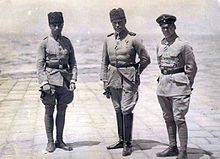
Otto Liman von Sanders ( German: Otto Liman von Sanders ; February 17, 1855 , Stolp - August 22, 1929 , Munich ) - German general, military adviser to the Ottoman Empire during the First World War .
| Otto Lyman von Sanders | |||||||||
|---|---|---|---|---|---|---|---|---|---|
| him. Otto liman von sanders | |||||||||
 | |||||||||
| Date of Birth | February 17, 1855 | ||||||||
| Place of Birth | Stolp | ||||||||
| Date of death | August 22, 1929 ( 74) | ||||||||
| Place of death | Munich | ||||||||
| Affiliation |  German Empire German Empire Ottoman Empire Ottoman Empire | ||||||||
| Type of army | |||||||||
| Years of service | 1874-1919 | ||||||||
| Rank | lieutenant general mushir | ||||||||
| Part |
| ||||||||
| Commanded |
| ||||||||
| Battles / wars | World War I :
| ||||||||
| Awards and prizes |
| ||||||||


Content
Early years
Lyman von Sanders' father was a Prussian nobleman [1] . Like many other Prussians of noble origin, he joined the army, where he rose to the rank of lieutenant general. In 1913, he was appointed head of the German military mission in the Ottoman Empire .
In the Ottoman Empire
After the defeat in the First Balkan War, Turkey urgently needed modernization of the army. At the end of 1913, the great vizier Said Halim Pasha turned to Kaiser Wilhelm II with a request to send German officers under the command of an experienced general for this purpose. Kaiser chose von Sanders for this. Shortly after arriving in Istanbul, the general met with Sultan Mehmed Reshad , the great vizier and the ruling triumvirate of the Young Turks . Sanders found a common language with everyone except Enver Pasha , whom the German general considered too inexperienced for the post of army leader. For his part, Enver was dissatisfied with the fact that the army would obey a foreigner [2] .
In July 1914 (just before the start of the war) Enver Pasha invited Germany to conclude an alliance. The German ambassador in Constantinople , Hans von Wangenheim , after consulting with von Sanders, declined the offer. The refusal was motivated by the fact that the Turkish army is weak, the economy is going through hard times, and the Turkish leadership itself was not competent enough. However, on July 20 ( August 2 ), the German and Ottoman governments signed a secret treaty of military alliance; the terms of the agreement, among other things, included a clause on the “influence” of the German military mission on the actions of the Turkish army [3] . At first, this influence was practically absent, but in view of the relative failures of the Turks, the Germans tightened control over the actions of the Ottoman troops.
When the Ottoman Empire finally entered the war (after two months of trying to avoid a direct conflict with the Entente), Enver Pasha showed von Sanders his plan to defeat Russian defense at Kars . Von Sanders tried to dissuade Enver from implementing the plan, but his advice was ignored, and this operation turned into a disaster for the Turks at Sarykamysh . The war continued: Dzhemal Pasha received an order to force the Suez Canal ; his adviser was the German general Friedrich von Kressenstein . The attack on Suez was failed, however, the Turks did not suffer significant losses.
The hesitant Enver Pasha arrived at Constantinople, where he led the troops located in the area of the capital. The task was to prevent its capture by the troops of the Entente . Soon Enver transferred command to von Sanders.
The Battle of Gallipoli
Von Sanders had little time to organize defense - only a month, but he had two advantages. Firstly, the Ottoman 5th Army was the best military unit of the Turks, it included 6 divisions , with a total of 84,000 well-armed soldiers. Secondly, he took advantage of the mistakes of the Allied command : instead of using a powerful fleet to break directly to Istanbul, the British and French admirals decided to land in order to capture the Dardanelles .
On April 25, 1915, the main British forces landed at the Hellespont . The correct decision of von Sanders was the appointment of Kemal Pasha as commander of the 19th Infantry Division. Kemal’s division saved the Turks from an imminent disaster. His soldiers made a march on the day of the invasion and took the defensive line above the landed Australians and New Zealanders, so their progress was difficult. The defense organized by Kemal Pasha was reliable and did not fail in the next five months.
From April to November 1915 (when the decision was finally made to evacuate), von Sanders had to defend himself from numerous allied attacks. The British tried to break into the Suvla region, but this also did not bring success. The only achievement of the British was that they managed to do without major losses. However, the victory was for the Turks , and Lyman von Sanders made a significant contribution to this.
In early 1915, the previous head of the German military mission in the Ottoman Empire, Baron Colmar von der Goltz , arrived in Constantinople as a military adviser to Sultan Mehmed V (who had no actual power). The old baron did not want to deal with Liman von Sanders and did not like the Young Turk triumvirate ( Enver Pasha , Dzhemal Pasha , Talaat Pasha ), who led the country during the war. A series of major offensives proposed by von der Goltz ended in nothing, in the face of the advance of the Entente forces on three fronts ( in the Dardanelles , the Caucasus and the recently opened Mesopotamian front ). In October 1915, Enver Pasha sent Lyman von Sanders to fight with the British in Mesopotamia.
Palestinian Campaign
In 1918, in the last year of the war, when the Ottoman Empire was essentially agonizing, Lyman von Sanders took command of the Turkish forces in Palestine , replacing another German general, Erich von Falkenhain , who was defeated by the British under General Allenby at the end 1917 year.
The position of Liman was not easy due to the low combat efficiency of the Turkish army. His troops were only capable of defensive actions. The defense lasted quite a while, but when General Allenby’s troops broke through the front, the Ottoman army was destroyed within a week ( Battle of Megiddo ). The fled von Sanders almost got captured by the British troops.
After the war, in February 1919, von Sanders was detained in Malta . He was accused of war crimes, but six months later he was released and resigned.
In 1927, von Sanders published memoirs about his service in the Ottoman Empire before and during the war, which he wrote in captivity in Malta. Two years later, he died in Munich at the age of 74.
Rewards
- Order of the Red Eagle , 2nd degree (Prussia)
- Order “ Pour le Mérite ” with oak leaves (Prussia, January 10, 1916)
- 1st Class Iron Cross (Prussia)
- 2nd Class Iron Cross (Prussia)
- Gallipoli Star Medal (Ottoman Empire, 1915)
- 1st Class Ottoman Order (Ottoman Empire, January 24, 1915)
- Imtiyaz Medal with Sabers (Ottoman Empire, March 10, 1915)
- Order of Medjidie (Ottoman Empire, August 12, 1918)
Notes
- ↑ Bernt Engelmann, "Germany without Jews." Translated from German by DJ Beer, New York: Bantam Books, 1984, p. 132
- ↑ Rogan, 2017 , p. 67.
- ↑ A Peace to End All Peace: The Fall of the Ottoman Empire and the Creation of the Modern Middle East David Fromkin. Owl Books. 636 pages. 2001. ISBN 0-8050-6884-8
Literature
- Zalessky K. A. Who was who in the First World War. - M .: AST ; Astrel, 2003 .-- 896 p. - 5,000 copies. - ISBN 5-17-019670-9 (ACT); ISBN 5-271-06895-1 (Astrel).
- Kotov B. S. “German Bosphorus”: the mission of Lyman von Sanders in the responses of the Russian press // Bulletin of the Samara Scientific Center of the Russian Academy of Sciences. 2012. Volume 14. No. 3. P. 127-134. - ISSN: 19905378
- Eugene Rogan The fall of the Ottoman Empire. World War I in the Middle East, 1914–1920 = The Fall of the Ottomans: The Great War in the Middle East. By Eugene Rogan. . - M .: Alpina Non-fiction, 2017 .-- 560 p. - ISBN 978-5-91671-762-4 .
Links
- Otto Liman von Sanders biography on the Chronos website
- World War One.com Short biography. January 2006.