The needle-tailed swift [1] , or the spiny-tailed swift [2] , or the spiny - tailed swift [2] ( lat. Hirundapus caudacutus ), is a species of bird from the swift family [3] .
| Needletail Swift |
 |
| Scientific classification |
|---|
| No rank : | Bilateral symmetrical |
|
| International scientific name |
|---|
Hirundapus caudacutus ( Latham , 1801 ) |
| Area |
|---|
|
| Security status |
|---|
Least ConcernedIUCN 3.1 Least Concern : 22686677 |
|
Content
Large swift. The body is 19–22 cm long. Weight is 100–175 g. The wing is 19.8–22.0 cm. The wingspan is 48–55 cm [4] . Unlike other swifts, the tail without a notch, directly cut off, the shaft of each steering pen protrudes 3-5 mm outward in the form of a needle [5] . The forehead, throat and undertail in adult birds are white. The wings are long, crescent. The wings are black or dark brown with a metallic sheen and a green tint. On third degree feathers, elongated white spots.
The back is clayey-gray, light brown. goiter , chest and abdomen black-brown. On the legs, 3 fingers are directed forward, and 1 - backward, the foregrip is not feathered.
Young birds from afar are indistinguishable from adults, but differ in a dimmer plumage with a weak tint and a narrower white stripe bordering the abdomen.
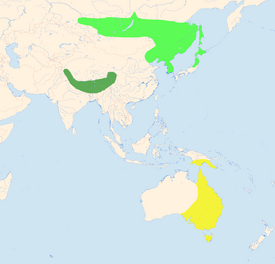
Torn area. One part of the range is located in South and Southeast Asia, the other is located in the south of the Far East and Siberia - from Northeast Altai to Sakhalin , in the west - to the Tomsk region. In Russia, a very rare species, although in some places common [4] .
It inhabits forests and groves with old hollow trees, forest habitats combined with meadows, clearings, open spaces. Willingly settles near ponds.
Poorly studied. Migrant. They arrive at the end of May. Keeps in the air in packs, never lands on the ground [6] . The flight is extremely fast, swift [6] . It is considered the fastest bird in the fauna of Russia; it has a speed of up to 160 km / h [4] . The scream is not loud, rattling, in contrast to other types of swifts - they are silent. Fly off in September, winter in Australia.
Breeds in hollows of trees at various heights. The hollow can be deep, reaching several meters. In the clutch there are 3–7 white eggs measuring 30–35 × 21–24 mm [4] . Adult birds cannot take out shells and litter of chicks from nests.
- ↑ Database "Birds of the Russian Federation" on the website of the A. N. Severtsov Institute of Ecology and Evolution .
- ↑ 1 2 Boehme R. L. , Flint V. E. The Bilingual Dictionary of Animal Names. Birds. Latin, Russian, English, German, French / Ed. ed. Acad. V. E. Sokolova . - M .: Rus. lang., "RUSSO", 1994. - S. 152. - 2030 copies. - ISBN 5-200-00643-0 .
- ↑ Gill F. & Donsker D. (Eds.): Owlet-nightjars, treeswifts, swifts . IOC World Bird List (v9.2) (June 22, 2019). doi : 10.14344 / IOC.ML.9.2 .
- ↑ 1 2 3 4 Ryabitsev V.K. Birds of the Urals, Urals and Western Siberia. - M.: 2001.
- ↑ Vtorov P., Drozdov N. Key to birds of the fauna of the USSR. - M .: 1980.
- ↑ 1 2 Boehme R. L., Kuznetsov A. A. Birds of forests and mountains of the USSR. - M .: Education, 1981. - 223 p., Ill., 24 p. silt
- Vtorov P.P. , Drozdov N. Identifier of birds of the fauna of the USSR . - M .: 1980.
- Ryabitsev V.K. Birds of the Urals, Urals and Western Siberia. - M .: 2001.
- Boehme R. L., Kuznetsov A. A. Birds of the forests and mountains of the USSR. - M .: Education, 1981. - 223 p., Ill., 24 p. silt