Sigbert I ( 535 - November / December 575 ) - King of the Franks in 561-575 from the Merovingian dynasty .
| Sigebert I | |||||||
|---|---|---|---|---|---|---|---|
| lat Sigibertus , fr. Sigebert i | |||||||
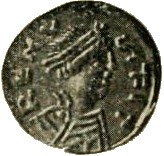 Golden tremis of the Frankish king Sigibert I, minted at Reims . National Library of France , medals room, Paris | |||||||
| |||||||
| Predecessor | Hlotar i | ||||||
| Successor | Childebert II | ||||||
| Birth | 535 | ||||||
| Death | November / December 575 (40 years) Vitry-en-Artois | ||||||
| Rod | Merovingians | ||||||
| Father | Hlotar i | ||||||
| Mother | Ingunda | ||||||
| Spouse | Brunhilda | ||||||
| Children | son: Childebert II Daughters: Ingunda , Chlodosvinta | ||||||
Biography
Origin
Sigbert I, whose name translates from Frankish as “The Brilliant Winner” , was the son of King Hlothary I and Ingund [1] .
Kingdom of Sigebert I
In the division of the Frankish kingdom, Sigibert inherited its northeastern part, which was considered the "kingdom of Theodoric I ". Its official capital was Reims [2] , but its present center of gravity was in the valley of the Moselle and Middle Rhine rivers, where the main city was Metz [3] , since this kingdom expanded considerably in the direction of Thuringia , Saxony , Alemannia and Bavaria , to the borders of the Slavs . Compared to the other parts of the Frankish state in the kingdom of Sigebert, there were most of the peripheral duchies that needed to be controlled and the borders that had to be protected. Apparently, Sigebert himself chose this territory, which could be expanded in different directions, because he had already shown his military talents, taking part with his father in the campaign of 555 years against the Saxons . [4] In addition, Auvergne , Velaye , Zhevodan, and Ruerg were annexed to the kingdom of Sigebert , as well as a part of Provence with the cities of Marseille , Avignon and Ises , which were conquered by the kings Theodoric I and Theodebert I. These lands provided significant fiscal resources, and they were inhabited by Roman families dedicated to law and literature. The kingdom of Sigebert quickly acquired a paradoxical appearance: it was distinguished by a penchant for military adventures, and at the same time it was ruled by pedantic officials.
In the 6th century, the name of the kingdom of Sigebert was not yet established. The terms “kingdom of Theodoric”, “ Belgika ” or “ Franconia ” were equally used. Gregory of Tours first defended the word Austrasia [5] , which later caught on in the name of this kingdom.
High dignitaries and advisers
Quite a little is known about the highest dignitaries of the Austrazian palace, and we know many of them only by their names. So it is known that the post of referendum was held by a certain Siggon; as the head of the office, he had to keep the seal of Sigebert with him. [6] The palace treasurer, who was in charge of the royal treasury, was called Haregisel; Gregory of Tours disliked him, because he had made his entire career in the palace and used his legal and accounting skills to break free. [7] The last of the top officials. who can be identified - the count of the palace, who was supposed to take court on important matters in the absence of the king; His name was Tsiutsilon. [8] In the immediate environment of the royal couple was also a goth named Sigil [7] , but what post he held is unknown; Perhaps it was one of the people who came with Brünnhilde in 556 , but could also be a defector accepted by the Franks.
Wars with the Avar Khaganate
In 561, after the death of King Hlothari I, the Avars invaded Gaul , into the possession of King Sigebert. By this time, the Avars occupied the lower Danube region, and from where they made raids up to Thuringia . Sigebert spoke out against them and, joining them in battle, defeated them and put them to flight. However, later their kagan, through ambassadors, achieved friendship with Sigebert. But at the time when Siegbert was occupied by the Avars, his brother Chilperic I captured Reims and some other cities that belonged to Siegebert. Because of this, an internecine war arose between them. When the winner of the Avars, Siegbert, returned, he occupied the city of Soissons , captured the son of King Chilperic Theodobert who was there and took him into custody. He then marched against Chilperic and engaged him in battle. Having won and turned him to flight, Sigebert re-established his right to rule over his cities. He ordered the son of Chilperic Theodobert to be kept in the Pontion villa (in Champagne ) for a year. Since Sigebert was a kind-hearted man, he sent him later unscathed to his father, giving gifts, but he first took an oath from him that he would never do anything against him. However, later Theodobert repeatedly broke this oath [9] .
Probably from 566, the eastern frontiers of Austrasia were threatened by a new raid by the Avars. Since this people sometimes went to the mercenaries to the Byzantines, it is possible that the emperor sent them against Siegebert to prevent him from attacking Italy . Sigigert came out against them with a large army, but was utterly defeated by them. Grigory of Tours considered himself obliged to justify this defeat, citing the fact that the Avars, like true pagans, had resorted to magic: ghosts appeared on the battlefield and frightened the Austrazian warriors. Sigebert's army turned to flight, and he himself was captured by the Avars and was kept under guard until he was ransomed from captivity. After this, Sigebert concluded an agreement with the Avar Khagan that never in their lifetime there would be any war between them. The position of this Christian monarch, concluding an alliance with the pagans, confused Gregory of Tours. Since this chronicler depended on Sigebert, he confined himself to an ambiguous statement: “And this [contract] is rightfully regarded as praise to him than dishonor” . [10] But Gregory makes it clear that many thought otherwise.
Siegebert Marries Brünnhilde
Sigebert, seeing that his brothers elect wives who are not worthy of themselves, and marry even with maids in their caprice, sent an embassy to Spain with rich gifts, and ordered to request the hands of the youngest daughter of the Visigoths Atanagilda Brunnhilde ( Fredegar in his Chronicle reports that the daughter of Atanagilda , Sigebert's bride, was called Bruna, and after her marriage she was given the name Brunnhilde [11] ). Atanagild agreed and in 566 this wedding took place. Grigory of Tours notes that Brungilda was a girl of fine upbringing, beautiful, good-natured, noble, intelligent, and pleasant to talk to. She was of the Arian religion , but due to the instructions of the bishops and the insistence of the king herself was converted to the Orthodox Nicene faith [12] .
Brother Guntram's conflict
In the same year, Sigebert wished to seize the city of Arles , which belonged to his brother Guntramn . To this end, he ordered the inhabitants of Clermont to go camping. The army was headed by the count of this city Firmin. Sigebert's other army commanded by Adovaria approached Arles from the other side. The inhabitants of Arles had no choice but to open the gate in front of them. Taking possession of this land, the Australians demanded that the people take the oath of allegiance to Sigebert. Thus, it was not just a predatory operation, but an attempt to conquer. Apparently, Sigebert remembered well that at one time Harlem was owned by Theodebert I , one of the former Kings of Austrasia, who even organized circus games here in imitation of ancient emperors. Probably, Sigebert believed that it was he who had to depart this ancient city, which at one time even the capital of the Roman Empire , whose architectural decoration, although it had come into severe decline, was still impressive.
This daring raid alarmed Guntramn, who sent an army commanded by patrician Celsus. Celsus stepped forward and took the city of Avignon , belonging to Siegebert. Then he approached Arles, surrounded him and began to besiege the city, where Siegebert's army was locked up. According to Grigory of Tours, Sigebert's army could defend the city if the local bishop of Sabaud did not change the oath of allegiance, making it easier for Guntram to win. He advised the soldiers of Siegebert to make a sortie. But, defeated by the army of Celsus, they fled and, approaching the city, found its gate closed. And since the spears were at their backs and the townspeople’s stones were at the top, they headed towards Ron and tried to cross to the other side. Riding on the shields along the river, they could hardly reach a level place to go ashore. But many of them drowned, caught up in a turbulent current. Without things, without horses, they returned to their homeland with great shame. So King Guntramn again received his city, and he returned to the possession of his brother, by his usual kindness, by his usual kindness [13] .
Killing the Galezvintas
Sigebert's brother Chilperic also sent envoys for the Pyrenees to ask his wife Brunnhilda Galeswint ( 567 ) to be his wife. Atanagilda didn’t want to marry a libertine, and he did it only after Chilperic had vowed that he would keep the queen in love and honor, and send all the concubines out of court. For a while, Khilperic kept his promise, but soon the intrigues of King Fredegond 's former concubine bore fruit: Galeswint was bored by the king, and he wanted to get rid of her. One morning the queen was found strangled in her bed, and rumor began to blame for the murder of Chilperic himself. Fredegond returned to the court of the undisputed mistress and soon became known as the new queen [14] .
Treaty between Chilperic and Sigebert
The assassination of Galeswinta in 568 caused ancestral revenge on the part of her sister Brünnhilda and her husband Cygibert. Sigebert sent messengers to Guntramn , who, perhaps, from obedience to folk customs, or because Chilperic ’s heinous crime drove him out of the family, stuck to the offended side. After that the war began. Siegebert, excited by the revenge of his wife Brünnhilde, who had unlimited power over him, and who suddenly discovered his highly ardent character, wanted to fight to the last extreme, without stopping even the thought of fratricide. But Guntram, in his Christian sense, or in his weakness of will, soon changed his role as an ally to the role of mediator. By asking and threatening, he forced Siegebert to convene the people for a public trial and wait for his sentence. According to “the sentence of the glorious king Guntram and the noble men sitting in Malberg : the cities of Bordeaux , Limoges , Cahors , Béarn and Bigorr , who Galeswint, the sister of the most excellent Madame Brunhilde, received on her land in the land of Franks , as everyone knows, in the morning gift , the widow's plot, will be transferred from this day to the possession of Queen Brünnhilde and her heirs, so that, through such a fine, the peace of God between the glorious sovereigns Chilperic and Sigibert is now restored . ” The meeting broke up, and both kings separated, apparently reconciled ( 569 year ).
Chilperic violates the contract
But Chilperic could in no way be akin to the thought that he should obey the decision of the court; on the contrary, he hoped to regain his cities with time or reward himself at the expense of Sigebert's possessions. This plan, which had been ripened and kept secret for almost five years, suddenly showed up in 573 , when Chilperic set out to take away from Sigibert the cities of Tours and Poitiers, after Haribert died. To this end, he gathered an army in Angers under the command of Clovis, his youngest son from the Audovers . The latter, without declaring war, went on the Tour and captured this ancient, well-fortified city, without encountering resistance. The fact is that King Siegbert, like both other kings, held permanent garrisons only in those cities where they themselves stayed, and city dwellers who were entirely or almost completely Gallo-Romans had little interest in which of the Frankish kings will belong to. Having captured Tours, Hlodvig set off for Poitiers, which he captured with the same ease, and settled in him, since he was the central point between Tours and the cities of Limoges , Caorus and Bordeaux , which he still had to conquer [15] .
Guntramn intervenes in the conflict of his brothers
Learning of the surprise attack, King Sigebert sent for help to Brother Guntramn . The participation that Guntramn took five years ago in the reconciliation of the two kings seemed to impose on him a certain duty of the judge towards him, the right to recover from someone who did not keep the word and violated the popular verdict. With this thought, consonant, however, with a penchant for justice, which constitutes a special feature of his character, he took upon himself the task of taming Chilperic’s hostile attempt on his life, and forcing him to submit again to the conditions of the sentence of the Franks . Guntramn sent an army against Chlodwig under the leadership of his best commander Eonia Mummola , a Gallo-Roman [15] .
Mummol marched from the capital of the Burgundian kingdom of Chalon-on-Sone and went to the city tour along the road through Nevers and Bourges . As he approached, young Chlodwig, who had returned to Tours with the intention of withstanding a siege there, decided to retreat, and, waiting for reinforcements, took a comfortable position on his way to Poitiers , near this city. Meanwhile, the touring citizens peacefully accepted the Gallo-Roman leader, who occupied the city in the name of King Sigebert, and swore allegiance to him. In the meantime, the expected reinforcements under the command of Seager and Basil approached the Hlodwig camp near Poitiers; the first was a franc, the second Gallo-Roman, both zealous supporters of King Chilperic . It was a large but poorly disciplined army, consisting mostly of serfs and free peasants. Despite their courage and even bitterness in battle, Seeger and Basil could not block the way to Poitiers with the greatest or, better to say, the only tactic of that time. Attacked from the front and from the flank, they were overwhelmed with enormous losses on the Clovis francs, who immediately fled and scattered. Both commanders of the volunteers fell, and Chlodwig, not having enough people to defend Poitiers, turned to flee on the way to St. Having seized the city of Poitiers after such a victory, Mummol considered his assignment completed, and, forcing the citizens, like in Tours, to swear allegiance to King Sigibert, returned to Burgundy, not finding it necessary to pursue the Nestrians [15] .
Hlodvig, meanwhile, fearing to meet the barrier to retreat to the north or, perhaps, from a youthful distance, instead of moving to Angers , continued to follow in the opposite direction and headed for Bordeaux , one of the five cities that he was ordered to seize. He came with a handful of poorly equipped people to the city wall, and the gates were opened to him. This is an amazing fact, from which the governmental impotence of the Merovingian royal power is clearly revealed. In such a big city there were not enough troops to protect the rights of Queen Brunnhilde and the supreme power of King Siegebert from a crowd of fugitives, homeless and emaciated. Clodvig stayed in Bordeaux for a month, until the Duke of Sigulf, a citizen of the King of Australia , guarding the frontier or the Iberian mark, launched a surprise attack on him. Clovis and his men fled, leading the way through Angers. Sigulf pursued them, but without success [16] .
Theodebert violates the oath given to Sigebert
Such an insignificant end of the campaign, so defiantly undertaken, brought Chilperic to his soul a dark and furious annoyance. Deciding to revenge brilliantly for insulting his honor, he gathered an army on the banks of the Loire , much more numerous than the first, and entrusted his superiors to Theodebert, the eldest of his sons, who had once been captured by Siegebert and gave him an oath to mend harm against him. Cautious Guntramn reasoned this time that his secondary intervention would be useless to reconcile the brothers and, of course, was destructive to him. Refusing to mediate, he ordered so that in case of failure could stay away and not interfere in the feud. He laid the charge for the reconciliation of both kings on the spiritual council; according to his order, all the bishops of the kingdom, who by their position did not participate in the royal quarrel, gathered in the neutral city of Paris , where, according to a separate agreement, none of the sons of Chlothar I could enter without the consent of the other two. The Council sent the most convincing messages to the Nestrian king, asking them to keep the peace and not to encroach on the rights of the brother. But the speeches and messages were useless. Chilperic, not listening to anything, continued to prepare for war [16] .
Meanwhile, Theodebert crossed the Loire and moved to Poitiers , where the Austrazians concentrated their forces. The commander of the Austrazian army in Aquitaine, Gundovalwal, was imprudent to give a battle to the Neistrians , who were much more numerous, and was defeated. Theodobert joined Poitiers, and, owning this city in the center of Austrian Azvitania, he could freely move to each of the cities, which he was ordered to take. He chose the direction of the north and entered the tour of the land lying on the left bank of the Loire. Whether by his father’s order, or according to his own understanding, he waged a fierce war, spreading everywhere where he underwent murder and devastation. With horror, the citizens of Tour saw clouds of smoke from their walls, which spoke of the fires of neighboring villages. Although they were associated with King Sigibert with a sacred oath, however, drowning out religious fears, they surrendered to the will of the victor, begging him to be merciful [16] .
Having conquered Poitiers and Tours, the Nastrian army laid siege to Limoges , who opened the gates to him himself. From Limoges, Theodebert went to Cahors . The long way of his army was marked by the destruction of villages, the robbery of houses and the desecration of shrines. Temples were devastated and burned, priests killed, monks offended and monasteries destroyed to the ground. When hearing about such devastation, the general fear spread throughout Aquitaine, from the banks of the Loire to the Pyrenees [16] .
Zarein tribes come to the aid of Siegebert
While these events took place in Aquitaine, King Sigebert collected all his forces. Cigbert called for arms not only the Franks who lived on the banks of the Meuse , the Moselle and the Rhine , but also all the Germanic tribes who lived on the other side of the Rhine. These were the Sweves , or Swabians, and Alemanni , then the Thuringians and Bavars , who maintained their nationality under the rule of the hereditary dukes, and, finally, several nationalities of Lower Germany, who left the formidable Saxon League in good faith or coercion. The news of this great armament in Austrasia caused anxiety not only among Chilperic’s subjects, but also among Guntramn’s subjects, who himself shared their fears. Therefore, he favorably responded to the request for help, which Chilperic addressed to him. Chilperic moved his forces to the eastern part of the Seine in order to protect the passage through it. Guntramn, for his part, occupied the northern border with troops, which was not protected by natural barriers [17] .
In 574, the troops of the King of Australia after a few days of march arrived in the area adjacent to Arsis-on-Oba . From there, in order to invade the kingdom of Chilperic, Sigebert had to pass through the lands of Guntramn. Siegebert categorically demanded permission from Guntramn. The king of Burgundy did not dare to resist Sigebert’s huge wild army and agreed to the passage of these troops across the Troyes . In this city, he had a date with Sigibert and vowed to him an indestructible peace and sincere friendship. Learning about this betrayal, Chilperic hurried to leave his position on the left bank of the Seine and retreat deep into his kingdom. After useless efforts to slip away from his enemy, he asked for peace. Sigebert, despite his obstinate character, was, however, generous. He agreed to consign all to oblivion, so that the cities of Tours , Poitiers , Limoges and Cahors should be immediately returned to him, and Theodobert’s army would return for Loire [17] .
Both kings seemed very pleased with each other, but there was strong discontent in the Austrian army. The troops recruited beyond the Rhine grumbled at an unexpected world that had deprived them of the spoils they had hoped to acquire in Gaul. With difficulty pacifying the rebellion that was about to begin, Sigebert moved the army back to the banks of the Rhine. The army went on the Paris road, but did not enter this city, because Sigebert, faithful to his obligations, respected his inviolability. In the course of the journey, the Austrazian troops ravaged the places they passed through, and the outskirts of Paris remembered their invasion for a long time. Most of the villages and villages were burned, houses were looted, and many soldiers were taken into captivity, as the king could not warn or stop such violence. Moreover, the northern possessions of Guntramn were also defeated. This caused a rift between Sigebert and Guntramn and forced the latter to once again side with Chilperic [17] .
Theodebert's Death
The peacefulness of Chilperic was short-lived. Seeing himself out of danger, he returned to his constant thoughts and again turned his greedy eyes on the Aquitaine cities. The quarrel that arose between the brothers Guntramn and Sigebert seemed to him a favorable circumstance for the resumption of his enterprise. Having concluded an alliance with Guntram, and in full hope of success, in 575, Chilperic again sent his son Theodobert for the Loire, and with the army entered the territory of Reims , which formed the western limit of the Australian kingdom. His invasion was accompanied by the same devastation as Theodebert's war in Aquitaine: he burned the villages, destroyed the harvest and robbed everything that could be taken with him [18] .
Siegebert again called for the Eastern Franks and Zarean tribes and moved to the aid of the Rheim province. When he approached, Chilperic, avoiding battle, as in the previous company, began to retreat down the river Marne and went to the lower course of the Seine . Cigbert pursued him all the way to Paris and occupied this city, despite the oaths he had brought eight years ago. Located in Paris, King Sigebert first sent troops against Theodobert, who, repeating his last year’s company, had just entered Limoges [18] .
The Australian dukes Godegizel and Guntramn , nicknamed Bose (that is, “Evil”), recruited, although poorly armed, but rather numerous militia in the regions of Chateaudun and Vandom , approached Limoges. Theodobert spoke to them and took up a position on the banks of the Charente , near Angouleme . During the transition part of the troops fled, so that before the start of the battle, he was almost all abandoned. Despite this, he fought with great courage and was killed in a fight. The Gallic villagers, who formed the army of Godegizel and Guntramn Bose, without respect for the long hair that distinguished the son of King Chilperic from the others, robbed him along with other corpses and left him naked on the battlefield. An Australian leader named Arnulf, although an enemy of Theodobertus, buried him at his own expense in Angouleme [18] .
Neistrians ask Sigebert to be their king
Meanwhile, King Guntram, secondly yielding to his peace-loving inclinations or prompted by fear, reconciled with Siegebert. Chilperic, brought to complete despair by this double misfortune, left the banks of the Seine, hastily passed through his whole kingdom and took refuge behind the walls of Tournai with his most faithful people [18] . Крепкое положение этого города, первоначальной столицы Франкского государства, побудило Хильперика избрать в нём убежище. В ожидании осады он занялся набором людей и пополнением боевых запасов, пока Сигиберт, свободный в своих движениях по всей Нейстрии, овладевал городами этого королевства. Заняв те города, которые лежали к северу и востоку от Парижа, он направился на запад, решив всё завоёванное, и города и земли, отдать в уплату своим зарейским воинам. Намерение это возбудило во всех франках, даже австразийских, сильные опасения. Австразийцы не желали иметь своих природных врагов соседями в Галлии, а нейстрийцы, со своей стороны, страшились утраты собственности, порабощения и всех бедствий, неразлучных с завоеванием страны. Нейстрийские знатные франки послали к Сигиберту послов с просьбой стать их королём. Сигиберт с радостью принял посольство и предложение нейстрийцев; он уверил их клятвой, что ни один город не будет предан войскам на разграбление, и обещал прибыть на собрание, где, по обычаю предков, его должны были провозгласить королём. Потом он совершил военную рекогносцировку до пределов Руана и, удостоверясь, что ни один из крепких городов на западе не намерен ему сопротивлятся, возвратился в Париж [7] .
Брунегильда , желая отклонить мужа от обращения к братской любви и для личного надзора за исполнением своего мщения, оставила город Мец и прибыла к Сигиберту в Париж. Она была так уверена в несомненности своего торжества, что предприняла это путешествие с обеими дочерьми, Ингундой и Хлодосвинтой, и сыном Хильдебертом , четырёхлетним ребёнком. Повозки с её имуществом были наполнены сокровищами и всем, что только было у неё лучшего из золотых уборов и драгоценных вещей. Сигиберт, послав часть войска обложить Турне и начать осаду, сам же прибыл в Витри , на реке Скарпе, где намечалось провести собрание для провозглашения его королём западных франков [7] .
Убийство Сигиберта
Осаждённый в Турне и считавший своё положение почти безнадёжным, король Хильперик ждал развязки с каким-то бесстрастием. В тот момент не растерялась только Фредегонда: она подговорила двух убийц, и те, пройдя через австразийский лагерь, добились приёма у Сигиберта и закололи его смазанными ядом кинжалами, сами пав от рук его стражников ( ноябрь / декабрь 575 года ). Убит Сигиберт был на 14-м году своего правления, сорока лет от роду и всего через 18 дней после смерти Теодеберта. Австразийцы, узнав о смерти своего короля, сняли осаду Турне и ушли в свою страну. Хильперик прибыл в Витри и предал со всеми почестями тело брата земле в деревне Ламбре на Скарпе. Впоследствии его останки перенесли отсюда в Суассон, в построенную им же самим базилику святого Медарда . Его погребли рядом с его отцом Хлотарем [7] .
После смерти Сигиберта его жена Брунгильда с детьми оставалась в Париже. Хильперик прибыл в Париж, захватил Брунгильду и отправил её в изгнание в город Руан, а её сокровища присвоил себе. Однако маленький сын Сигиберта Хильдеберт ускользнул. Предводитель рейнских франков Гундовальд укрыл его, затем перевёз в центр отцовского королевства, где верные Сигиберту люди провозгласили мальчика своим королём [19] . Кроме того, он получил поддержку со стороны своего дяди Гунтрамна.
Family
Жёны и дети
- С 566 года — Брунгильда (букв. «Закованная в броню воительница» ). Дети от этого брака:
- Ингунда (567/568 — 585/586) — в 579 года выдана замуж за старшего сына вестготского короля Леовигильда Герменегильда
- Хильдеберт II (570 — март 596) — король Австразии с 575 года
- Хлодосвинта (575/576 — после 594) — в 587 году была помолвлена с королём вестготов Реккаредом I , но свадьба не состоялась.
Средневековые хронисты считали детьми короля Сигиберта и Брунгильды также Бальдерика, Бову и Анхиза (они упоминаются в «Истории Реймсской церкви» Рихера), но современные историки не поддерживают такой идентификации. Однако в ряде современных книг, особенно церковной тематики, их продолжают называть королевскими детьми [20] .
Pedigree
| 16. Меровей, вождь франков | ||||||||||||||||
| 8. Хильдерик I, король франков | ||||||||||||||||
| 17. Хлодосвинта | ||||||||||||||||
| 4. Хлодвиг I, король франков | ||||||||||||||||
| 18. Медельф Тюрингский | ||||||||||||||||
| 9. Базина Тюрингская | ||||||||||||||||
| 19. Базина Саксонская | ||||||||||||||||
| 2. Хлотарь I, король франков | ||||||||||||||||
| 20. Гундиох, король бургундов | ||||||||||||||||
| 10. Хильперик II, король бургундов | ||||||||||||||||
| 21. неизвестно | ||||||||||||||||
| 5. Клотильда Бургундская | ||||||||||||||||
| 22. неизвестно | ||||||||||||||||
| 11. Агриппина | ||||||||||||||||
| 23. неизвестно | ||||||||||||||||
| 1. Сигиберт I, король франков | ||||||||||||||||
| 24. неизвестно | ||||||||||||||||
| 12. Бизин, король Тюрингии | ||||||||||||||||
| 25. неизвестно | ||||||||||||||||
| 6. Бадерих, король Тюрингии | ||||||||||||||||
| 26. Медельф Тюрингский | ||||||||||||||||
| 13. Базина Тюрингская | ||||||||||||||||
| 27. Базина Саксонская | ||||||||||||||||
| 3. Ингунда Тюрингская | ||||||||||||||||
| 28. неизвестно | ||||||||||||||||
| 14. неизвестно | ||||||||||||||||
| 29. неизвестно | ||||||||||||||||
| 7. неизвестно | ||||||||||||||||
| 30. неизвестно | ||||||||||||||||
| 15. неизвестно | ||||||||||||||||
| 31. неизвестно | ||||||||||||||||
Notes
- ↑ Gregory of Tours . History of Franks, Vol. IV , 3.
- ↑ Gregory of Tours . History of Franks, Vol. IV , 22.
- ↑ Gregory of Tours . History of Franks, Vol. IV , 35.
- ↑ Венанций Фортунат. Carm. VI, 1a, v. 11—12
- ↑ Gregory of Tours . History of Franks, Vol. V , 14.
- ↑ Gregory of Tours . History of Franks, Vol. V , 3.
- ↑ 1 2 3 4 5 Григорий Турский . History of Franks, Vol. IV , 51.
- ↑ Gregory of Tours . History of Franks, Vol. V , 18.
- ↑ Gregory of Tours . History of Franks, Vol. IV , 23.
- ↑ Gregory of Tours . History of Franks, Vol. IV , 29.
- ↑ Фредегар . Хроника, кн. III, 58, 81.
- ↑ Gregory of Tours . History of Franks, Vol. IV , 27.
- ↑ Gregory of Tours . History of Franks, Vol. IV , 30.
- ↑ Gregory of Tours . History of Franks, Vol. IV , 28.
- ↑ 1 2 3 Григорий Турский . History of Franks, Vol. IV , 45.
- ↑ 1 2 3 4 Григорий Турский . History of Franks, Vol. IV , 47.
- ↑ 1 2 3 Григорий Турский . History of Franks, Vol. IV , 49.
- ↑ 1 2 3 4 Григорий Турский . History of Franks, Vol. IV , 50.
- ↑ Gregory of Tours . History of Franks, Vol. V , 1.
- ↑ Book of the Saints, p. 37 (недоступная ссылка)
Literature
- Gregory of Tours . Franks history = Historia Francorum . - M .: Science , 1987. - 464 p.
- Фредегар . Хроника / / The Fourth Book of the Cronicle of Fredegar with its continuations. — London: Thomas Nelson and Sons Ltd, 1960.
- Дюмезиль, Брюно. Королева Брунгильда = La reine Brunehaut / Перевод с французского М. Ю. Некрасова. - SPb. : ЕВРАЗИЯ, 2012. — 560 с. - 3 000 copies — ISBN 978-5-91852-027-7 .
- Western Europe . // The rulers of the world. Chronological genealogical tables on world history in 4 vols. / Compiled by V. V. Erlikhman . - T. 2.
Links
- SIGEBERT I 561—575, CHILDEBERT II 575—596, THEODEBERT II 596—612, THEODERICH II 596—613, SIGEBERT II 613 (англ.) . Foundation for Medieval Genealogy. The appeal date is January 16, 2012.
- Sigibert I von Frankenkoenig (нем.) . Genealogie Mittelalter: Mittelalterliche Genealogie im Deutschen Reich bis zum Ende der Staufer. Дата обращения 16 января 2012. Архивировано 12 февраля 2012 года.