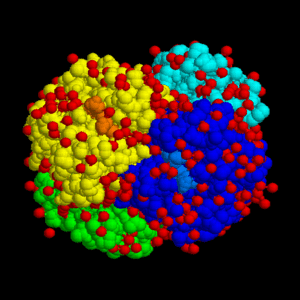
Hemoglobin molecule: 4 subunits are colored in different colors.

Haem - prosthetic hemoglobin group
Complex proteins ( proteids , holoproteins ) are two-component proteins in which, in addition to peptide chains (a simple protein ), a component of a non-amino acid nature is contained - a prosthetic group . During the hydrolysis of complex proteins, in addition to amino acids , the non-protein part or its degradation products are released.
Various organic ( lipids , carbohydrates ) and inorganic ( metals ) substances can act as a prosthetic group .
The following classes are distinguished among complex proteins depending on the chemical nature of prosthetic groups [1] :
- Glycoproteins containing covalently linked carbohydrate residues as a prosthetic group and their subclass are proteoglycans , with mucopolysaccharide prosthetic groups. Hydroxyl groups of serine or threonine are usually involved in the formation of bonds with carbohydrate residues. Most extracellular proteins, in particular immunoglobulins, are glycoproteins. In proteoglycans, the carbohydrate part is ~ 95%; they are the main component of the intercellular matrix .
- Lipoproteins containing non-covalently bound lipids as a prosthetic part. Lipoproteins formed by apolipoprotein proteins binding lipids to them and perform the function of lipid transport.
- Metalloproteins containing non-heme coordinated metal ions. Among metalloproteins there are proteins that perform deposition and transport functions (for example, iron-containing ferritin and transferrin ) and enzymes (for example, zinc-containing carbonic anhydrase and various superoxide dismutases containing ions of copper, manganese, iron and other metals as active centers)
- Nucleoproteins containing non-covalently bound DNA or RNA, in particular, the chromatin from which the chromosomes are composed, is a nucleoprotein [2] .
- Phosphoproteins containing covalently bound phosphoric acid residues as a prosthetic group. The formation of ester bonds with phosphate involves hydroxyl groups of serine or threonine, phosphoproteins are, in particular, milk casein [3] :
- Chromoproteins are the collective name for complex proteins with colored prosthetic groups of various chemical nature. These include many proteins with a metal-containing porphyrin prosthetic group that perform various functions - hemoproteins (proteins containing heme - hemoglobin , cytochromes , etc. as a prosthetic group), chlorophylls ; flavoproteins with a flavin group, etc.
Notes
- ↑ Author A.N. Nesmeyanov, N.A. Nesmeyanov. The beginning of organic chemistry. Book Two 221. Date of access December 26, 2012. Archived December 27, 2012.
- ↑ st. 743
- ↑ Author A.N. Nesmeyanov, N.A. Nesmeyanov. The beginning of organic chemistry. Book One 331. Date of access December 26, 2012. Archived December 27, 2012.