Project 11451 Small Anti-Submarine Ships (MPC) ( Sokol code, NATO code designation - Mukha class corvette ) is a type of small hydrofoil anti-submarine ship .
| Small anti-submarine ships of project 11451 | |
|---|---|
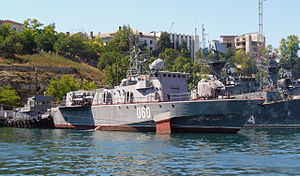 MPK-220 "Vladimir" | |
| Project | |
| A country |
|
| Manufacturers |
|
| Operators |
|
| Preceding type | project 1141 "Falcon" |
| Subsequent type | Project 11455 Krechet (not built due to the collapse of the USSR) |
| Years in operation | 1987 - 2013 |
| Scheduled | four |
| Built | 2 |
| Saved | one |
| Canceled | 2 |
| Scrapped | one |
| Main characteristics | |
| Displacement | 369 tons (standard) 422 tons (normal) 475 tons (full) |
| Length | 49.9 m (largest) 44.8 m (waterline) |
| Width | 9.98 m (body) 21.1 m (in wings) |
| Draft | 7.26 m (afloat on the wings) about 4.0 m (on the go) |
| Reservation | not |
| Engines | 2 × GGTA M10D (three-shaft) 1 × GGTA M16 |
| Power | 2 × 20 000 l. with. 1 × 10 000 l. with. |
| Speed | 65 knots (full [1] ) 50 knots (in still water) 45-47 knots (on a wave [2] ) 12 knots (economic) |
| Autonomy of swimming | 7 days |
| Fuel supply | 105 tons |
| Crew | 39 people [3] |
| Armament | |
| Navigational weapons | Radar station MR-220 |
| Radar weapons | RLSU JSC MP123-01 |
| Electronic weapons | SJSC “Star” - “Dawn” |
| Artillery | 1 × 1 × 76 mm AK-176 M |
| Flak | 1 × 6 × 30 mm AK-630 (on MPK-220 "Vladimir") |
| Missile weapons | 8 × MANPADS 9K38 “Needle” |
| Mine torpedo armament | 2 × 4 × 400 mm TA TR-224, 8 homing torpedoes SET-72 |


Serial production of these ships became possible after the development, construction and practical testing of the pilot ship Alexander Kunakhovich, project 1141 .
Content
Design
The ships of the project 11451 were technically somewhat different from the prototype ship:
- the engine consists of two gas turbine GTU M10D units with a capacity of 20,000 hp and one gas turbine M16 with a capacity of 10,000 hp (provides small and reverse) with a two-speed gearbox;
- instead of two side rudders, one middle was installed, which improved handling during wing travel;
- the geometry of the bow and stern wing devices has been changed, which has reduced the resistance to the movement of the ship;
- to provide maneuvering at low speed, two aft retractable swivel columns and a bow thruster are installed;
- torpedo tubes moved to the stern and made rotary;
- instead of the bow artillery mount (AU) AK-630M installed AU AK-176;
- the installation of a sonar complex (SAC) "M1-01 Star" with an increased detection range of submarines and an antenna immersion depth of up to 200 meters is provided.
In total, three ships were built, head 503 as part of the Ukrainian Navy, was not officially adopted.
Purpose
Ships were intended to perform the following tasks:
- Ensuring the deployment of fleet forces, including the SSBN (eliminating the likelihood of their destruction by enemy submarines upon leaving the base).
- Protection of naval bases .
- Protection of shock ships and convoys , search and destruction of enemy submarines in coastal areas.
Application Tactics
IPC features were high speed, lowered sonar station (OGAS) with a long range, powerful means of destruction of submarines. These features allowed the ship, as part of a search and strike group of 3-4 units, to carry out a spasmodic (helicopter) search for submarines. At the same time, the ship for a short time examines the water area with the help of the OGAS antenna, operating at a stop and descent to the depth of the best passage of the hydroacoustic signal (up to 200 meters). After completing the survey of the selected area, the IPC, lifting the antenna, at high speed switches to a new design observation point.
The average search speed is noticeably higher than that of anti-submarine defense (PLO) ships with conventional GAS antennae.
The first ship to establish contact with the submarine assumes the functions of a guide and ensures the continuous delivery of the coordinates of the target to the attacking ships.
It was assumed that the ship would be able to successfully solve the tasks of combating enemy submarines (PL) at a distance of up to 200 miles from the coast.
Armament
- 1 × 1 × 76 mm AK-176 M, MPK-220 Vladimirimetz installed 1 × 6 × 30 mm AK-630 M
- 2 × 4 × 400 mm TA TR-224
Project Representatives
| Title | Head No. | Bookmark Date | Launching | Inclusion in the Navy | Notes |
|---|---|---|---|---|---|
| MPK-215 | 501 | 04/17/1982 | 08/08/1987 | 12/31/1987 ( Black Sea Fleet ) | Retired March 15, 2001, disassembled for metal |
| MPK-220 " Vladimir " | 502 | 05/12/1984 | 08/20/1990 | 12/30/1990 ( Black Sea Fleet ) | Withdrew from the fleet in 2014, it is in the sludge in Sevastopol. Perhaps it will be converted into a museum. |
| Lugansk | 503 | 1989 | Built for the Ukrainian Navy . For 2007, the readiness was estimated at 98% [4] . | ||
| "Lviv" | 504 | 1990 | built for the Ukrainian Navy . For 2014, the readiness was estimated at 95%. |
Current status
As of 2013, the MPK-220 Vladimirimets was out of combat service of the Russian Navy [5] , but until 2014 it was listed on the Black Sea Fleet [6] . By order of the Commander of the Black Sea Fleet dated February 9, 2016, he was transferred from the category “armament and military equipment” to the category “military property”.
According to information that appeared in October 2014, the Feodosia More factory can build two highly unfinished MPCs of the Sokol project (factory 503 and 504) for the Russian Navy that are in a high degree of readiness, and therefore sent the corresponding appeal to the Russian Ministry of Defense [7] .
Notes
- ↑ Shown in trials in November 1987.
- ↑ At a wave height of 2.0-3.0 m
- ↑ State of 1987
- ↑ Lugansk corvette is 98% ready, but it doesn’t seem to be launched. (Russian)
- ↑ MPK-220 "Vladimir"
- ↑ Small anti-submarine ship "MPK-220" ("Vladimir")
- ↑ The shipyard in Feodosia proposed that the Russian Ministry of Defense build anti-submarine hydrofoil ships. 10/03/2014