
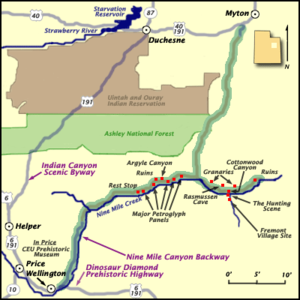
Nine Mile Canyon ( eng. Nine Mile Canyon , literally. Nine Mile Canyon ) is a canyon about 60 km long, located in the United States in the Carbon and Duchenne counties in eastern Utah . The name is associated with the length of the unpaved road that existed on the territory of the canyon in the 19th century.
The canyon enjoys a reputation as the “world's longest art gallery” due to the large number of petroglyphs found here, most of which were created by the Indians of the Fremont culture and the Utah tribe. In addition to rock paintings, archaeologists have discovered the remains of rocky dwellings and ancient granaries here. Also, the canyon is a popular place of pilgrimage for tourists.
In 1880, the canyon served as an important transport corridor in the region. European settlers founded here a few ranches and even the town of Harper, which existed for a short time [1] [2] . After in the 1910s. the message switched to more convenient roads, people left the canyon, and until recently only tourists visited it. The discovery of large natural gas deposits deep beneath the Tavaputs Plateau since 2002 led to an influx of industrial vehicles into these lands. A large number of harmful emissions from this vehicle threatens cave paintings. There is a public debate on how to find a reasonable balance between industrial and cultural interests [3] [4] . Another threat is vandalism (see photos below), and one of the forms of vandalism is the application of the sign “private property” directly to ancient images.
According to the most cautious estimates, the canyon presents at least 1,000 cave art specimens containing a total of about 10,000 individual images. [5] According to some estimates, the number of petroglyphs may be an order of magnitude higher; [6] In any case, there is no doubt that the number of petroglyphs in the canyon is the largest in all of North America. Most of the petroglyphs are knocked out in the rocks, some are painted with paints.
In addition to petroglyphs, researchers have discovered hundreds of ancient well-houses, rocky dwellings and granaries , although only a small part of them have been excavated to date. Many of these structures are located high above the canyon on rocky ledges and mesas . These dwellings were built by the Indians of the Fremont culture , who lived in the canyon in the period 950-1250. [7] In contrast to the cultures of hunters and gatherers surrounding them, the Fremontians were an agricultural crop, growing corn and pumpkin in a canyon. Unlike other places of distribution of the Fremont culture, few samples of their ceramics were found in the Nine Mile Canyon, which apparently indicates that there were no beans in the local diet that required long cooking. [8] Back in the 1930s, in the canyon, one could see the remains of the irrigation facilities of the Fremont culture, but as a result of modern cultivation, they disappeared. [9]
By the 16th century, the ancestors of the Utah tribe arrived in the canyon. In addition to the ancient drawings, the utah also performed their drawings on the rocks, but in their own style. Many images of the early 19th century depict Utah Indians on horseback. Despite the large number of Utah-related artifacts discovered in the canyon, there is no archaeological evidence of their camps or other permanent dwellings here. [ten]
Notes
- ↑ Barton, John D. A History of Duchesne County. - Salt Lake City: Utah State Historical Society, 1998. - P. 81–82. - ISBN 0-913738-41-7 .
- ↑ Carr, Stephen L. The Historical Guide to Utah Ghost Towns. - 3rd. - Salt Lake City, Utah: Western Epics, 1986. - P. 168. - ISBN 0-914740-30-X .
- ↑ Nine Mile Canyon . America's 11 Most Most Endangered Historic Places . National Trust for Historic Preservation (2004). Date of treatment May 8, 2009. Archived on April 6, 2012.
- ↑ Shaw, Richard . Proponents prepare to nominate Nine Mile to national register , Sun Advocate (March 17, 2005), S. 1. Date of access November 23, 2007.
- ↑ Spangler, Jerry D. Horned Snakes and Axle Grease: A Roadside Guide to the Archeology, History and Rock Art of Nine Mile Canyon. - Salt Lake City, Utah : Uinta Publishing, November 2003 .-- P. 141. - ISBN 0-9746090-0-5 .
- ↑ Kloor, Keith. Dirtraker (Eng.) // Archaeology : magazine. - Archaeological Institute of America 2007 .-- September – October ( vol. 60 , no. 5 ). - P. 40-45 . - ISSN 0003-8113 . ( Abstract )
- ↑ Watt, Ronald G. A History of Carbon County. - Salt Lake City: Utah State Historical Society, 1997. - P. 14–16. - ISBN 0-913738-15-8 .
- ↑ Spangler, p. 45.
- ↑ Spangler, p.21.
- ↑ Spangler, pp. 55-57.
Literature
- McCourt, Tom. The Split Sky: A Journey of Discovery in Utah's Nine Mile Canyon. - Southpaw Publications, 2003 .-- ISBN 978-0974156811 . A memoir of a young man's experiences on a Nine Mile Canyon ranch in the 1960s.
Links
- Exploring Nine Mile Canyon ( PDF ), brochure with a map and guide
- Nine Mile Canyon Guide and Information
- Nine Mile Canyon Backway at National Scenic Byways Program
- Nine Mile Canyon Coalition , a group dedicated to the preservation of Nine Mile Canyon
- Action Alert from the National Trust for Historic Preservation
- Harper at Carbon County UTGenWeb
The famous Cottonwood Panel , also known as the "Big Hunt"
Imprints under the hooves of a bison are characteristic of Utah drawings.
Rock paintings: from archaic to modern
Gas compressor plant of Bill Barrett Corporation , at the junction with Dry Canyon
The conflict between ancient art and modern private property
Road dust is carried through the canyon.
Dust Covered Petroglyphs