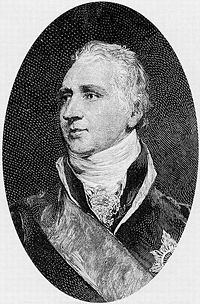
Charles Whitworth [2] , 1st Earl of Whitworth ( Eng. Charles Whitworth, 1st Earl Whitworth ; May 19, 1752 - May 13, 1825 ) - English diplomat of the late 18th century , acting British envoy to Russia from 1788 to 1800, in France - from 1802 to 1803.
| Charles Whitworth | |
|---|---|
| English Charles whitworth | |
 | |
| Date of Birth | May 19, 1752 |
| Place of Birth | Kent |
| Date of death | May 13, 1825 (72 years old) |
| A place of death | Sussex |
| Nationality |  United Kingdom United Kingdom |
| Occupation | Diplomat |
| Father | |
Content
- 1 Biography
- 2 At the cinema
- 3 notes
- 4 Sources
Biography
Born in 1752 in Kent , he was the eldest son (he had two brothers and four sisters) and the heir to Sir Charles Whitworth (a member of the British Parliament) and was the nephew of another British diplomat, Baron Charles Whitworth .
In 1772 he entered the military service in the guard, in May 1781 he became captain, and in 1783 he was appointed lieutenant colonel of the 104th regiment.
In 1785 he was appointed ambassador extraordinary and plenipotentiary of Great Britain to the court of the Polish king Stanislav II . He was in Warsaw until 1788 during the turbulent period preceding the second section of the Polish-Lithuanian Commonwealth .
In 1788, he was transferred to the same rank of Ambassador Extraordinary and Plenipotentiary of Great Britain to St. Petersburg .
Whitworth managed to improve the Anglo-Russian relations, aggravated in connection with the Russian-Turkish war of 1787-92 . For facilitating the conclusion of the Iasi Peace Treaty (1792), he received awards from the English government and Catherine II ( Order of the Bath and the Diamond Sword).
However, relations between the two countries deteriorated again due to William Pitt's policy of containing Russia in Europe.
Whitworth took part in the negotiations and the signing of the St. Petersburg Union Treaty - on the division of the Commonwealth between Austria and Russia ( 1795 ). After the death of Catherine II, Emperor Paul I refused to confirm the agreement, as a result of which Whitworth's position became very difficult. However, Whitworth, acting through pro-English leaders of Russian diplomacy ( A. Bezborodko , group A. R. Vorontsov , N. P. Panin ), prompted Paul to draw closer to England.
In 1797, Whitworth signed a trade agreement favorable to England with the Russian government, and a year later a new union treaty against France. Paul I petitioned George III to grant Whitworth peers (which was performed in 1800 ).
The constant delays of the St. James’s cabinet in the payment of military subsidies [3] , as well as England’s plans for Malta (ending with its capture in 1800 ) caused serious irritation in St. Petersburg. London , in turn, expressed dissatisfaction with the intention of Paul I to withdraw Suvorov’s troops to Russia and the planned rapprochement between Russia and France after the 18 Brumaire coup .
Pavel demanded the recall of the English envoy Whitworth from St. Petersburg , which was unambiguously reported in the rescript to the Russian envoy in London, S. R. Vorontsov, dated February 1, 1800 :
“Having long had a reason to be dissatisfied with the behavior of the gentleman of Whitworth in the present circumstances, when you need ... peace and harmony, in order to avoid unpleasant consequences, which may arise from the presence of false ministers at my court, I wish that cavalier Whitworth was recalled, which you, together to the Minister of Aglitz, demand the appointment of another minister ... ” [four]
However, the emperor soon reconsidered his decision to replace Whitworth with another diplomat. Instead, on April 13, 1800, he ordered S.R. Vorontsov to leave London for a while:
“Finding from a small number of real cases that your presence in England may not be entirely necessary, I allow you to use this time to improve your health, for which you will go to the waters of the continent, leaving your charge d'affaires at the British court d.s Lizakevich . "
Due to the deterioration of Russian-English relations in May 1800 in St. Petersburg and London, almost simultaneously there was a decrease in the level of diplomatic representatives to charge d'affaires.
In 1800, Whitworth was sent by the English government to Copenhagen to prevent the alliance of Denmark with Paul I. From here he kept in touch with the Anglophile-minded circle of Russian nobles, led by the disgraced brothers Zubov and their sister Zherebtsova . Through them, Whitworth helped organize the assassination of Paul I , after which the threat of a Russian-French alliance against England was temporarily eliminated. In addition to Zherebtsova, the English envoy was in almost open communication with the married Countess Tolstoy .
According to the notes of the Saxon ambassador Rosenzweig, in the fall of 1800, secret negotiations began between Nikita Petrovich Panin and the heir to the Russian throne, Grand Duke Alexander, on the introduction of a regency like the English. “The English ambassador in Petersburg, Whitworth, could give useful advice on this to his close friend Panin: he had a good idea of the English regency system associated with George III, and was interested in overthrowing Paul, who had cooled down to England and was getting closer to Napoleon.” [5] England probably subsidized the conspirators , ”wrote the historian Valiszewski , citing English sources. In any case, the "English gold" and the advice of Sir Whitworth played a role in the overthrow of Paul I. “In London, they not only knew about the impending plot for the life of Emperor Paul, but even contributed to the success of the plot with money,” said the historian Shumigorsky .
In 1802 , after the conclusion of the Amiens Peace , Prime Minister Henry Addington sent Whitworth as official envoy to Paris. For the French and for Napoleon Bonaparte personally, this came as a surprise, since Whitworth did not hide his fierce hostility towards the French Republic.
Under the terms of the Amiens world, Britain was obliged to free Malta from its presence and, according to the agreements, return the island to the knights of the Maltese island, however, it did not do this and systematically took time. On March 13, 1803, Napoleon called Whitworth to take his final decision on the status of Malta. As Whitworth continued to maneuver, Napoleon interrupted the audience and quickly left the hall, shouting: "Malta or war!" In April, Whitworth presented an ultimatum to the British government, where Britain offered to retain Malta for another 10 years. The answer to the ultimatum should have been given within seven days. Napoleon agreed to the terms, but proposed to shorten the stay of the British in Malta. England rejected the offer. On May 12, 1803, Whitworth left Paris, and on May 16, Great Britain declared war on France.
In the years 1813-1817, Whitworth was Lord Lieutenant of Ireland . In 1815 he received the title of Earl of Newport.
In the movie
- Lord Whitworth is one of the characters in the film Golden Age by Ilya Khotinenko (2003). The role of Whitworth was performed by actor Guri Atnev.
Notes
- ↑ Oxford Dictionary of National Biography / C. Matthew - Oxford : OUP , 2004.
- ↑ There are also transcription variants of the Whitworth surname such as Whitworth, Whitworth, Whitworth, Whitworth, and Whitworth in the literature.
- ↑ Martens F.F. Decree. Op. T. X1, p. 2-5.
- ↑ AWPRI, f. Relations of Russia with England, op. 35/6, d.526, l. 6.
- ↑ Nikita Petrovich Panin (Unavailable link) . Date of treatment August 29, 2009. Archived May 12, 2006.
Sources
- Historical and documentary department of the Russian Foreign Ministry. RUSSIA AND EUROPE IN THE PERIOD AND AFTER THE FRENCH REVOLUTION OF THE END OF XVIII
- Sokolov O. V. The battle of two empires 1805-1812. - Astrel, 2012 .-- S. 89-92.