Maidu is an endangered tribal group of Indians living in northern California in the United States, in central Sierra Nevada , between the Feather and American River rivers.
| Maidu | |
|---|---|
| Abundance and area | |
| Total: 2500 [1] | |
 California California | |
| Tongue | English , maidu |
| Religion | Christianity , animism |
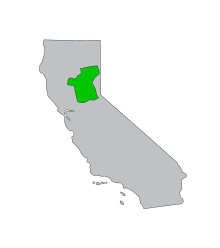
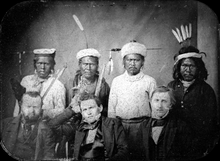

The word maidu in maidu means "man." The group is divided into southern (nisenan), north-eastern (mountain) and north-western (konkau) maidu [2] .
Population
Estimates of the Maidu population before contact with Europeans vary widely. Alfred Kroeber (1925: 883) believed that as of 1770 the number of maidu was 9,000 (including nisenan and konkau). Sherburn Cook (1976: 179) suggested that the number was slightly higher - 9,500 people.
As of 1910, Kroeber noted in his report the number was 1,100. According to the 1930 census, there were only 93 of them.
Culture
Maidu were engaged in hunting and gathering .
Maidu were also well-known basket manufacturers . Their baskets were very detailed, of various sizes - from tiny, thimble-sized, to large, about 3 meters in diameter. Some stems used for weaving were so thin that they can be seen only under a magnifying glass. For weaving, a large number of plants were used - fern roots, red crimson bark, yellow willow branches, hazel branches, yucca leaves, swamp reed and sedge roots - which made it possible to combine stems of different colors and types and create intricate geometric ornaments of red, black, brown on baskets and yellow flowers of various shades.
Subsistence economy
Although maidu were engaged only in hunting and gathering, but not in farming, however, like many other tribes of California, they cleared the lands where tribal meetings were held, mainly with the help of fire, and fertilized oak groves where they collected one of their main food products - acorns . To store acorns for the future, they built wicker storages.
In addition to acorns, which served as a source of food starch and fat , there were many edible plants and animals in the Maydas.
Homes
Maidu houses, especially those located on hilly terrain or in the mountains, were semi-underground . They were circular structures with a diameter of 6 to 12 meters, the floor of which was at a depth of almost a meter below the soil level. After the floor of the building was dug up, a frame of logs and poles was built, on which a thick layer of earth was laid. In the middle of the house was a hearth for winter heating. Summer houses looked different: they were built from cut branches that were tied and fastened to poles, after which they were covered with a layer of earth and clay. The entrance of the summer dwellings was oriented east, so that the sun would wake up in the morning, and so that during the day the heat would not penetrate the dwelling.
Social Organization
Maidu were inhabited in small villages by small tribal groups without centralized tribal leadership. Leaders were usually chosen from those men who led the local Kuksu cult, but these leaders did not exercise daily leadership, but were responsible for resolving internal disputes and negotiating between villages.
Religion
The kuksu cult, common in the Maidu tribe, also existed in the Pomo and Patvin tribes. This cult of central California was based on a secret society of men performing the “big head” dance.
Language
The languages spoken by mayda, although they belonged to the same family, were very different from each other in terms of vocabulary, grammar and syntax, up to the lack of mutual understanding. Maidu languages are divided into the following main branches: northeastern maidu, yamoni-maidu (or mayda proper); southern maidu or nisenan ; northwest maidu or konkau ; valley maidu or chico .
Notes
- ↑ "California Indians and their Reservations." Archived July 26, 2010 to Wayback Machine SDSU Library and Information Access. (retrieved 2 Sept 2010)
- ↑ Robbins, John ACTION: Native American human remains and associated funerary objects: (inaccessible link) . thefederalregister.com ( 2000-12-14 ). Date of treatment August 14, 2008. Archived on April 6, 2012.
Literature
- Cook, Sherburne F. 1976. The Conflict between the California Indian and White Civilization . University of California Press, Berkeley.
- Kroeber, AL 1925. Handbook of the Indians of California . Bureau of American Ethnology Bulletin No. 78. Washington, DC
- Heizer, Robert F. 1966. Languages, Territories, and Names of California Indian Tribes . University of California Press, Berkeley.