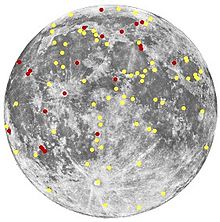
Short-term lunar phenomena (KLA) are various short- term local anomalies of the form of the lunar surface and near-moon space caused by non-stationary processes on the moon .
First descriptions of short-term lunar phenomena

English scientist and chronicler Gervase of Canterbury left one of the first descriptions of a short-term lunar phenomenon, which was observed by 5 people on July 18, 1178 : “The upper horn of the moon split into two parts. From the middle of this rift, a flaming torch suddenly leapt out, splashing fire, hot coals and sparks over a long distance in all directions. ” Eyewitness testimonies were given under oath. The age of the moon is 1.5 days after the new moon . According to scientists D. Hartung and J. O'Keefe, the described phenomenon was accompanied by the fall of the meteorite on the invisible side of the moon, which resulted in the formation of 22-km crater Giordano Bruno [1] [2] [3] .
Classification of short-term lunar phenomena
Misty phenomena . It is assumed that the short-term disappearance of the visible parts of the Moon’s relief and hazy auroras may cause gases to escape from its depths to the surface due to the tidal force of the Earth. The release of gases is most likely when the moon is in perigee and tidal stresses can lead to the opening of cracks. Tidal forces of the Earth on the Moon are 32.5 times higher than from the Moon on Earth. Over the years of observation, the phenomenon has been repeatedly noted in the Sea of Crises and inside the crater Plato .
Changes in brightness . Changes in the albedo of the shafts of lunar craters are observed when the bright details become even brighter. It is explained by the movement of dust clouds and the evaporation of lunar ice , the presence of which was detected by the Clementine and Prospector spacecraft. Formations where this phenomenon is observed include the shafts of the craters of Proclus , Cenzorin, and Aristarchus . The opposite effect — darkening of the lunar surface — was found by observers in the Picard crater and Proclus .
Bluish radiance . Most often observed in the crescent moon on a dark, ash- filled side, or during lunar eclipses . Represent bright glow bluish or bluish tint. Most often observed in the crater Aristarkh . It can be explained by the phenomenon of piezoelectricity , similar to the earth ones. The electric field can occur in the rocks due to mechanical stresses and cause ionization and luminescence.
Reddish radiance . Can also be explained by piezoelectricity . The phenomenon can be detected with the help of red and blue filters, alternately placed at the eyepiece of the telescope . Observed on the shaft of the crater Aristarkh and inside the crater Gassendi . In 1965–1966, NASA conducted a series of experiments called the MOON-BLINK Project to research and document such phenomena.
Twilight and shadow phenomena . Twilight phenomena occur in the lunar shadow, when dawn or dusk is not observed in time, and the shadow becomes not black, but gray. Shadow phenomena include the appearance of shadows where they should not be, for example, when the bottom of the crater is in the shadow, although the sun is high. A possible explanation of the phenomenon is heat stroke. At sunrise, the temperature of the lunar surface for a couple of hours varies from −120 to +110 ° C, which causes a dramatic thermal expansion of the lunar rocks.
Star-like flashes . The most likely cause may be the fall of a meteorite on the lunar surface. For example, on May 13, 1972, near the landing site of Apollo 14, the Smithsonian Institution registered a meteorite impact with a capacity of 1000 tons of TNT . ALPO even organized a special office for registering meteorite impacts on the moon.
Star-like lights . Observed from several minutes to an hour as a bright point of light on the moon. Lights are usually reported on the dark side of a young moon at the age of 3–4 days or during total lunar eclipses.
Light moving objects . They move not only against the background of the lunar disk, but also in its surroundings. There are various explanations (for example, the movement of gas-dust clouds).
List of lunar objects where transient phenomena were most often observed.
| An object | Phenomenon |
|---|---|
| Gigolo | Changing the appearance of a dark spot on the bottom, increasing the brightness and changing the color of the central slide |
| Aristarchus | Glow and flashes in the penumbra and shadows, increase in brightness, bright spots, change in color, turbidity |
| Archimedes | Flickering dots on the bottom |
| Atlas and Richcioli | Changes in the appearance of dark spots on the bottom during eclipses and throughout the lunation |
| Viet | Changing the type of dark spots south of the crater |
| Gassendi | Glow in the shadow during eclipses, moving KLY |
| Goden and Agrippa | Glow on the background of ash light and during eclipses |
| Grimaldi | The change in the appearance of dark spots on the bottom during eclipses, flickering dots on the bottom |
| Kant | Filling the crater with fog [4] |
| Kepler | Glow during eclipses, increase brightness, turbidity |
| Copernicus | Increase brightness, glow on the background of ash light and during eclipses |
| Langren | Glow in the crater bowl |
| Linney | Increasing the size of the bright spot during eclipses |
| Lichtenberg | Reddish spots |
| Manilius and Menelaus | Glow on the background of ash light, flash and glow in the shadow during eclipses |
| Mersenne | Blurred, "clouds" |
| Messier and satellite crater Messier A. | Turbidity |
| Sea of Tranquility | Moving kly |
| Picard | Brightness enhancement, clouding |
| Plato | Bright spots, changing the brightness of the light sector at the bottom, the glow on the background of ash light, flash during eclipses |
| Pliny | Glow in the shadow |
| Posidonius | Turbidity |
| Proclus | Bright glow in the earth's shadow |
| Teetat | White "cloud" [5] |
| Mountains of tenerife | Glow on the background of ash light |
| Timokharis | Reddish shine [6] |
| Quiet | Changing the appearance of a dark border during eclipses, the glow of rays in the earth's shadow |
| Furrow hygina | Change the appearance of dark spots |
| Eratosthenes | Change the appearance of dark spots on the bottom |
[one]
Notes
- ↑ 1 2 A. I. Voitsekhovsky, “Secrets of the Moon”, -M, Veche, 2006, Pp.338, 290—291
- А Astronomical Bulletin, vol. XII, No. 1, 1978
- ↑ VB Hartang. 20 km diameter impact crater observed on June 18, 1178, Meteoritics. 11, No 3, 187–194, 1976
- ↑ Kant crater description on The Moon-Wiki site
- ↑ Crater description on the The Moon-Wiki site.
- ↑ Description of the Timocharis crater on The Moon-Wiki site.