Quebec ( French Québec [ kəˈbɛk ], English Quebec [ kwɪˈbɛk ] [1] ) is the capital of the Canadian French-speaking province of Quebec and the main urban agglomeration in the east of the province. The city has the Quebec Parliament and the main government apparatus of the province, although the city is much smaller than Montreal .
| Quebec English Quebec (Québec) | |||
|---|---|---|---|
| - City , capital - | |||
 | |||
| |||
Coordinates: | |||
| Control | |||
| A country |  Canada Canada | ||
| Provinces |  Quebec Quebec | ||
| Region | Capital Nacional | ||
| Established | July 3, 1608 | ||
| Current status with | 1833 | ||
| The mayor | Regis Labom | ||
| Demography | |||
| Population | ▲ 677 942 people (2018) | ||
| Density | 1506.5 people / km² | ||
| Ethno-burial | Quebec | ||
| Official language (s) | French | ||
| Geography | |||
| Area | 450 km² | ||
| Points | lowest: 0 m highest: 118 m | ||
| Timezone | UTC − 5: 00 | ||
| Telephone code | + 1-418 | ||
| Geographic Code | 24 23027 | ||
| Web site | |||



Since 2001, Quebec has been one of Canada's most economically prosperous cities. The main growth sectors of the city’s economy are biotechnology, industry, tourism, healthcare, nutrition, insurance, and applied technology [2] . Quebec is also an important port center, its port is the third in the country in terms of cargo turnover. In addition, the city receives about 70 thousand tourists and 30 thousand crew members annually [3] .
In 2009, the city's population was 508,349 people who live in 6 urban areas: Cite-Limualu, Riviera, Saint-Foix-Silleri-Ca-Rouge, Charlebur, Beaufort and Haut-Saint-Charles. Together with the surrounding area, 746,252 residents live in the city. In 2008, Quebec celebrated the 400th anniversary of its founding with great fanfare, thereby emphasizing its role as the cradle of French civilization in North America .
Quebec is known for its historic quarter, a large number of museums and cultural institutions. Quebec's nickname is the "city of theaters."
History
Quebec name history
The narrowing of the river between Quebec and Levy (on the opposite bank) gave the name to the city: Kebec in Algonkin language meant "the place where the river narrows." According to another theory, although less widespread than the previous one, Samuel de Champlain borrowed the name from the Indians, who called their land with the word Kebec. Another hypothesis is that the city simply bears the name of the indigenous people living near this kebik region, today known as “Montagnier” [4] .
In the course of history, two other possible names of the city were considered. Samuel de Champlain wanted to give the new city the name "Louis" in honor of King Louis XIII . In addition, when creating the Canadian Confederation in 1867, the city wanted to give the Indian name "Stadakona" to avoid confusion with the name of the new province [5] .
Background
The place where the city of Quebec now stands, was literally 14 thousand years ago under the ice cap. 2 thousand years later it was under water as a result of the melting of the glaciers that formed the Champlain Sea, which eventually became a river. Then only the hills of Quebec were visible. Thus, only 6 thousand years later, the place where Quebec is now appeared from under the water [6] .
On March 18, 1534, Jacques Cartier sailed from Saint-Malo in France to study for the king of France, Francis I, the internal lands and waterways of North America. He had already studied the east coast of America in Brazil . Cartier chose a region that was on the same parallel with France. The goal was to find a way to India , China and Japan . If he could get there, Cartier would be able to establish control over territory and trade in this new sea route to the wealth of the East.
In the Gulf, the researcher and crew visited various places and went to Gaspe Gulf, where they had an unexpected meeting with a large group of Native Americans. Cartier met a leader named Donnacona. After establishing relations with the first group of natives, Cartier took with him the two sons of Donnacona. They acted as guides in the valley of the St. Lawrence River . As the summer passed quickly, Cartier decided to return to France. He hoped to present his findings (various objects and natives) to the king. The sons of Donnacona accompanied Cartier on his journey to France.
Cartier was allowed to conduct a second expedition. Jacques Cartier found out that there is a place where a large river begins. He decided to climb along the river in 1535 . Cartier climbed the river, which he called the river of St. Lawrence. The main goal, however, remained to find a new sea route to Asia. At that time, ships of other European powers also entered the region, trading with the Indians and catching cod. Cartier returned in 1541 with the goal of creating a permanent settlement. This first settlement, Charlbur-Royal , was abandoned less than a year after its founding, in the summer of 1542, largely due to the hostility of the natives in combination with difficult living conditions in the winter.
City under French rule
Quebec was founded by Samuel de Champlain , a French explorer and diplomat on July 3, 1608 , on the site of a long-abandoned Iroquois settlement called Stadacon. Champlain, also called the “father of New France, ” served as the city manager for his whole life. The location turned out to be favorable for creating a permanent colony.
In 1665 , the city's population was 550 people in 70 residential buildings. A quarter of the inhabitants were members of religious orders: secular priests, Jesuits , Ursulinki , who ran the local hospital, Hotel Dieu [7] . Quebec was taken under British control in 1759 and was occupied until 1763 . It was the site of three battles during the Seven Years War - the Battle of Beaufort, ending with the victory of the French ( July 31, 1759); battles on the plains of Abraham , in which British troops under the command of General James Wolf defeated the French general Louis-Joseph de Moncalm on September 13, 1759, and soon afterwards took the city; and the final battle of Saint-Foix, in which the French defeated ( April 28 , 1760 ). France ceded New France , including the city, to Great Britain in 1763.
At the end of French rule in 1763, the territory of the modern city of Quebec was a world of contrasts. Forests, villages, fields and pastures surrounded the city with 8-9 thousand inhabitants (for comparison, the population of Montreal at that time was only 5 thousand inhabitants). The city was notable for its monumental architecture, fortifications, dirty streets, houses of stone-rich and shacks of the poor in the suburbs of Saint-Jean and Saint-Roche. Despite the status of the capital, Quebec remained a small colonial city, closely connected with the countryside. In two markets, cities traded surpluses with farms and firewood, and nearby imported goods from France.
British rule
During the American Revolution , revolutionary troops from the southern colonies attacked the British garrison in an attempt to “liberate” Quebec. The defeat of the revolutionaries from the south put an end to the hope that the peoples of Quebec would join the American Revolution and that Canada would join the Continental Congress and become one of the states of the United States of America along with other British colonies of North America. In fact, the outcome of the battle marked the beginning of the split of British North America into two different political entities. The city itself was not attacked during the 1812 war , when the United States once again attempted to seize Canadian lands. Because of fears of a repeat of the American attack on Quebec in 1820, the construction of the Quebec fortress began. The Americans no longer attacked Canada after the 1812 war, but until 1871 a large British garrison remained in the fortress. The fortress is still used by the military, and also attracts tourists.
In 1840 , after the formation of the province of Canada, the role of the capital was divided between Kingston , Montreal , Toronto , Ottawa and Quebec (from 1852 to 1856 and from 1859 to 1866 ). In 1867, in Ottawa (which was chosen as the permanent capital of the province of Canada), the city was chosen as the capital of the Dominion Canada. The Quebec Conference on the Canadian Confederation was held here.
XX and XXI centuries
During World War II , two conferences were held in Quebec. The first Quebec Conference was held in 1943 with the participation of Franklin Delano Roosevelt ( US President at the time), Winston Churchill (British Prime Minister), William Lyon Mackenzie King (Canadian Prime Minister) and T.V. Sun ( Chinese Foreign Minister ) The Second Quebec Conference was held in 1944 , and Churchill and Roosevelt attended. The conference was held in the buildings of the fortress and the neighboring Chateau Frontenac . During these meetings, most of the Normandy landing plans were developed.
Metropolitan functions
Throughout its more than four hundred-year history, Quebec served as the capital. From 1608 to 1627 and from 1632 to 1763 , it was the capital of French Canada and the whole of New France, from 1763 to 1791 , it was the capital of the province of Quebec, from 1791 to 1841 , it was the capital of Lower Canada , from 1852 to 1856 and from 1859 to 1866 , it was the capital of the province of Canada, and from 1867 , it became the capital of the province of Quebec . The administrative district in which Quebec is located is officially called Capital-Nacional [8] [9] [10] .
Attractions
Geographical location
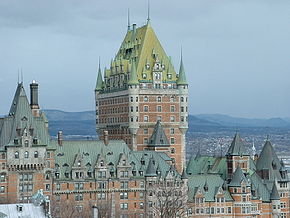
The city is part of a special metropolitan area (la Capitale Nationale) near the mouth of the St. Lawrence River . This is the only city north of Mexico whose impressive fortifications designed to protect New France from British attacks have survived. The old city of Quebec in 1985 was declared the international heritage of UNESCO . One of the main attractions of the city is Frontenac Castle (Chateau Frontenac) - a hotel built in the late 19th century in the style of the late Middle Ages .
Quebec itself is located on the left bank of the St. Lawrence River. With the city of Levi located on the right bank, it is connected by the Quebec bridge .
Climate
Quebec is located in the humid zone of the continental climate of the province and therefore has a temperate climate [11] . This climate is characterized by four distinct seasons: hot summers, with a maximum above 35 ° C and cold winters, with minima up to −30 ° C and heavy snowfalls. Between these two seasons there is autumn and spring with frequent rains.
In summer, the weather is usually sunny, but when the air is hot and humid, it causes severe thunderstorms when passing through cold fronts. The first snow usually falls in October or November, but as a rule, snow cover is established until December. During the winter of 2006/07, Quebec experienced temperatures above average and a lot of precipitation in the form of snow until mid-January. On the contrary, in the winter of 2007/08, there was an increase in the number of snowstorms and record snowfalls, with more than 550 cm of snow cover [12] . One of the most famous winter storms that hit Quebec is the March storm of 1971 called the “Perfect Storm.”
| Climate quebec | |||||||||||||
|---|---|---|---|---|---|---|---|---|---|---|---|---|---|
| Indicator | Jan | Feb | March | Apr | May | June | July | Aug | Sep | Oct | Nov | Dec | Year |
| Absolute maximum, ° C | 10.0 | 11.7 | 17.8 | 29.9 | 33.0 | 33.9 | 35.6 | 34,4 | 33.9 | 28.3 | 20,0 | 13.9 | 35.6 |
| Average maximum, ° C | −7.7 | −6 | 0.1 | 7.9 | 16.7 | 22.2 | 24.9 | 23.1 | 17.9 | 11.0 | 2.9 | −4.9 | 9.0 |
| Average temperature, ° C | −12.4 | −11 | −4.6 | 3.3 | 10.8 | 16.3 | 19.1 | 17.6 | 12.5 | 6.5 | −0.5 | −9.1 | 4.0 |
| Average minimum ° C | −17.3 | −16.1 | −9.4 | −1.5 | 4.9 | 10.3 | 13,2 | 12.0 | 7.1 | 2.0 | −4.1 | −13.3 | −1 |
| Absolute minimum, ° C | −35.4 | −36.1 | −30 | −18.9 | −7.8 | −0.6 | 3.9 | 2.2 | −4.8 | −10 | −24 | −32.3 | −36.1 |
| Precipitation rate, mm | 90 | 74 | 85 | 76 | one hundred | 110 | 119 | 120 | 124 | 96 | 106 | 109 | 1208 |
| Source: World Climate Canadian Department of the Environment | |||||||||||||
Population
At the end of French rule, the population of Quebec (about 9,000 souls) was almost double the population of Montreal (about 5,000), but over time the latter significantly surpassed it.
According to the 2006 census , 491,142 people lived in the city of Quebec itself, and 715,515 people lived in the metropolitan area. A total of 48.2% were men and 51.8% were women. Children under five years of age accounted for approximately 4.7% of Quebec's resident population. This compares with 5.2% in the province of Quebec, and 5.6% for Canada as a whole.
In 2001, 13.0% of the resident population in Quebec were of retirement age (65 years and older for men and women) compared with 13.2% in Canada. The median age is 39.5 years, compared with 37.6 years for Canada as a whole.
In the five years between 1996 and 2001, the population of Quebec grew by 1.7%, compared with an increase of 1.4% in the province of Quebec as a whole. Quebec has a population density of 216.4 people per square kilometer, compared with an average of 5.3 for the province as a whole. According to the 2001 census, more than 90% of the population is Roman Catholic. The city also has small Protestant and Jewish communities.
| 1931 | 1941 | 1951 | 1961 | 1971 | 1981 | 1991 | 2001 | 2006 | 2010 |
|---|---|---|---|---|---|---|---|---|---|
| 131,000 | 151,000 | 289,000 | 379,000 | 481,000 | 576,000 | 645,550 [13] | 686 569 [14] | 715 515 [14] | 750,000 (estimate) |
Immigration
For a long time the city was the gateway to Canadian immigration: first immigrants from France settled here, then, after the Anglo-American conquest, they were replaced by immigrants from the British Isles. Due to the rapid growth of the local French-speaking population and the gradual crowding out of the English language in the 20th century, mass British immigration ceased. Immigration resumed at the end of the 20th century in a different quality from other countries, mainly again from France. According to the 2006 census, 22 160 natives of foreign countries lived in the city (only 4.5% of its population). Due to such a low share of immigrants, their unemployment rate (10%) is much lower than in other cities in Quebec and Canada, although it is twice as high as among the local population. 43% of them came from European countries (which is the highest figure for cities in North America) and 21% - from the countries of the Western Hemisphere. 43% of arrivals from Europe are French citizens [15] .
Language
The main and almost the only language in the modern city is the French language , or rather, its special dialect . Unlike Montreal , the percentage of residents with native English is very small - about 1.9% (for comparison, residents with native Spanish - 3%). French is the mother tongue for 94.8% of the city’s inhabitants, only about 15% know English at a good level (2001 census data). Almost paradoxical at the same time is the fact that the population of the modern city as a whole is traditionally cool about the idea of the province's independence from the rest of Canada (during the last referendum on this issue, only 54% of the city residents voted for independence). There are explanations for this: firstly, as civil servants of the provincial capital of a large federal state, many city residents and their families are afraid of losing jobs and access to Canadian federal funds; secondly, the few Anglophones of the city are no longer regarded as an immediate threat. The situation in Montreal is almost exactly the opposite of Quebec: the share of francophones is lower there, in addition, they still have to study English in order to compete in the labor market and in education with a rather large and still influential English-speaking community (especially in the business center of the city) .
The British made repeated but generally unsuccessful attempts to colonize and assimilate the French-speaking residents of the city. So, throughout the 19th century, the city was the main reception center for British immigrants, and English was native to 40% of the inhabitants of Quebec at that time [16] [17] [18] . Today, English-speaking residents make up only 1.5% of the population of the city and its suburbs [19] .
Gradually, however, with the outflow of the English-speaking population to the economically more dynamic west and the partial assimilation of the Irish, the English language in the city fell into decay, and the French-speaking population has grown significantly and is now absolutely dominant. The key role in preserving the French language was played by the Catholic Church , which contrasted its value system with the norms of British Protestantism , as well as the higher natural growth of Francophones. More than 90% of citizens profess Catholicism . There are few immigrants from the former USSR , unlike Toronto - about 1000 people.
The annual Quebec Winter Carnival attracts tourists from all over the world, including those from neighboring English-speaking regions, so the English-speaking population increases significantly during this event.
Economics
Most jobs in Quebec are concentrated in public administration, defense, services, trade, transport and tourism. As the provincial capital, the city benefits as a regional administrative center: by the way, the provincial government is the largest employer in the city, it employed 27,900 people in 2007 [20] . CHUQ (local hospital network) is also one of the largest employers in the city, with more than 10,000 employees in 2007. In 2008, the unemployment rate in Quebec was 4.5% [21] , which is significantly lower than the provincial and national average levels (7.3% and 6.6%, respectively) [22] .
About 10% of jobs are concentrated in the manufacturing industry [23] . The main products of production are pulp and paper, finished food products, metal, wood processing products, chemicals, electronics and electrical equipment, printed materials. There is also a Beenox computer games studio in the city.
Education
Laval University is located in the western part of the city, in the town of Saint-Foix . However, the Laval University School of Architecture is located in the center of Old Quebec. The central campus of the University of Quebec , the National School of Government, and the National Research Institute are also located in the city.
Numerous vocational colleges are located in Quebec City, including Francois Xavier-Garno College, O'Sullivan College, Limualo College, Saint Foix College and Saint Lawrence College , as well as private institutions such as Notre Dame de College -Foix , Merisi College, Bart College .
Quebec has the oldest educational institution for women in North America - the Quebec Ursulinok Monastery , located at 12 Rue Donnacona.
Transport
Roads
Quebec Bridge and Pierre Laporte Bridge connect the city with the south bank of the St. Lawrence River . As well as the ferry service to Levy, the bridge connects Quebec with Orleans . The city is a major center of the provincial road network, fan-shaped on both sides of the river with an extensive motorway system. Several important motorways of the road network pass Quebec, of which the 40th motorway connects it west with Montreal , and the 175th motorway connects with the city of Shikutimi .
Public Transport
The public transport office has a bus fleet and recently [ when? ] introduced regular bus routes. The Office is also exploring the possibility of a tram return to offload the busiest lines, as well as attract new public transport users. A project worth $ 900 million needs the approval of the highest state bodies, since the city does not have the resources to finance such an ambitious project. Rail transport is operated by VIA Rail in (Gare du Palais). The intercity bus station is adjacent to the train station.
Air and sea traffic
The city is served by Jean Lesage International Airport , located in the western part of the city. There is also a large port on the St. Lawrence River [24] .
Public Safety
The Quebec City Police Department provides security in the city. Quebec has one of the lowest crime rates in Canada. There was not a single murder in the city in 2007 [25] .
Twin Cities
- Bordeaux ( French Bordeaux ), France
- Guanajuato ( Spanish: Guanajuato ), Mexico
- Calgary , Alberta , Canada
- Cannes ( French Cannes ), France
- Liege ( fr. Liège , Netherlands. Luik , Wallon. Lidje ), Belgium
- Montevideo ( Spanish Montevideo ), Uruguay
- Namur ( Fr. Namur , Netherlands. Namen , Wallon. Nameûr ), Belgium
- Albany New York , USA
- Paris ( French Paris ), France (partner city)
- Saint Petersburg , Russia
- Xi'an ( Chinese ex. 西安 , pinyin : Xī'ān , pall .: Xi'an ), China
- Sousse ( Arabic سوسة , French Sousse ), Tunisia
- Ouagadougou ( fr. Ouagadougou ), Burkina Faso
- Hue ( Vietnamese. Huế ), Vietnam
- Changchun ( Chinese trade. 長春 , exercise. 长春 , pinyin : Chángchūn ), China
- Iasi ( rum. Iaşi ), Romania
Notes
- ↑ Quebec in Oxford Dictionaries Online . Oxford University Press . Date of treatment August 18, 2017.
- ↑ Quebec Chamber of Commerce
- ↑ Port of Quebec . Archived March 31, 2008.
- ↑ Montagnais
- ↑ Commission de toponymie du Québec: Québec . Archived March 3, 2016.
- ↑ Commission de la toponymie du Québec . Archived December 22, 2008.
- ↑ Morison, Samuel Eliot. The Oxford History of the American People. - New York City: Mentor , 1972.- P. 150.
- ↑ Décret concernant la révision des limites des régions administratives du Québec, RQ c. D-11, r.2, made pursuant to the Territorial Division Act, RSQ c. D-11
- ↑ Québec Portal> Portrait of Québec> Administrative Regions> Regions . Date of treatment May 13, 2009.
- ↑ An Act respecting the National capital commission, RSQ c. C-33.1 . CanLII (May 4, 2009). Date of treatment May 13, 2009.
- ↑ Les zones climatiques: fiche climatique du Québec du sud au nord . Gouvernement du Québec. Date of treatment December 22, 2008. Archived on August 25, 2011.
- ↑ Bilan de la saison de neige 2007-2008 (Unavailable link) . Center de ressources en impacts et adaptation au climat et à ses changements. Date of treatment October 22, 2008. Archived October 6, 2008.
- ↑ Statistics Canada. Community Profile - Quebec City −1996
- ↑ 1 2 Population and dwelling counts, for census metropolitan areas and census agglomerations, 2011 and 2006 censuses
- ↑ 3.2.3 Les immigrants français de la Ville de Québec & 124; Destination Québec . Archived on March 13, 2015.
- ↑ L'Église anglicane forcée de s'ouvrir au français . Archived March 18, 2015.
- ↑ Quebec: A History 1867-1929: A History 1867-1929 - Paul André Linteau, René Durocher, Jean Claude Robert - Google Books
- ↑ Morrin Center. Anglos in Québec . Literary and Historical Society of Quebec. Date of treatment March 15, 2007. Archived February 12, 2012.
- ↑ Voice of English-speaking Québec: A Portrait of the English-speaking Community in Quebec (link not available) . Voice of English-speaking Québec (2007). Date of treatment March 15, 2007. Archived on September 29, 2007.
- ↑ " Canada's largest employers by city, 2007: Quebec City . Archived on April 18, 2010. . ”London: University of Western Ontario . Retrieved January 12, 2009.
- ↑ Labor: Labor force characteristics, population 15 years and older, by census metropolitan area . Archived on August 10, 2011. . ” Statistics Canada . Retrieved January 12, 2009.
- ↑ “ Latest release from the Labor Force Survey .” Statistics Canada . Retrieved January 12, 2009.
- ↑ “ Québec City: Economy, transportation, and labor force .” The Canadian Encyclopedia. Historical Foundation of Canada, 2008. Retrieved January 12, 2009.
- ↑ [ http://www.portquebec.ca/index.php?lang=en_GR Port of Quebec] . Дата обращения 24 июня 2009. Архивировано 12 февраля 2012 года.
- ↑ Quebec City closing in on a year without murder