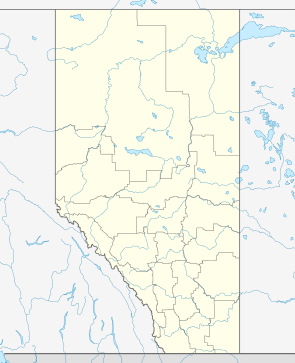
Calgary ( English Calgary [ˈkælɡ (ə) ri] ) is a city in the province of Alberta in Canada . Located in the south of the province , in the foothills and prairies area , about 80 km east of the Canadian Rocky Mountains watershed. The city is also located in the Alberta grasslands.
| Calgary English Calgary | |
|---|---|
| - City - | |
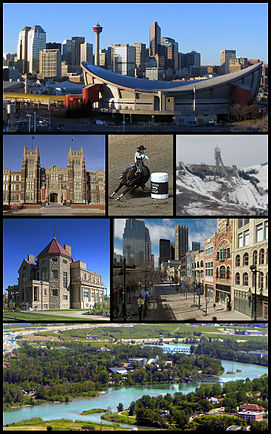 | |
 Flag Nickname : Livestock Trading Center, City Stampida Motto : Forward | |
Coordinates: | |
| Control | |
| A country |  Canada Canada |
| Provinces | Alberta |
| Region | Calgary |
| Census District | 6 |
| Founding date | 1875 |
| Current status from | January 1, 1894 |
| Mayor | Nahid Nenshi ( List of mayors ) |
| Governing body | Calgary City Council |
| Manager | Owen A. Tobert |
| Members of Parliament | List Diana Ablonci |
| Deputies of the Legislative Assembly | List Lindsay Blackkett |
| Demography | |
| Population | 1,235,171 people ( 2016 , 3rd ) |
| Density | 1329 people / km² |
| Agglomeration | 1,392,609 people (2016, 4th ) |
| Density in agglomeration | 237.9 people / km² |
| Ethno-horonim | Calgaric |
| Geography | |
| Square | 726.50 km² |
| Agglomeration area | 5107.43 km² |
| Height above sea level | 1048 m |
| Timezone | MST ( UTC − 7 ) ( summer time UTC − 6 ) |
| Postcode | T1Y - T3R |
| Telephone code | +1 403 , 587 |
| Web site | |

In 2016, the population of Calgary was 1,235,171 inhabitants, and the city became the third most populous in the country and the largest in Alberta . With suburbs in 2011, the population was 1,214,839 people, and the Calgary agglomeration became the fifth largest in Canada.
Located 294 km south of Edmonton , and the densely populated zone between these cities is known as the “ Calgary Corridor - Edmonton ”.
Business activity in Calgary is mainly related to the oil industry , agriculture and tourism . In 1988, Calgary became the first Canadian city to host the Winter Olympics .
History
First Settlement
Before the Europeans settled in the Calgary area, it was inhabited by pre-Clovis peoples for at least 11,000 years [1] . In 1787, the cartographer David Thompson spent the winter with a group of Indians on the bank of the Bow River. He was the first known European to visit this territory, and the first known European to settle in the Calgary area was John Glenn in 1873 [2] . The indigenous way of life remained virtually unchanged until the 1870s, until the Europeans exterminated the population of American bison until it almost disappeared.
In the Calgary area, a Northwest Mounted Police Post was established (now the Royal Canadian Mounted Police ). The SZKP branch was created in 1875 to protect the western plains from American whiskey dealers, as well as to protect the fur trade. Initially, the post was named Fort Brizbua by the name of the officer SZKP Efran-A. Brizbua , but in 1876, Colonel James MacLeod renamed it Fort Calgary . This name was given in honor of Calgary on the Isle of Mull (Scotland). There is no generally accepted version of the origin of the name of this city, but the Museum on the Isle of Mull explains that the expression kald gart in Old Norse means “cold garden”. Perhaps this was the name the Vikings living in the Inner Hebrides [3] called. According to another version, the name is probably derived from the Gaelic expression Cala ghearraidh "meadow (pasture) on the coast."
In 1885 [4] , Banff National Park was organized, which, along with the Banff Springs hotel, became a place of pilgrimage for tourists from around the world. The starting point for those heading to this park is Calgary International Airport.
On November 7, 1886, a fire broke out, as a result of which fourteen buildings were destroyed, and the losses were approximately $ 103,200. Although no one was killed or injured at the same time, in order to prevent this from happening again, the city authorities prepared an order according to which all large buildings in the center of the city should be built from Pascapui sandstone [5] .
After the Canadian Pacific Railway approached the city in 1883 and a railway station was built, Calgary began to turn into a significant commercial and agricultural center. Currently, Calgary is still headquartered by the Canadian Pacific Railway .
In 1884, Calgary received the rights of a municipality ( town ) and residents chose their first mayor, George Murdoch . In 1894, its charter was changed to provide a higher urban status ( city ) as part of the Northwest Territories [6] . After the arrival of the railway in this area, the Dominion government began to lease pasture land for a minimal fee (up to 40,000 hectares at 2.5 cents per hectare per year). As a result, cattle breeding began to actively develop around Calgary. Already being a transportation and trade hub, Calgary soon became the center of trade in cattle and meat packing industry of a pan-Canadian scale.
From 1896 to 1914, immigrants from all over the world flocked to the area in connection with the free provision of " manor " land. Farming and herding became the main components of the local economy, determining the future of Calgary for many years to come. The world famous Calgary Stampid is still held annually in July. From a small exhibition of agricultural products with cowboy contests, which was held in 1912 by four rich ranchers, it turned into the “largest open-air spectacle on earth”.
Oil boom
Oil in Alberta was first discovered in 1902, but it did not play an important role in the life of the province until 1947, when its huge reserves were discovered. Calgary was immediately at the center of the oil boom . Thanks to the Arab oil embargo of 1973, oil prices rose sharply, and the city’s economy grew very rapidly. For eighteen years, the population has increased by 272,000 people. - from 403,000 (1971) to 675,000 (1989); and over the next eighteen years, by 345,000. (up to 1,020,000 lives in 2007). Over the years of the boom, skyscrapers appeared one after another in the city, and the relatively low business district was quickly built up with multi-storey buildings, which is still ongoing. Unfortunately, the business part of Calgary occupied the restless central part of the city, and therefore many historic sandstone buildings are still being destroyed there.
The Calgary economy was so closely connected with the oil industry that, together with a decrease in the average annual price of oil, in 1981, business activity also decreased in the city. The subsequent fall in oil prices was perceived by business as the cause of the collapse in the oil industry, and as a result, in the entire Calgary economy. However, it did not depend for long on low oil prices, and had fully recovered by 1990.
Newest History
Due to the fact that a large number of Calgarians were employed in the energy sector, the effects of the economic crisis of the early 1980s were significant, and the unemployment rate promptly increased. However, by the end of the decade, the economy recovered. Calgary quickly realized that the city should not pay so much attention to oil and gas, and its economy and culture have since become more diverse. The period of recession marks the transformation of Calgary from a medium-sized steppe city, no different from others, into a large multinational and multi-structured center. This transformation was “consolidated” in 1988, when the XV Winter Olympic Games were held in the city. The success of these Games essentially brought him worldwide fame.
Due in part to rising oil prices, the economy in Calgary and Alberta until the end of 2008 was the fastest growing in the country. Despite the fact that the oil and gas industry was a significant part of the economy, the city invested heavily in other areas of activity, including tourism and high-tech production. Currently, more than 3.1 million people visit the city annually to visit its festivals and places of recreation, and especially Calgary Stampede . The nearby ski resorts of Banff , Lake Louise and Kanmore are also becoming more and more popular with tourists, and as a result they pass through Calgary. Other modern industries include light industry, high technology, film, e-commerce, transportation, and service delivery. The quality of life in the city is recognized as very high: Calgary took the 5th place on this indicator in 2006, the 4th in 2007, the 5th in 2008, the 6th in 2009 and the 3rd in 2010 according to Mercer Quality of Living Survey and became the 5th city, the most convenient for living in the world, according to the Economist Intelligence Unit (EIU). In 2010, Forbes magazine recognized Calgary as the cleanest city in the world [7] . In 2011, Mercer also placed the city in the first place in the development of non-waste life support systems and production.
In 2015, the Mayor of Calgary announced his intention to compete for the right to host the 2026 Winter Olympics . [8] In April 2018, the IOC announced the list of applicants for holding the Winter Olympics in 2026, which included the National Olympic Committee of Canada with an application from Calgary. [9] On November 13, 2018, a referendum was held in Calgary, in which 171,750 citizens (56.4% of all those who took part in the vote) voted against the Games in the city. [10] On November 18, the same Calgary city council officially refused to host the Winter Games in the city. [eleven]
Geography
Calgary is located in the transition zone between the foothills of the Canadian Rockies and the Canadian Prairies . The height of the center of Calgary above sea level is approximately 1048 m, and the height of its airport is 1083 m. Actually Calgary covers an area of 726.5 km² (2006), which, for example, exceeds the area of the city of Toronto .
Two large rivers flow through the city. The Bow River flows from northwest to south. Its tributary, Elbow, flows from south to north and flows into Bow near Downtown Calgary. Since the climate in this area is usually dry, dense vegetation is naturally found only in river valleys, on some north-facing slopes and in Fish Creek Provincial Park .
The city occupies a large territory and consists of the central part and the surrounding microdistricts with different population density. Unlike most cities with large agglomeration, in Calgary, most suburbs became part of the city itself, with the exception of cities such as Erdry in the north, Cochran in the north-west, Strathmore in the east, and Springbank and Berspou in the west. The city of Okotoks , which is not formally part of the Calgary agglomeration, is located very close to the south of it and is also considered a suburb. The economic area of Calgary includes a bit more territory than the agglomeration , and its population in 2008 was 1,251,600 people.
For many years the city took over the land to maintain its growth; The last such connection was completed in July 2007, when the neighboring village of Shepard entered the city, and the city borders got close to the village of Balzac and were very close to the cities of Erdre and Chestermir . Despite this proximity, neither Erdrey nor Chestermere is currently planned to be added to Calgary, and the Chestermir administration is even planning a development plan for the independent development of land between this city and Calgary.
The city of Calgary is directly bordered by two counties: the county of Rocky View (in the north, west and east) and Foothills No. 31 (in the south).
Calgary neighborhoods
The business part of the city consists of five neighborhoods: O'Claire (including the Festival Quarter), Downtown West End , Commercial Center , Chinatown and Downtown East Village . The commercial center, in turn, is divided into several quarters: Stephen Avenue Shopping Mall, Entertainment Quarter, Art Quarter and Administrative Quarter. Separate from the business part, south of 9th Avenue is the most densely populated neighborhood of Calgary Beltline . It includes several neighborhoods, including Connaught, Victoria Crossing and part of the Rivers quarter. Beltline is the object of a large-scale reconstruction plan for the municipality, which involves increasing the population density and “revitalizing” the center of Calgary.
The first part of the central part adjoins to the business part. These include Crescent Heights , Hounsfield Heights-Briar Hill , Hilhurst - Sunnyside (including Starling Kensington ), Bridgeland , Renfrew , Mount Royal , Mission , Ramsay and Inglewood with Albert Park-Radisson-Sights, and his sister, his sister, his son , Ramsay and Inglewood with Albert Park - Sadisson-Heights, and his racesay and Ramsay and Englewood with Albert Park . The central part, in turn, borders on the relatively densely populated neighborhoods of Rosedale and Mount Pleasant in the north; Bowness , Parkdale and Glendale in the west; Park Hill , South Calgary (including Marda Loop ), Bankview , Altadore and Killarney in the south; and Forest Lawn - International Avenus in the east. The remaining neighborhoods, usually separated by highways, are considered to be suburban. There are more than 180 individual neighborhoods in Calgary.
Some of the neighborhoods of Calgary were once independent cities that were part of Calgary as it grew. These include Bowness , Ogden , Montgomery , Forest Lone , Midnapore , Rosedale and, since 2007, Shepard .
Climate
Calgary is located in the temperate continental climate zone ( Dfb according to the Köppen climate classification and plant cold resistance zone 3a according to the USDA classification) with a long, dry, cold, but unstable winter and a short, moderately warm summer. Much of the city’s climate is determined by its height above sea level and the close proximity of the Rocky Mountains . In Calgary, it can be a very cold winter, but the warm and dry wind of Shinuk in the winter months blows for a while on the city from behind the mountains and saves the Calgarians from the cold. In just a few hours, this wind can raise the temperature in winter to 15 ° C and persist for several days. Shinuk is so common in Calgary winter that only once (in January 1950) for more than 100 years of meteorological observations in the winter in Calgary there was no thaw. More than half of all winter days, the daily maximum exceeds 0 ° C.
Calgary is a city of extreme temperatures, since the record low temperature in 1893 was −45 ° C, and the record high in 1919 - 36 ° C. About five days a year, the temperature falls below −30 ° C, but the period of extremely low temperatures usually does not last long. According to the Ministry of the Environment of Canada, the average daily temperature in Calgary varies from −9 ° C in January to 16 ° C in July.
Due to the location of Calgary high above the sea level and dryness summer evenings can be very cool. The average summer minimum temperature is 8 ° C. During the daytime, temperatures in Calgary can reach 29 ° C in June, July and August, and sometimes in September and May. Calgary's dry climate with a relative humidity of 55% in winter and 45% in summer is similar to the climate in other cities in the west of the Great Plains and the Canadian Prairies . Unlike the cities located to the east - Toronto , Montreal , Ottawa and even Winnipeg - the humidity in Calgary during the summer period is an exceptional factor.
The city is one of the sunniest in Canada - the sun shines there on average 2400 hours a year. Calgary International Airport in the northeastern part of the city receives an average of 412.6 mm of precipitation per year , 320.6 mm of precipitation in the form of rain, and 126.7 cm in the form of snow . Most precipitation falls from May to August, and in June the monthly rainfall is maximum. In the rainiest month in the entire history of meteorological observations, June 2005, 248 mm of precipitation fell in Calgary. There are frequent droughts that can happen at any time of the year and last for months, and sometimes for several years. The rainfall in the western regions is slightly higher than in the east, so the groves in the western suburbs gradually give way to treeless grasslands on the eastern border of the city.
Calgary is located in Southern Alberta, where there is often a cold snap (although alternating with warming) in winter. The snow depth in Calgary exceeds 1 cm approximately 88 days a year (for example, in Toronto approximately 65 days). However, the amount of snow that has fallen (as well as temperature) can vary considerably in different areas of this area - this is mainly due to the difference in altitude and proximity to the mountains. The temperature in the southern part of Calgary is also usually slightly higher than at the airport.
Thunderstorms come to Calgary for about 22 days a year, most of which occur in the summer months. Calgary is located on the border of the Alberta region, where hailstorms often occur, so the destructive hail is there at intervals of several years. The heavy hail that struck Calgary on September 7, 1991 and caused $ 400 million in damage was one of the most devastating natural disasters in Canadian history . Tornadoes rarely appear in this area, as it most often turns to the west of the dew point front .
Normal seasons (not clearly defined in Calgary, since the climate is very unstable)
- Winter: from November to March
- Spring: April to May
- Summer: from June to August
- Autumn: September to October
| Climate at Calgary International Airport | |||||||||||||
|---|---|---|---|---|---|---|---|---|---|---|---|---|---|
| Indicator | Jan. | Feb | March | Apr | May | June | July | Aug | Sen | Oct. | Nov. | Dec | Year |
| Absolute Maximum, ° C | 16.5 | 22,6 | 22,8 | 29.4 | 32.4 | 35.0 | 36.1 | 35.6 | 33.3 | 29.4 | 22,8 | 19.5 | 36.1 |
| Average maximum, ° C | −2,8 | −0,1 | 4.0 | 11.3 | 16.4 | 20.2 | 22.9 | 22.5 | 17.6 | 12.1 | 2.8 | −1,3 | 10.5 |
| Average temperature, ° C | −8.9 | −6,1 | −1.9 | 4.6 | 9.8 | 13.8 | 16.2 | 15.6 | 10.8 | 5.4 | −3,1 | −7.4 | 4.1 |
| Average minimum, ° C | −15,1 | −12 | −7,8 | −2,1 | 3.1 | 7.3 | 9.4 | 8.6 | 4.0 | −1,4 | −8.9 | −13,4 | −2,4 |
| Absolute minimum, ° C | −44,4 | −45 | −37,2 | −30 | −16,7 | −3.3 | −0,6 | −3,2 | −13,3,3 | −25,7 | −35 | −42,8 | −45 |
| Precipitation rate, mm | 11.6 | 8,8 | 17.4 | 23.9 | 60.3 | 79,8 | 67.9 | 58,8 | 45.7 | 13.9 | 12.3 | 12.2 | 412.6 |
| Source: Department of the Environment Canada, 2012 | |||||||||||||
Flora and fauna
Many species of plants and animals are found in and around Calgary. In Calgary, the northern zone of distribution of Douglas fir ( Pseudotsuga menziesii diff. Glauca ) begins. Another widespread conifer found in the Calgary area is Canadian spruce ( Picea glauca ).
Culture
Calgary is a modern city, at the same time it has preserved much of its traditional culture with its saloons in hotels, western bars, night clubs, football and hockey . Calgary is the center of country music in Canada, sometimes called "North Nashville ."
There are several areas in Calgary where different cultures are represented. One of the most diverse microdistricts of the city is Forest-Lone, where the quarter in the area of 17th Avenue Southeast is also known as International-Avenue. There are many national restaurants and shops.
Despite the fact that many Calgarians continue to live on the outskirts of the city, the more central quarters of 17th Avenue, Kensington, Inglewood, Forest Lone, Marda Loop and Mission Square are becoming popular, and the population density in these quarters has recently increased. As a result, nightlife and cultural activities began to develop there.
The Calgary Public Library (PBC) is a city-wide public library network with 17 branches, where books, e-books, CDs, DVDs, Blu-Ray discs, audio books, and other media are issued. The PBC is the second largest library in Canada and the sixth municipal library system in North America based on handing out books and other media to a home.
Calgary houses the South Alberta Jubilee Concert Hall, a social and cultural center and a place for performing arts. The concert hall is one of the twin buildings in the province, the second of which is in Edmonton, and both of them are colloquially known as Jubi. In this concert hall for 2538 seats, opened in 1957, hundreds of Broadway musicals , theater, stage and private productions were held. Calgary Jubi is home to the Alberta Ballet , the Calgary Opera House , the Kiwanis Music Festival and for annual civil ceremonies on Memorial Sunday. Both concert halls work 365 days a year and are managed by the provincial authorities. By the centenary of the province in 2005, a significant reconstruction was carried out in both buildings.
Calgary also has several private theaters; including One-Yellow-Rabbit , which is adjacent to the EPCOR Center for the Performing Arts, with the Calgary Symphony Orchestra , the Calgary Theater , the Alberta Theater Project and the Junction-Grand Theater, a cultural center dedicated to contemporary living art. Calgary is also the birthplace of improvisational and theatrical games known as “ Theater-Sport ”. The city also annually hosts the Calgary International Film Festival and the International Animation Festival .
There are visual and abstract artists in the city, such as the United Congress Art Group, and several art galleries in the business district, many of which are located in Stephen Avenue and 17th Avenue. The largest of these is the Calgary Art Gallery (KGK). Calgary is also home to the Alberta College of Fine Arts .
Calgary hosts several marching brass bands - Calgary Round-Up Band, Calgary Stetson Show Band, Bishop Grandin Marching Ghosts and two-time champion of the Calgary Stampede Showband World Brass Band Show and Calcary Stage Calgary Stampede Showband military orchestras, Royal Calgary Region Bands, and Calcary Stage Bandas show band martial arts bands. shelf. There are many other civilian brass bands in the city, especially the Calgary Police Service orchestra.
Calgary hosts several annual festivals and events. These include the Calgary International Film Festival , the Calgary Folk Music Festival, the Calgary Comedy Festival Fannifest , the Greek Festival, Karifest, the Banff-Calgary International Literary Festival Werdfest, the Lilac Festival, the Globalfest , the Calgary Extremes Festival, the Summerstock Festival, the Martial Arts Festival, the Arts Festival, the Gray Festival, the Globes Festival , the Calgary Extremes Festival, the Summerstock Festival, the Gray Festival, the Calvary Festival Calgary International Living Word Festival and many other cultural and national festivals. The Calgary Stampid is the most famous event in Calgary, which is held annually in July from 1912. It is one of the largest festivals in Canada , in which 10-day rodeo and exhibition are held, which in 2005 was attended by 1,242,928 people.
There are several museums in the city. The Glenbow Museum is the largest in Western Canada and consists of an art gallery and an indigenous gallery. Other major museums include the Chinese Cultural Center (the largest autonomous cultural center in Canada with an area of 6,500 m²), the Canadian Olympic Gallery of Glory and Museum (in the Canadian Olympic Park ), military museums, the Museum of Choral Music and the Aerospace Museum.
The Calgary area also attracts filmmakers. In the vicinity of the city numerous films were shot. Tom Selleck's Crossfire Trail motion picture was filmed on a ranch near Calgary, although the scene of the film is Wyoming .
Sports and recreation
Due largely to the proximity of the Rocky Mountains , Calgary has traditionally been a popular center for winter sports. After the 1988 Winter Olympics , several major sports facilities remained in the city, including the Canadian Olympic Park ( luge , cross-country skiing , ski jumping , downhill skiing , snowboarding and some summer sports) and the Olympic Oval ( speed skating and ice hockey ). These facilities are the main training places for a number of professional athletes. In the summer months, the Canadian Olympic Park is also used as a place for mountain biking.
In summer, fishing is very popular on the Bow River. Golf is also extremely popular among the Calgarians, and there are a lot of venues for this sport in the city.
In August 2009, the World Ski Championships took place at the Predator Bay Water Ski Club, about 40 kilometers south of the city.
As part of the popular Battle for Albert, urban sports teams are constantly competing with their Edmonton counterparts: most often Calgary Flames and Edmonton Oilers in the National Hockey League and Calgary Stampiders with the Edmonton Eskimo in the Canadian Football League .
There are many parks in the city, including Fish Creek Provincial Park , Nous Hill Park , Bowness , Edwardy , Inglewood Bird Sanctuary , Confederation Park and Princes Island . Nous Hill Park is the largest urban park in Canada. Together with most urban neighborhoods, these parks are the largest multi-purpose (walking, cycling, roller skating, etc.) route system in North America.
Founder of the city professional wrestling school Stu Hart is the founder of one of the most famous wrestling systems in the history of this sport.
| Club | League | Home stadium | Base | Champion titles |
| Calgary Stampiders | Canadian Football League | McMahon Stadium | 1945 | 6 |
| Calgary Flames | National Hockey League | Scoshabank saddledom | 1980 | one |
| Calgary Rafnex | National Lacrosse League | Scoshabank saddledom | 2001 | 2 |
| Calgary Wipers | Golden Baseball League | Stade Foothills | 2004 | one |
| Club | League | Home stadium | Base | Champion titles |
| Calgary Canax | Alberta Youth Hockey League | Max Bell Center | 1971 | 9 |
| Calgary Mastangs | Alberta Youth Hockey League | Olympic arena about. David Bauer | 1990 | one |
| Calgary Speed Skating Association | Speed Skating Canada | Olympic Oval | 1990 | ten |
| Calgary Hitman | Western Hockey League | Scoshabank saddledom | 1995 | one |
| Calgary Ouval Extreme | Western Women's Hockey League | Olympic Oval | 1995 | four |
| Calgary Mavericks | Canadian Rugby Super League | Calgary Rugby Park | 1998 | one |
| Calgary United | Canadian Premier Futsal League | Stampe Corral | 2007 | 0 |
Attractions
Downtown Calgary has an eclectic variety of restaurants and bars, cultural events, public (like Olympic Square) places and shopping areas. Among the most well-known shopping areas are: Te-Cor Shopping Center (formerly Calgary-Eaton / T-Square-Square), Stephen Avenue and O-Claire Market. The attractions of the business center include Calgary Zoo , Telus Science World, Telus Conference Complex , Chinatown , Glenbow Museum , Calgary Tower , Calgary Art Gallery (KGC) and EPCOR Performing Arts Center. Devonian gardens , occupying an area of 1.01 hectares on the 4th floor of T-Di-Square (above the commercial zone), are among the largest urban indoor gardens in the world. In Downtown Calgary , north of O-Claire, is the city’s Princes Island Park . South of the business part are the city center and Beltline . This area is rapidly becoming the most active and densely populated mixed zone in the city. In the center of the quarter is the popular 17th Avenue, famous for its many bars and nightclubs , restaurants and shops. During the Calgary Flames participation in the Stanley Cup playoffs in 2004, more than 50,000 fans visited the match days on 17th Avenue. Concentration of fans in red sweaters on 17th Avenue led to the fact that during the playoffs, the street was jokingly called the “ Red Mile ”. In the business part is easy to get on the city express tram .
The sights of the western part of the city include the park Heritage Park , which represents life in Alberta before the First World War , where you can see historical vehicles in working condition: a steam locomotive , a wheelboat and an electric tram. The village itself is a mix of exact replicas of buildings and historical buildings in southern Alberta. Other important attractions include the Canadian Olympic Park and the Spruce Meadows . In addition to numerous shopping areas in the city center, many large suburban shopping centers are open in Calgary. The largest of them are Chinook Center and Southcenter Mall in the south, West Hills and Signal Hill in the southwest, South Trail Crossing and Deerfoot Meadows in the southeast, Market Mall in the northwest, Sunridge Mall in the northeast and the new Crossyron Mills between the northern borders of Calgary and the southern borders of Erdrey.
Downtown Calgary is different from other neighborhoods for its numerous high-rise buildings. Some of these buildings, such as the Calgary Tower and Schoshabenk-Sadledoom , are so unique that they are symbols of Calgary. Administrative buildings are mainly located in the commercial center, whereas in the West End and Beltline sub-business areas residential towers are most often found. These buildings are witnesses of sharp rises in business activity and city failures; therefore, it is easy to identify various periods of development that determine the appearance of the business part. The first boom in the construction of skyscrapers came at the end of the 1950s and lasted until the 1970s. After 1980, during the recession, the construction of many high-rise objects was immediately stopped. Major construction resumed only in the late 1980s - early 1990s, which was given impetus to the 1988 Winter Olympics and economic growth.
In total, in the center there are 10 administrative buildings not lower than 150 meters (approximately 40 floors). The highest of these is the Suncor Energy Center (formerly Petro-Canada Center), which is the highest administrative tower in Canada, excluding Toronto . Calgary Towers Bankers Hall are the tallest twin towers in Canada. In the business part, construction of several larger administrative towers is planned: The Bow , Jamison Place, Aets Avene Place (two towers), Centennial Place (two towers), City center (two towers) and very much expected (although only known rumored to be the twin towers of Imperial Oil and the First Canadian Center . In 2008, there were 264 completed multi-storey buildings in Calgary, 42 under construction, 13 received construction permits and 63 proposed projects.
Administrative buildings in the business district are connected by the world's largest network of pedestrian overpasses (elevated covered pedestrian bridges), officially called +15 . This name is due to the fact that the height of bridges, as a rule, is 15 feet (4.6 m) above ground level.
Demographic indicators
| Population history | ||
|---|---|---|
| Year | Number of | % change |
| 1884 | 506 | - |
| 1891 | 3876 | 666 |
| 1901 | 4,091 | 5.5 |
| 1911 | 43,704 | 968.3 |
| 1921 | 63 305 | 44.8 |
| 1931 | 81,636 | 29.0 |
| 1941 | 87 267 | 6.9 |
| 1951 | 129,060 | 47.9 |
| 1961 | 249,641 | 93.4 |
| 1971 | 403 320 | 61.6 |
| 1981 | 591 857 | 46.7 |
| 1991 | 708 593 | 19.7 |
| 2001 | 879 003 | 24.0 |
| 2006 | 988 193 | 12.4 |
| 2009 (city census) | 1,065,455 | 7,8 |
According to the 2009 Urban Census, the population of Calgary is 1,065,455 people.
According to the Federal Census of Statistics Canada 2006, 988,193 people lived in the city itself. 49.9% of its population was male, and 50.1% were female. Children under 5 years old made up about 6% of the resident population. For comparison, in Alberta this indicator is at the level of 6.2%, and in Canada as a whole - 5.6%.
In 2006, the average age in the city was 35.7 years (in Alberta, 36 years, in Canada as a whole, 39.5 years).
In 2001, the city was inhabited by 878,866 people, and in 1996–768,082 people.
From 2001 to 2006, the Calgary population grew by 12.4%. During the same period, the population of Alberta increased by 10.6%, and Canada - by 5.4%. The population density in the city averaged 1,360.2 inhabitants per square kilometer (in the province an average of 5.1 inhabitants per square kilometer).
The city census, conducted annually to negotiate financial agreements with the provincial and federal governments, registered a population of just over 991,000 in 2006. The population of the Calgary agglomeration in 2006 was just over 1.1 million, and the economic area of Calgary was just under 1.17 million. On July 25, 2006, the city government officially announced the birth of a million people in the city, after the census showed that the population increased by about 98 people per day. This date was determined only presumably by statistical approximation, and the calculations took into account only children born in Calgary families. The balance of migration in 2006 was 25,794 people per year, which is significantly more than 12,117 people / year. in 2005.
National minorities
Calgary agglomeration is the third in Canada in terms of the diversity of visible minorities after Toronto and Vancouver (among agglomerations with a population of more than 200,000).
| Ethnic background | ||
|---|---|---|
| Ethnic group | Number of | Percent |
| Canadians | 237,740 | 25.64% |
| The British | 214 500 | 23.13% |
| The Scots | 164,665 | 17.76% |
| Germans | 164,420 | 17.73% |
| Irish | 140 030 | 15.10% |
| Ukrainians | 125,720 | 13.56% |
| French people | 113 005 | 12.19% |
| Chinese | 65,365 | 6.7% |
| Calgary City 2006 Source: Statistics Canada 2006 | Number of | Group share | % of total population | |
|---|---|---|---|---|
| Visible minority group | Chinese | 65,365 | 28.1 | 6.7 |
| Dark skinned | 20 540 | 8,8 | 2.1 | |
| Filipinos | 24 915 | 10.7 | 2.5 | |
| South Asian peoples | 56 210 | 24.2 | 5.7 | |
| West Asian peoples | 5,930 | 2.6 | 0.6 | |
| Arabs | 11,245 | 4.8 | 1.2 | |
| Latinos | 13,120 | 5.6 | 1,3 | |
| Peoples of Southeast Asia | 15 410 | 6,6 | 1.6 | |
| Koreans | 6,710 | 2.9 | 0.7 | |
| Japanese | 4 490 | 1.9 | 0.5 | |
| Belonging to different groups | 6,605 | 2.8 | 0.7 | |
| Other | 1 920 | 0.8 | 0.2 | |
| Total visible minorities | 232 460 | 100 | 23.7 | |
| Total indigenous population | 24,425 | 2.5 | ||
| Other minorities or natives | 722 600 | 73.8 | ||
| Total population | 979 485 | 100 | ||
Governance and Policy
Calgary is usually considered a conservative city dominated by social and financial conservatives . Due to the fact that the city is a corporate center, there is a high proportion of office workers. The high concentration of oil and gas corporations in 1971 led to the rise of the Progressive Conservative Party of Peter Lockheed . In the 1990s, the right-wing reformist party of Canada dominated political culture at the federal level, and conservative progressists prevailed at the provincial level.
The Green Party of Canada also nominated Calgary deputies: in the 2004 federal election, it received 7.5% of the vote in the city, and in particular, 11.3% in the North constituency of Calgary . Before the 26th Alberta general election , the right-wing Alberta Union was organized, advocating conservative financial and social reforms. However, neither the Union of Alberta, nor its successor, the Union of Rose Hip, succeeded in obtaining deputy seats in the 2008 provincial election .
However, as the population grows, Calgary policy also becomes more diverse. One emerging alternative movement was particularly active during demonstrations about the World Petroleum Congress 2000 and anti-globalization protests at the B8 summit in 2002 . The protesters were both local residents and visitors. Branches of various activist organizations are opened in the city, as well as the Anti-Capitalist Association .
City Policy
Calgary is governed by the Alberta Urban Governance Act (1995). Calgarians elect 14 district councilors and mayor to the Calgary City Council every four years. In the 2010 municipal elections he was elected mayor of Nahid Nenshi . Nahid Nenshi was also re-elected to his position in 2013 and 2017 .
The city’s operating budget in 2007 was $ 2.1 billion and was 41% taxed on property . Property taxes are collected annually at $ 757 million, 386 of which are for residential property and 371 for non-residential property. 54% of expenses are paid to the city employees' salary, salary and benefits.
In Calgary, independently of each other, there are two departments of secondary education: state and special. Both departments are composed of 7 elected proxies, representing 2 districts out of 14. The secondary education departments are considered part of the urban policy in Calgary, as they are elected simultaneously with the City Council.
Provincial Policy
In the provincial legislature, Calgary is represented by 23 deputies, including 16 conservative progressives, four Albert liberals , two members of the Union of the Wild Rose and one member of the Alberta Party . Exactly 14 years (from December 14, 1992 to December 14, 2006) Calgary-Elbow took the chair of the provincial prime minister and the head of Alberta’s Progressive Conservative Party, Ralph Klein . Klein was first elected to the Alberta Legislative Assembly in 1989, and resigned on September 20, 2006. As provincial prime minister and head of the Progressive Conservative Party, he was replaced by a deputy of the Legislative Assembly from Fort Saskatchewan - Vegrevilla Ed Stelmach . Following this change of leadership, the role and representation of Calgary in provincial matters were significantly reduced, since three deputies began to represent him in the provincial cabinet instead of eight, with only one Greg Melchin retaining his ministerial post. In June 2007, in the by -election in the former Ralph Klein constituency, which the PCP has retained since it came to power in 1971, Albert liberal Craig Chaffins won the election . Experts predicted that in the 2008 general election the Tories would lose many votes in their traditional stronghold, which many took for granted and did not attach any importance to this.
In the 2008 election, the Liberals increased the number of Calgary deputies from four to five. The unexpected was not the result of the PCP in Calgary, due to the discontent of the Stelmachus government, especially in the Calgary Center, but the fact that the PCP won a major victory in Edmonton. In general, the number of liberal deputies was reduced to nine, and for the first time in history the majority of this faction represents the constituencies of Calgary.
Federal Policy
All eight federal Calgary deputies are members of the Conservative Party of Canada (CCP). The CCP's predecessors traditionally reserve the majority in Calgary. The deputy from the Southwest Calgary federal electoral district is the Prime Minister and the head of the CPC, Stephen Harper . Interestingly, Preston Manning , the head of the Canadian Reform Party , which was the predecessor of the CCP, represented the same district. Former Prime Minister and head of the Progressive Conservative Party of Canada (also the predecessor of the CCP) Joe Clark represented the Calgary Center constituency. Of the 22 Canadian prime ministers, two represented any Calgary constituency directly as prime ministers. The first of these was R. B. Bennet , from 1930 to 1935 representing the West of Calgary .
Economy
| Employment by industry | ||
|---|---|---|
| Industry | Calgary | Alberta |
| Agriculture | 6.1% | 10.9% |
| Manufacturing industry | 15.8% | 15.8% |
| Trade | 15.9% | 15.4% |
| Finance | 6.4% | 5.0% |
| Health and Education | 14.1% | 15.4% |
| Business services | 25.1% | 18.8% |
| other services | 16.5% | 18.7% |
The oil and gas industry is no longer dominant in the Calgary economy, as before, although its share in the gross urban product remains the largest. In 2006, Calgary’s real gross domestic product (at 1997 prices) was 52.39 billion Canadian dollars , while the share of oil and gas and mining in it was 12%. The largest oil and gas companies are BP , EnCana , Imperial Oil , Suncor Energy , Shell Canada , TransCanada and Nexen - thus, Calgary manages 87% of Canadian producers of oil and natural gas and 66% of coal-mining enterprises.
| Labor Resources (2006) | |||
|---|---|---|---|
| Indicator | Calgary | Alberta | Canada |
| Employment | 72.3% | 62.4% | |
| Unemployment | 2.1% | 2.6% | |
| Labor force participation | 75.4% | 66.8% | |
In 1996, the Canadian Pacific Railway moved its main office from Montreal to Calgary and is now one of the largest employers in the city, with a staff of 3,100 employees. In 2005, Imperial Oil transferred its head office from Toronto due to low Alberta corporate taxes and for greater proximity to its oil enterprises. This resulted in the relocation of approximately 400 families.
Other major employers include Shaw Communications (7,500 employees), NOVA Chemicals (4,900 workers), Telus (4,500 workers), Nexen (3,200 workers), CNRL (2,500 workers), Shell Canada (2,200 workers), Dow Chemical Canada (2,000 workers ).
In October 2006, EnCana announced the construction of Te Bow , a 58-story skyscraper in the business center of the city. This new corporate headquarters will be the tallest building in Canada outside of Toronto upon completion.
In 2009, the labor force of the city was 649,300 people (and the share of the economically active population was 76.3%). In 2006, unemployment was at one of the lowest levels among major cities in Canada (1.2%), so there is even a shortage of both skilled and unskilled workers in the city. For service workers, bonuses are often applied when signing, and initial wage rates for elementary school students in local express eaters reach $ 15 per hour. Hotels in the business part had to close entire floors due to the lack of staff to clean all the rooms. The local housing boom, combined with large-scale road construction projects and competition with high-wage northern oil fields, creates a tense job situation.
Near the Calgary International Airport is the headquarters of WestJet , and at the airport - the head office of Enerjet . The headquarters of Canadian Airlines and Zip (a subsidiary of Air Canada ) were also located near the city’s airport until their liquidation.
Education
In the 2010-2011 school year, 99,491 pupils received full secondary education in 223 English-language secondary schools run by the Calgary Education Council , and together with students of the Chinook Education Service and receiving distance education, this number rises to 102,917 people. Another 43,000 people attended 95 schools in a separate English-speaking Calgary Catholic school district . The relatively small French-speaking community has its own secondary education departments (free and catholic) that serve Calgary and the larger neighboring counties. Also in the city opened several provincial schools . There are several unique schools in Calgary, including the National Sports School , the country's first high school for Olympic athletes. There are also many private schools in Calgary, including Rundle, West Island High Schools, Rundle Boarding Schools, Clear Water, Mountain View, Webber, Delta West, Masters, Adventist Chinook Winds Boarding School, Theological School Menno Simons and Edge School.
Calgary also hosts Lord Beaverbrook’s largest high school in Western Canada , which had 2,241 students in the 2005-2006 school year . Currently, the number of students in the Biverbrooke school is 2013 (2009), and only a few schools are ahead of this indicator; Western Canada's middle school numbers 2035, and Sir Winston Churchill's high school has 1983 students (2009).
Calgary has five large public institutions of higher education. The most important institution granting academic degrees is Calgary University , where in 2006, 28,807 students were enrolled. Two other major institutions of higher education include the University of Mount Royal with 13,000 students, awarding degrees in several fields, and the Southern Alberta Institute of Technology with more than 14,000 students, providing polytechnic and secondary vocational education, issuing degrees, diplomas in applied areas. YuATI's main territory is in the northwestern sector north of the business part.
The smaller institutions of higher education in Calgary are the University of Bow Valley , the Alberta College of Art and Design, and the University of Columbia .
There are also several private liberal arts institutions: the University College of Ambrose , the official Canadian University College of the Church of the Nazarene, and the Christian Missionary Union and the University of Saint Marys . Calgary also has the only campus in Canada , DeVry, in Canada.
Media
The main newspapers in Calgary are Calgary Herald and Calgary San . The city has its own local television studios Global , Citytv , CTV and CBC .
Transportation
Calgary is a transportation hub between Central and Western Canada. Calgary International Airport (YYC) in the north-east of the city is the third in Canada in terms of aircraft traffic, and, moreover, it is a major freight center. Non-stop flights from here go to different cities of Canada, USA, Europe, Central America and Asia. Due to the location of Calgary on the Trans-Canada Highway and the main line of the Canadian Pacific Railway (RTC, including the Elite sorting station ), it is an important center for the transport of goods. VIA Rail does not provide long-distance rail service with Calgary - Rocky Mountaineer and Royal Canadian Pacific are involved.
Calgary has a network of major streets and freeways. In this network, the roads running from east to west are called avenues, and those running from north to south are called streets. Many avenues and streets are numbered. Until 1904, the streets had different names, and since then all the streets have received numbers in the direction from the city center. Streets in residential areas, as well as toll-free and freeway highways usually do not correspond to the common grid and therefore are often not numbered. However, there is an agreement between the developers and the city, according to which the unnumbered streets in Calgary should have a prefix by the name of their neighborhood to make it easier to find them in the city.
Calgary Transit provides urban transportation services through a network of bus routes and light rail lines. The Calgary Tram, known as the C-Train , was one of the first such modes of transport in North America. Trams run along three lines (but two routes) with a total track length of 48.8 kilometers (mainly on the same level as the other transport, but with the right of way ), which carry 42% of people working in the business part. In the fourth quarter of 2009, the C-Train system transported an average of 266,100 passengers on a weekday, and thus became the third-most intensive network of light railways in North America, second only to the Monterrey subway and the Toronto tram network . There are more than 160 bus routes, and the rolling stock running on them is 800 units.
As an alternative to more than 260 kilometers of combined bicycle lanes on the streets, a network of multi-purpose (bike, walking, roller skating, etc.) paths with a total length of 635 kilometers are organized.
Healthcare
Three major emergency hospitals for adults and one major pediatric emergency care facility are open in Calgary, including Foothills Medical Center , the largest hospital in Alberta, Peter Lockheed Center , Roquieu Hospital and the largest children's hospital in the steppe provinces of Alberta . All of them are administered by the Calgary District of the Alberta Health System . The Tom Baker Cancer Center is also located in Calgary, the leading cancer center in Alberta (located at the Foothills Medical Center), Grace Women's Clinic, which provides various medical services, and the Libin Cardiovascular Surgery Institute . In addition, hundreds of smaller clinics and dental clinics have been opened in Calgary, including the Sheldon M. Kyumir center (a large, round-the-clock consulting clinic) and the Richmond Road Medical and Diagnostic Center (LDCRDC) . Calgary University Medical Center also collaborates with the Calgary Health District in the field of cancer, cardiovascular disease, diabetes, joint damage, arthritis and genetics.
The four largest Calgary hospitals, taken together, have more than 2,100 beds and employ more than 11,500 people.
Armed Forces
The presence of the Canadian Armed Forces naturally affected the local economy and culture from the very beginning of the 20th century, when a squadron of the Strathcones cavalry was sent here. After many failed attempts to create its own city unit, on April 1, 1910, the 103rd regiment was finally organized (Calgary arrows). After the Second World War , the base of the Canadian Armed Forces (BKVS) Calgary was founded in the form of Curry Barracks and Harvey Barracks. The base remained the most important institution of the Ministry of National Defense (INR) in Calgary until it was transferred to the reserve in 1998, when most of the units were relocated to Edmonton BKVS . Despite this closure, several spare parts of the Canadian Forces and the military training center for officers are still located throughout the city. These include the NKU Tekmese Navy spare part, the Royal Calgary Regiment (CCA) , the Calgary Scottish Regiment (with orchestra ), the 746th Communications Squadron , the 14th (Calgary) Service Battalion, the 15th (Edmonton) Medical a detachment in Calgary, the 14th (Edmonton) platoon of the military police in Calgary, the 41st communications detachment in Calgary (the 33rd engineering squadron), as well as a small number of personnel supporting regular armed forces.
Current Issues
The recent economic boom and rapid growth in Calgary has led to results such as urban sprawl and infrastructure project debt. Without geographic barriers to growth, apart from the Tsuu-Ting reservation , the suburbs have grown significantly in a very short time. This created difficulties in providing the city’s population with the necessary transport infrastructure.
The restructuring of the Beltline and Downtown East Village was aimed at significantly increasing the population density in the central region, but it did not stop the growth rate. In 2003, the total population of the business district ( Commercial Center , Downtown East Village , Downtown West End , O-Claire and Chinatown ) was just over 12,600 people. In addition, 17,200 people lived in Beltline to the south of the business part, which in total gives about 30,000 inhabitants.
Due to the growth of the city, its south-western borders are now directly adjacent to the Tsuu-Tina-Nation Indian Reservation . New housing construction at the most south-western borders of the city required a large highway from the city center to be held there, but due to difficulties in negotiations with Tsuu-Tina, construction of the highway has not yet been started.
Twin Cities
The city of Calgary supports cultural and educational cooperation and trade development programs under partnership agreements with six cities: [12] [13]
| City | Province / State | A country | date |
|---|---|---|---|
| Quebec | Quebec | Canada | 1956 |
| Jaipur | Rajasthan | India | 1973 |
| Naucalpan de Juárez | Mexico City | Mexico | 1994 |
| Daqing | Heilongjiang | China | 1995 |
| Daejeon | Chuncheon namdo | The Republic of Korea | 1996 |
| Phoenix | Arizona | USA | 1997 |
Notes
- ↑ University of Calgary. Archaeology Timeline of Alberta (inaccessible link) . Archived February 12, 2012.
- ↑ Alberta Tourism, Parks, Recreation and Culture. The Glenns Neopr (Inaccessible link) . Archived September 27, 2007.
- Мал Malla Museum (Tobermory, Isle of Mull, Scotland).
- Ks Parks Canada - Cave and Basin National Historic Site . Pc.gc.ca (May 21, 2010). Archived February 12, 2012.
- ↑ The Sandstone City . Archived May 20, 2011. (inaccessible link - history )
- ↑ City of Calgary. Historical Information (inaccessible link) . Archived February 12, 2012.
- ↑ RBC
- ↑ RIA "News" . Calgary will compete for the Winter Olympics-2026 . Eurosport (September 16, 2015). The appeal date is November 20, 2018.
- ↑ IOC . Olympic winter games 2026 (English) . Olympic.org (3 April 2018). The date of appeal is 2018-11-. Archived July 7, 2018.
- ↑ Meghan Potkins. Calgarians vote No on hosting 2026 Olympic Games (eng.) . Calgary Herald (14 November 2018). Circulation date November 20, 2018. Archived November 14, 2018.
- ↑ AFP . Calgary Formally Ends Canada's 2026 Winter Olympic Bid (Eng.) . VOA News (19 November 2018). Circulation date November 20, 2018. Archived November 20, 2018.
- ↑ Calgary Economic Development. Sister Cities . The date of circulation is January 6, 2007. Archived July 22, 2011.
- ↑ City of Calgary. Welcome to Calgary (unavailable link) . The appeal date is July 4, 2009. Archived June 1, 2008.
See also
- Downtown calgary
- Calgary (region)
- List of Alberta municipalities
- Alberta cities list
- List of prominent Calgarians
Links
- Official website (inaccessible link - history ) .
- Calgary Wiki (inaccessible link) . Archived June 11, 2009.
- Calgary 's Wikigid Guide (eng.)
- 2001 census data
- "The intercultural relations of the city of Calgary in 2009" (Inaccessible link) . Archived June 2, 2010.
- The City of Calgary: eMaps Unreferenced (inaccessible link) . Archived February 1, 2010.
- Official Calgary Tourism Service website