Pied flycatcher [1] , black-headed flycatcher or birch [2] ( lat. Ficedula hypoleuca ) - a songbird of the flycatcher family ( Muscicapidae ).
| Pied flycatcher |

Male | 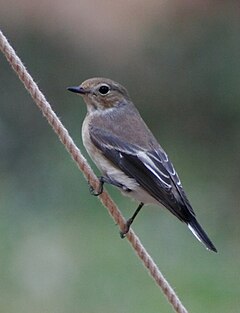
Female |
|
| Scientific classification |
|---|
| No rank : | Bilateral symmetrical |
| Infrastructure : | Passerida |
| Superfamily : | Muscicapoidea |
|
| International scientific name |
|---|
Ficedula hypoleuca ( Pallas , 1764 ) |
| Security status |
|---|
Least ConcernedIUCN 3.1 Least Concern : 22709308 |
|
Content
The coloring of the adult male is black and white, contrasting. The back and crown are black, there is a white spot on the forehead, the lower back is gray, the tail is brownish-black with a white hem along the edges, the belly is white, the wings are dark brown, almost black with a large white spot. Females and young males are more dimly colored: black tones in the plumage are replaced by grayish-brown, white by dirty-white [3] . Body length about 16 cm, weight 15-19 g.
Fragment of the song of the pied flycatcher
The song is the chirping of “Pichi-Pichi-Coolie-Lychee” or “Citra-Citra-Three-Twist-Three,” the cry is the voiced “Pii.” Shouting a jerky "vin-vin", the bird occasionally flutters its wings impetuously and slowly turns its tail up and down.
The pied flycatcher is widespread in the forests of Europe and on the adjoining islands, in the central parts of Western Siberia, as well as in North Africa. Winters in tropical and North Africa. It nests in mixed and deciduous forests, preferring light and rare groves, forest edges, gardens with old, hollow trees, as well as hollow sections of the forest rich in hollows, covered with aspen and black alder .
The pied flycatcher feeds on hymenoptera (predominantly sawfly larvae), dipterans (mainly flies ), parasites (almost 50% of which are often carnivorous larvae of ladybirds), lepidoptera (exclusively caterpillars), as well as spiders and lepidoptera (various). The pied flycatcher does not fully justify its name: more than 2/3 of its prey is not flies, but sedentary insects, which it collects from the branches and leaves of trees and shrubs and in grass cover. In autumn, it also eats fruits and berries.
The nest arranges in natural hollows, old hollows of woodpeckers and some tits, in crevices of trees, under the roofs of wooden buildings. The construction of the nest lasts from 3 to 10 days. A nest is a pile made up of dry blade of grass, birch bark (if the nest is in a birch forest) or pine bark films (if the nest is in a pine), in a small amount there are also moss, hair, bast fibers. The tray is lined with dry leaves and stalks of cereals and other herbaceous plants. In May, the female lays 5-8 eggs of light blue color, which then hatches for 11-14 days. The male at this time guards the nest and sometimes feeds it. After hatching, the chicks are in the nest for 13-18 days. Both parents feed the chicks, making up to 400-500 flights daily with food to the nest. After the chicks leave the nest, adult birds, feeding the young for another 5–7 days, gradually lead them away from the nest [3] .
- ↑ Boehme R. L. , Flint V. E. The Bilingual Dictionary of Animal Names. Birds. Latin, Russian, English, German, French / Ed. ed. Acad. V. E. Sokolova . - M .: Rus. lang., "RUSSO", 1994. - S. 351. - 2030 copies. - ISBN 5-200-00643-0 .
- ↑ Birch, birds // Brockhaus and Efron Encyclopedic Dictionary : in 86 volumes (82 volumes and 4 additional). - SPb. , 1890-1907.
- ↑ 1 2 Vadim Boyarkin, Yulia Nakhimova Multilingual Flycatcher // Science and Life . - 2017. - No. 4. - S. 81-84. - URL: http://www.nkj.ru/archive/articles/31036/