Crafted Albion ( French: Perfide Albion ) is the peripheral name of England , used to characterize English foreign policy, including in Russian pre-revolutionary literature, and having a negative connotation [1] . Sustainable expression is one of several stereotypical phrases that negatively characterize the British policy towards other countries.
Content
- 1 Historical information
- 1.1 Etymology
- 1.2 In Europe
- 1.3 In Russia
- 2 See also
- 3 notes
- 4 Literature
Historical Information
Etymology
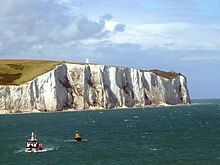
Albion ( lat. Albion ) as a toponymic component of this expression is the descriptive name of England, probably originating from the white chalk cliffs of Dover ( lat . "Albus" - white), which can be seen from the English Channel [2] . This name of the British Isles was already known to the ancient Greeks (in particular, it is mentioned by Ptolemy ) and then passed into the ancient Roman literature. Currently refers to book vocabulary, in particular poetic, or has an ironic meaning.
The use of the adjective “insidious” to characterize England has a long history, and the first recorded cases date back to the 13th century. So, in the historical chronicle of phrase “treacherous England” is applied to the behavior of King Richard the Lionheart during the Third Crusade [3] . Saxon Grammatik (1140-1208) wrote about the “English cunning (treachery)” ( lat. Anglica perfidia ) in the chronicle “ Acts of the Danes ” (X, 21.6): “Meanwhile, Magnus, thanks to the fidelity of the Danes, got what he wanted, < credulity > Sveno was deceived by treacherous angles. " Here we are talking about the fact that, according to the Danish chronicler, the Angles attacked the hopped Danes after a magnificent feast and “they were all treacherously put to death,” and England thanks to the crime regained independence, which she had previously lost “because of her cowardice” [4 ] [5] . The French theologian and preacher of the 17th century, Jacques-Benigne Bossuet, in “Sermons on the Feast of the Circumcision of Jesus Christ” also uses the expression about treacherous England [6] [5] . It has been suggested that this expression dates back to the Latin circulation “Punian treachery” and “Carthaginian treachery”, known since ancient times, [5] . The specific national-cultural features of this phraseological unit include: the denotative component of meaning (“British foreign policy”); token - Albion; prototype - facts of English and world history, which led to the spread of this phrase in various languages and traditions; negative emosem in the structure of connotation [7] .
In Europe
Similar meanings - “English treachery”, “treacherous Englishman”, “treacherous island”, etc. - were very popular in France during the French Revolution and subsequent years of Napoleonic rule [8] . Apparently, for the first time the expression "treacherous Albion" appeared in the poem "Era of the French" by Marquis Augustin de Ximenes (1726-1817): "We attack the treacherous Albion in its waters!" [9] [7] , which was published on October 5, 1793 [5] [10] . This expression became widespread during Napoleon I and in the era of the Napoleonic Wars , when it is constantly present in the French press and political rhetoric [5] . The royalist Chateaubriand in his “Grave Notes” ironically wrote that Bonaparte after abdication and exile on the island of Elba arrived there aboard the ship of the English fleet: “for the British won victory after victory at sea; he forgot about his hatred, about how he slandered the insidious Albion and showered him with insults ” [11] .
Later this image gains pan-European popularity and arises in the press, public opinion at every crisis, any deterioration in relations between states with the participation of Britain. So, in 1840, in connection with the events of the Second Turkish-Egyptian War (1839-1841) and the entry of Great Britain into a coalition with Egypt and Turkey in order to resolve the military conflict without the participation of France, which supported the Maronites , and a sharp aggravation of Anglo-French relations, this phraseological phrase again became very much in demand. Heinrich Heine wrote in a letter to the Augsburg Newspaper in July 1840 about rumors circulating in France about the “betrayal hardened in London”: “With the exception of the Legitimists, who are waiting for salvation only from foreigners, all the French gather around a three-color banner, and the war with the“ insidious Albion "is their universal password." In addition, the “warlike spirit" of the French was fueled by the return to their homeland in the same year of the ashes of England's long-time ill-wisher Napoleon [12] . This unfriendly rhetoric was repeated in France and in Europe in the future. Phraseologism actively used Karl Marx in his work and correspondence. So, regarding the changed cabinet policy, led by Lord Palmerston , Marx wrote [13] :
| For example, Lord Palmerston is taking a step that is obviously extremely harmful to the material interests of Great Britain. And on the other side of the Atlantic Ocean, or the English Channel, or in the heart of Germany, a political philosopher appears who puzzles over the mysteries of the politics of the trade machiavellism of the "insidious Albion", which is considered to be indiscriminate in means and adamant Palmerston |
In 1858, Marx allegorically wrote about the English Channel and the conflicting relations of the Third Empire and England at that time: “The wide ditch separating perfide Albion from la belle France is the French Lacus Curtius ... ” [14]
At the beginning of 1939, the influential journalist Pertinax ( fr. André Géraud ) argued that this characteristic of England was justified, since its policy of "balance of power" was nothing more than a "complete rejection of moral considerations" [15] . Widely used phraseology in modern media [16] .
Attempts have been made to explain "English cunning" from a more rational perspective. So, a diplomat and an expert in the field of international relations, Henry Kissinger , reflecting on the politics of England in the 19th century, wrote that, unlike other states, she chose a completely different path for herself within the international system, seeing it as a reflection of pragmatic politics. As an illustration, Kissinger cites the statement of the British Prime Minister Palmerston : “We do not have eternal allies and constant opponents,” which in fact meant that the island state did not need an officially developed strategy, since its leaders “inwardly” understood British interests: “In the words of Palmerston - "Our interests are eternal, and it is our duty to follow those interests'" [17] , which led to the fact that England had no long-term allies on the continent and reflects the confidence that it bo T he longer to lose than acquire from joining unions:
| Of course, numerous one-time allies of Great Britain pursued their own goals, as a rule, consisting in expanding spheres of influence or territorial acquisitions in Europe. When they, from the point of view of England, went beyond the acceptable, England switched sides or organized a new coalition against the former ally in order to protect the balance of power. Her persistence, devoid of any sentiments, and her self-determination, contributed to the acquisition by the UK of the epithet “Cunning Albion”. This kind of diplomacy may not have reflected a particularly sublime approach to international affairs, but it ensured peace in Europe.- Henry Kissinger. "Diplomacy" [17] . |
According to Kissinger, such a policy reflected the British position on maintaining a balance of power in Europe, which allowed the country to go a century after the Napoleonic Wars with the only conflict with another great power - the Crimean War [18] .
In Russia
In Russia, this expression became widespread during the Crimean War (1853-1856) and the Russo-Turkish War of 1877-1878 [19] . However, it should be noted that Anglophobia developed in Russia even before the Crimean War, especially among Slavophiles [20] . In 1851, F.V. Bulgarin ironically wrote about the 1851 World Exhibition held in London Hyde Park : “The insidious Albion convenes trade and industry from all corners of the world for a fraternal competition on the green lawns of Hyde Park” [21] . According to N. A. Erofeev , a specialist in the new history of Great Britain, it was the Crimean War that "drew the line in the development of the English image and completed the formation of a new symbol in the form of" insidious Albion "" [22] . In the 19th century, such expressions as “decrepit Albion”, “metropolis of gold”, “modern Carthage ”, “ English crap ” and others [23] [20] [24] also became widespread in Russia regarding English politics.
According to popular belief, in Russia this phrase was fixed under French influence. So, the editor of the St. Petersburg magazine “ Library for Reading, ” O. I. Senkovsky wrote in 1848 that stereotypes about England and the British became entrenched and spread in Russia under the influence of French culture: “Having gradually mastered all the stupidities of these books, all the planes of these judgments, we look at England through the prejudices and passions of our wise mentors and unwittingly animated by French patriotism against the sons of treacherous Albion ” [25] . According to the Finnish researcher of Russian-English relations V. Kiparsky, the characteristic “of the English as cunning ginger dealers, cunning baits, ruthless robbers and England as a corrupt or treacherous Albion probably arose with the help of the French model” [25] . This opinion is not entirely shared by N. A. Erofeev. He believes that French influence in this respect is quite possible, however, for the emergence of Anglophobia and the corresponding expressions in relation to England in Russian society, there were more thorough reasons. In addition, he notes that English Russophobia , which did not wane in the 19th century, provoked an anti-British response in Russia: “Moods and statements of this kind act like a boomerang and always return home through the border in an enhanced form” [25] .
Anti-British sentiment in Russia was supported by the geopolitical rivalry of the two great powers, in particular for supremacy in South and Central Asia , which in the 19th and early 20th centuries was called the Great Game . The expression gained distribution in journalism and fiction of those years:
| Where is the Englishman, there is deceit and greed! ... "The kingdom of heaven is not," cried out, dying, the unfortunate unbeliever ... "And if it were, the British would have made their way there long ago and occupied their place."Pisemskіy. Citizens. 2, 9. [26] |
In the “political tragicomedy” of the journalist M. L. Zlatkovsky “ John Bull of the End of the Century”, published in St. Petersburg in 1898, it was said: “I can’t reconcile myself with their international politics based on egoism, Machiavellianism and inhumanity to all other peoples of the globe . It is not for nothing that politicians called England “the insidious Albion” ” [20] .
Anti-British sentiment in Russian society was fueled by the events of the Boer War of 1899-1902. Public opinion was on the side of the Boers fighting, volunteers from Russia fought on the Boers side in Transvaal , the Russian press was not shy in expressions regarding the actions of Great Britain, and the government of Nicholas II pursued an anti-British policy [20] . However, gradually, from the beginning of the 20th century, closer relations began to develop between Russia and England, the result of which was the transition in the Russian public consciousness from the image of the "treacherous Albion" to the Entente ally [27] . Nevertheless, already during the First World War, as well as as a result of the events of the Civil War and military intervention in Russia that followed, Anglophobic sentiments revived. They also take place in modern Russia, especially during interstate crises, which naturally supports the existence of the expression "insidious Albion" in society and the media. The historian A. A. Dolinin wrote on this subject: “The formula gained particular popularity during the Boer War, when the intensity of Anglophobia in Russia reached a point comparable only to the reaction to the ultimatum of Lord Curzon or the case of the poisoning of Skripal and his daughter” [ 28] .
See also
- Anglophobia
Notes
- ↑ Albion // Great Soviet Encyclopedia : [in 30 vol.] / Ch. ed. A.M. Prokhorov . - 3rd ed. - M .: Soviet Encyclopedia, 1969-1978.
- ↑ Krylov G.A. (comp.). Etymological dictionary of the Russian language. - St. Petersburg: LLC Polygraphuslugi, 2005. - P. 17. - 432 p. - ISBN 5-89173-914-3 .
- ↑ Schmidt, HD The Idea and Slogan of “Perfidious Albion” // Journal of the History of Ideas. - 1953. - October (Vol. 14, No. 4). - pp. 604-616.
- ↑ Saxon Grammar. Acts of the Danes: In 2 vols. I — XVI books / Transl. with lat. A. S. Dosaev. - M .: SPSL; Russian panorama, 2017 .-- S. 383. - 1224 p. - ISBN 978-5-93165-369-3 .
- ↑ 1 2 3 4 5 Dushenko, Konstantin. World history in sayings and quotes . - M .: Eksmo, 2008 .-- 680 p. - ISBN 978-5-699-27306-5 .
- ↑ Jacques Bénigne Bossuet. Sermon pour la fête de la Circoncision de Notre-Seigneur // Oeuvres complètes . - Paris: Outhenin-Chalandre, 1840 .-- 858 p.
- ↑ 1 2 Trufanova L. A. National-cultural specificity of phraseological units (based on phraseological units of a non-anthropocentric orientation in English and Russian) // Bulletin of the Russian State Pedagogical University named after A.I. Herzen. - 2009. - Issue. 99 . - S. 201 . - ISSN 1992-6464 .
- ↑ Birikh A.K. Russian phraseology. Historical and etymological dictionary. About 6000 phraseological units. - M .: Astrel: ACT; Lux, 2005 .-- pp. 21-22. - 926 p.
- ↑ “Attaquons dans ses eaux la perfide Albion”, in L'ère des Français (1793).
- ↑ Kalanov N.A., Skryagin L.N. The English-Russian Dictionary of Marine Idioms and Jargon. - M .: Morkniga, 2013— p. 15, - ISBN 978-5-03-003315-0 .
- ↑ Chateaubriand, F.-R. de. Grave notes / Per. with fr. O. E. Greenberg and V. A. Milchina. Entry Art. and note. V.A. Milchina. - M .: Publishing House. Sabashnikovs, 1995 .-- S. 271. - 736 p. - (Monuments of world literature). - ISBN 5-8242-0036-X.
- ↑ Heine, Heinrich. Lutetium // Collected works in 10 volumes. - M .: State Publishing House of Fiction, 1958. - T. 8. - S. 77-91. - 394 p.
- ↑ Marx, Karl. Exposure of the diplomatic history of the XVIII century // Questions of history. - 1989. - No. 3 . - S. 3-17 .
- ↑ Marx, Karl, Engels, Frederick. Collected works. - M .: Directmedia, 2014 .-- T. 12. - S. 446. - 928 p. - ISBN 978-5-4475-3125-6 .
- ↑ Erofeev, 1982 , p. 288.
- ↑ About linguistic creativity (on the example of unofficial names of France and England) // Bulletin of the Voronezh State University. - 2017. - No. 3 . - S. 69-70 .
- ↑ 1 2 Kissinger, 1997 , p. 82-83.
- ↑ Kissinger, 1997 , p. 88.
- ↑ Sheshunova S.V. British and Russian as Enemies in the Crimean War: Literary Images // News of the Dnepropetrovsk University of the Name of Alfred Nobel. - 2016. - No. 2 (12) . - S. 79-90 .
- ↑ 1 2 3 4 Davidson A. B. The Image of Britain in Russia of the 19th and 20th Centuries // New and Contemporary History. - 2005. - No. 5 . - S. 51-64 .
- ↑ Erofeev, 1982 , p. 292-293.
- ↑ Erofeev, 1982 , p. 298.
- ↑ Erofeev N. A. "Decrepit Albion" (England in Russian journalism of the 30s and 40s of the 19th century) // Problems of British History. - M .: Nauka, 1980 .-- pp. 129-146.
- ↑ Orlov, Alexander. “England is finished!” Britain and the British as figures of silence in Leo Tolstoy’s novel War and Peace. - St. Petersburg: Aletheia, 2019 .-- S. 21. - 152 p. - ISBN 978-5-907115-39-2 .
- ↑ 1 2 3 Erofeev, 1982 , p. 301.
- ↑ “Insidious Albion” in the dictionaries of the Russian language - Yandex.Dictionaries (unavailable link) (unavailable link from 06/14/2016 [1217 days])
- ↑ A. Tumanov. Everyday Life of Victorian England in the Assessment of Russian Contemporaries // Scientific notes of Kazan State University. - 2010. - T. 152. Book 1. Part 3 . - S. 186—194 .
- ↑ Dolinin, Alexander. Englishwoman craps: the story of a hackneyed phrase // Intermezzo festoso. Liber amicorum in honorem Lea Pild: A historical and philological collection in honor of the associate professor of the Department of Russian Literature at the University of Tartu, Lea Pild. - Tartu: Department of Russian Literature, University of Tartu, 2019 .-- S. 112-120. - 408 p. - ISBN 978-9949-77-945-1 (pdf).
Literature
- Erofeev N.A. Misty Albion: England and the British through the eyes of Russians, 1825-1853 - M .: Nauka, 1982. - 320 p.
- Kissinger, Henry. Diplomacy / Per. from English V.V. Lviv. After G.A. Arbatova. - M .: Ladomir, 1997 .-- 850 p. - ISBN 5-86218-260-8 .
- Orlov A.A. Now I see the British close ...: Britain and the British in the ideas of Russians about the world and about themselves (second half of the 18th-first half of the 19th centuries). - M.: Hyperborea, 2008 .-- 360 p.