Gella ( dr. Greek Ἕλλη ) (sometimes Afamanta) - in ancient Greek mythology [1] is the daughter of the Orchomenan king Atamant and Nefela , the twin sister of Frix .
| Gella | |
|---|---|
 | |
| Gella and Frix | |
| Floor | |
| Father | |
| Mother | |
| Brothers and sisters | |
| Children | and |
Gella and her brother were raised by Ino's stepmother, who hated them. Ino decided to get rid of the twins and destroyed the entire stock of seeds in the city. Farming, fearing hunger, sent a messenger to the oracle , but Ino bribed him to lie on behalf of the oracle about the need to sacrifice Frix.
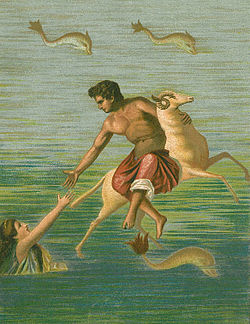
However, the mother of Gella and Frix, Nefela, sent to her children a gift from Hermes , a flying ram with golden wool, so that they would be saved from her stepmother. During the journey, Gella, slipping, fell into the water, and Frix managed to get to Colchis . Gella fell into the abyss between Sigay and Chersonese , this place got its name for this: Hellespont ( Greek .λλήσποντος , literally. "Sea of Gella"), now the Dardanelles [2] .
According to another story, a ram dropped it and lost its horn, but Poseidon saved her, and she bore him a son, Peon [3] , or Edon [4] . According to a rationalist interpretation by Diodorus , they crossed the sea on a ship whose bow was adorned with the head of a ram, and Gella, who became sick because of seasickness, fell into the sea [5] . Grave monument in Chersonesos [6] .
The protagonist of the tragedy of the unknown author "Gella", where the son recognized his mother [7] .
In honor of Gella (Afamanta), the asteroid (230) Afamanta was discovered, discovered in 1882.
Notes
- ↑ Myths of the peoples of the world: In 2 vols. - M. , 1991-92. - T. 1. - S. 271.
- ↑ Pseudo-Apollodorus . Mythological library. I. 9, 1; Aeschylus. Persians 70.
- ↑ Pseudo-Eratosthenes . Disaster. nineteen.
- ↑ Gigin . Astronomy. II. 20, 1.
- ↑ Diodorus of Sicily . Historical Library IV 47, 1
- ↑ Herodotus . Story. VII, 58.
- ↑ Aristotle . Poetics. 14.