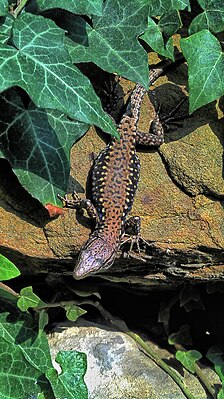
The rock lizard [1] , or the rocky lizard [1] ( lat. Darevskia saxicola ) is a species of lizards from the family of real lizards .
| Rock lizard |
 |
| Scientific classification |
|---|
| No rank : | Bilateral symmetrical |
| Infraclass : | Lepidosauromorphs |
| Infrastructure : | Skink-like |
|
| International scientific name |
|---|
Darevskia saxicola ( Eversmann , 1834) |
| Synonyms |
|---|
- Lacerta muralis fusca var. saxicola ( Bedriaga , 1886)
- Lacerta saxicola var. brauneri ( Mehely , 1909)
- Lacerta saxicola darevskii ( Szczerbak , 1962)
- Lacerta saxicola szczerbaki ( Lukina , 1963)
|
| Security status |
|---|
Least ConcernedIUCN 3.1 Least Concern : 164617 |
|
Content
The body has a length of up to 88 mm (young 22 - 27 mm), tail up to 156 mm. On top is a green color (usually in males), brownish, sometimes olive-gray, dark sand or ash-gray, and along the ridge 2 rows of small dark spots in the form of a strip still pass, on the sides of the body there are the same color of the strip with light, and at chest level - with blue eyes.
It is found in mountainous and rocky areas, along the sides of mountain roads up to the alpine zone (up to 3000 m). The number is up to 100 individuals per 1 km of the route. Daily activity. Wintering from September-October to February-March. At the end of June-July, 2-6 eggs are laid, about 6-8 x 12-16 mm in size, of which young individuals appear in July-September, reaching sexual maturity at the age of 2 years with a body length of 49-51 mm.
Food: Hymenoptera , Diptera , beetles , bugs , butterflies , cicadas , Orthoptera and spiders .
Currently, the area of Darevskia saxicola itself is entirely located in the Russian North Caucasus: within Kabardino-Balkaria, Karachay-Cherkessia and the south of the Stavropol Territory. The southern border of the distribution of this species passes along the northeastern spurs of Elbrus , crosses the Rocky Range, continues along the watershed in the upper Kuma, Podkumka, Zolka, etc. [2] . Literature references to the distribution of rock lizards in other regions relate to other Darevskia species previously included in the prefabricated species. In particular, in the south of the Crimean peninsula, the only species of this genus is Darevskia lindholmi .
Previously, this species was understood as the prefabricated taxon Lacerta saxicola - Eversmann, 1834. Mem. Soc. Natural Moscou, (2), 3: 349. Typical territory: Narzan (Kislovodsk, Northern Caucasus). Later, 17 separate species were isolated from its composition [3] . In 1999, a separate genus Darevskia was isolated, which included all parthenogenetic and related species.
Synonymy:
- Darevskia saxicola (Eversmann, 1834)
- Lacerta muralis fusca var. saxicola - Bedriaga (part.), 1886: 195.
- Lacerta saxicola var. brauneri - Mehely, 1909
- Lacerta saxicola darevskii Szczerbak, 1962. Zool. Well, vol. XLI, no. 9: 1380. Terra typica: Krasnodar Territory, Art. Hodzhokh, 50 km south of Maykop.
- Lacerta saxicola szczerbaki Lukina (Lukina), 1963. Izv. AN AzSSR, No. 6: 57. Typical territory: Anapa neighborhood.
- List of reptiles of Russia
- Caucasian lizard
- ↑ 1 2 Ananyeva N. B. , Borkin L. Ya. , Darevsky I.S. , Orlov N.L. The Pyatiling Dictionary of Animal Names. Amphibians and reptiles. Latin, Russian, English, German, French. / edited by Acad. V. E. Sokolova . - M .: Rus. Yaz., 1988 .-- 560 p. - 10,500 copies. - ISBN 5-200-00232-X .
- ↑ Ananyeva N. B. , Orlov N. L. , Khalikov R. G. , Darevsky I. S. , Ryabov S. A. , Barabanov A. V. Atlas of reptiles of Northern Eurasia (taxonomic diversity, geographical distribution and conservation status) . - SPb. : Zoological Institute RAS, 2004. - 232 p. - 1000 copies. - ISBN 5-98092-007-2 .
- ↑ Reptile Database synonym Lacerta saxicola