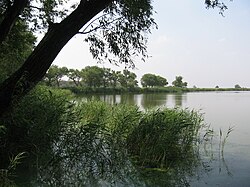
Samara [1] (Samar [2] ; Ukrainian Samara [3] ) - a river in Ukraine , the left tributary of the Dnieper ( Black Sea basin ) [2] .
| Samara | |
|---|---|
| Ukrainian Samara | |
 | |
| Characteristic | |
| Length | 311 km |
| Pool | 22,600 km² |
| Water consumption | 17 m³ / s (48 km from the mouth) |
| Watercourse | |
| Source | |
| • Location | southeast of s. Vesyolaya Gora ( Aleksandrovsky district of Donetsk region ) |
| • Coordinates | |
| Mouth | Dnieper reservoir |
| • Location | Dnipro city ) |
| • Coordinates | |
| Location | |
| Water system | Dnieper reservoir → Dnipro → Black Sea |
| A country |
|
| Regions | Donetsk region , Kharkov region , Dnipropetrovsk region |
 - source - source  - mouth - mouth | |


Content
The origin of hydronym
The most justified from the linguistic, geographical and historical points of view is the emergence of the ancient hydronym Samara in the Indo-Iranian or Indo-Aryan dialects of early pastoralists with the meaning 'summer river / water' [4] .
Indeed, the first part of the Samron hydronym / a / dates back to the Indo-Iranian (Aryan) basis * sama- with the meaning 'half year, year; season'; Wed other ind. sámā- with the same meaning 'season' and other Iranian. * ham-, * hama- 'summer (and fall?)', ml.-ave. ham 'summer'. Related words in other Indo-European languages are Armenian. am 'year, age' and amaṙn 'summer', dr. sam summer (dr. sumor), German Sommer (dr.-upper. Sumar), all with the meaning 'summer' - lead to the reconstruction of the Indo-European basis in the form * s (e) ṃ (H) eh 2 , or * semā- (with the distributor * -ā), or * semer- (with distributor * -r). If the latter is true, the name Samar could arise as a toponym with the meaning 'summer, summer (pasture)' and then become a hydronym for the main river of the area.
On the other hand, the second part of the Samar hydronym can be interpreted not as a suffix (s) - a / -r with an undetermined meaning, but as an Indo-European basis * u̯er- / * u̯ēr- 'flow (verb); water, river '. The indicated meaning of 'water' is preserved in Old Indian (Sanskrit. Vār-), Tocharian (A wär, B war), Luwian (u̯a-a-ar), Old Icelandic (vari) words. If the early Indo-Europeans really put the meaning “water, river” in the second part of the Samar hydronym, then it could be a secondary etymologization.
Other versions (including outdated and anecdotal).
- from Samur (Iran.) "beaver, otter." The names of the rivers in the Samara basin for this animal are not unique (Konduzla, Bobrovka). In addition to geographical and zoological considerations, the hypothesis does not take into account the fact that the initial form of the hydronym is Samar , not Samur .
- from Tatar., Chuvash. Samar, Kalmyk. Samr, Chagataisk. "Samar" - a bag, Kyrgyz. “Sardar” - a basin, a jug (M. Fasmer). It was assumed that in the Turkic dialects they could thus call "the bend of the river, its steep part", however, such values are not fixed in any of the Turkic languages;
- from Mongolian. Samar with the meaning "nut, nut" (V. F. Barashkov) or from the Mongolian "samura, samaura" - mix, stir. The hypothesis does not stand the chronological test - the hydronym appeared earlier than the native speakers of the Mongolian language in the relevant areas;
- from the combination of the Iranian root "sam" or "sham" or the Hungarian "Semar" (desert, steppe) and the Hungarian root "ar" - that is, the steppe river (I. Nikolsky)
- from the old Russian "Samara", "Samarka" - long-sex clothing (Yuri Fedosyuk)
- Sneporod (Sheepbred) - from pra-ie. * sneH- (i / u) - “tie, twist” and the basics of great-ie * p [h] orH- , the value of which can be restored as the Passage, the Channel ( V. B. Rumyantsev ).
In Ukrainian and Cossack sources, the river is called "Samar" , "Samar" . After the transition of territories along the banks of the river to the protectorate of Moscow , the name "Samara" gradually came into use.
Current
The source of the river is not far from the village of Veselaya Gora ( Aleksandrovsky district of Donetsk region ) on the western slopes of the Donetsk Ridge . It flows through the territory of Donetsk , Kharkov and Dnepropetrovsk regions. It flows into the Dnieper reservoir (former Lenin Lake) of the Dnieper at a distance of 409 km from the mouth of the latter in the vicinity of the Dnieper .
Pool
The length of the river is 311 km. The slope of the river is 0.33 m / km. The channel is winding, in the lower third straightens. The width of the channel to the confluence of the Volchaya tributary is 15–40 m, lower than 40–80 m (maximum up to 300 m). The river basin area is 22 660 km². The valley is predominantly trapezoidal, asymmetric, in some areas not clearly expressed. The valley extends from 2.5 km to 12 km. The floodplain is bilateral, 3-4 km wide (in places up to 6 km). There are old women. The average water discharge 48 km from the mouth is 17 m³ / s. Mixed food, mainly snow. The ice regime is unstable, freezes at the beginning of December, and opens at the end of March. Sometimes it freezes completely. In the upper reaches, it dries up at the end of July (in dry years until the beginning of November), forming separate streaks .
Mineralization of water Samara is high - the average over many years is: spring flood - 1750 mg / dm³; summer-autumn low water - 2135 mg / dm³; winter low water - 2447 mg / dm³ [5] .
In the river there are rudd , chub , crucian carp , pike , silver carp , catfish , roach , perch , bream , gobies , pike perch , high water bird , undergrowth , tench .
Below the confluence of the Wolf on the left bank - Samara Forest - the location of the camps, boarding houses, sanatoriums. Navigable to Novomoskovsk .
Waterworks
Near the villages of Kokhanovka and Kocherezhki there are hydrological posts . In the upper reaches of the dam. The runoff is regulated by numerous ponds and reservoirs for irrigation, water supply and fishing.
Settlements
Downstream:
- Donetsk region : Aleksandrovka village.
- Kharkov region : villages Sofiyivka , Chervonoye , Bashilovka , Verkhnyaya Samara , Pavlovka , Varvarovka .
- Dnipropetrovsk region : the village of Nikolaevka , the villages of Petropavlovka , Dmitrovka , Boguslav , Pavlograd , Guards , Cherkassky , Novomoskovsk , Podgorodnoe , Dnipro .
Archeology
- On the Samara River, a distal fragment of the left humerus of the “sapient Mustier” associated with the Mustier culture was discovered [6] .
- On the Igrensky Peninsula, at the confluence of Samara into the Dnieper near the village of Old Igren, Igrensky archaeological settlements were discovered [7] .
Tributaries
From source to mouth: Water (l), Rot (l), Opaliha (p), Bull (l), Lozova (l), Chaplinka (l), Dry Chaplinka (l), Big Ternovka (p), Malaya Ternovka ( p), Vyazovok (p), Bobrovka (p), Wolf (l), Volnyanka (p), Underground (l), Tatar (l), Kilchen (p).
Links
- Samara and the Wolf. Description of the water tourist route. . www.poezdnik.kiev.ua . Date of treatment April 7, 2019.
- On the rivers Volchya and Samara . www.skitalets.ru . Date of treatment April 7, 2019.
- Wolf - Samara Dneprovskaya . www.skitalets.ru . Date of treatment April 7, 2019.
- Maps and locations of the Samara River. Detailed description and photos. . web.archive.org . Date of treatment April 7, 2019.
Notes
- ↑ Samara // Dictionary of names of hydrographic objects of Russia and other countries - members of the CIS / ed. G.I. Donidze. - M .: Kartgeotsentr - Geodezizdat, 1999. - S. 321. - ISBN 5-86066-017-0 .
- ↑ 1 2 Samara // Great Soviet Encyclopedia : [in 30 vol.] / Ch. ed. A.M. Prokhorov . - 3rd ed. - M .: Soviet Encyclopedia, 1969-1978.
- ↑ Samara // Geographic Encyclopedia of Ukraine : 3 t / Editorial: A.M. Marynich et al. - K .: Ukrainian Radyansk Encyclopedia, 1993. - T. 3: P — Ya. - S. 158. - ISBN 5-88500-020-4 . (Ukrainian)
- ↑ Topography of the Samara fortress, ethymology and preceeding mentioning of the toponim in the written sources . www.academia.edu. Date of treatment December 12, 2015.
- ↑ Gorev L.N., Peleshenko V.I., Khilchevsky V.K. Hydrochemistry of Ukraine. - K .: Vishka school, 1995 .-- 307 p. (Ukrainian) ISBN 5-11-004522-4
- ↑ Kharitonov V. M. Findings of fossil hominids in Eastern Europe and adjacent regions of Asia (Part 2) . antropogenez.ru . Date of treatment April 7, 2019.
- ↑ Telegin D. Ya., Zaliznyak L. L. Excavations on the Igrensky Peninsula // Archaeological Discoveries, 1974 - M, 1975. - P. 358-359.