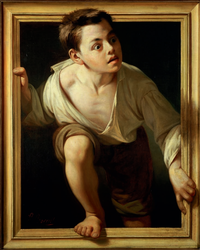
Dummy, or Trompley ( fr. Trompe-l'œil , “ optical illusion ”) is a technical technique in art, the purpose of which is to create an optical illusion that the depicted object is in three-dimensional space, while in reality it is painted in two-dimensional plane.
Content
Antiquity
This technique was used already in ancient Greece and ancient Rome . A typical example of antique trompe l'oeil is a wall image of a window, door, or atrium to create the false effect that a room is larger than it is.
In one of the most popular ancient Greek stories tells of a dispute between famous artists. Zeuxis created so real and convincing pictures that the birds flew in and pecked the grapes he painted. Once Zevksis asked his rival Parraziy , is it possible for him to throw off the curtain torn in rags from the picture of the latter, in order to evaluate it. But I found that this curtain is drawn. So Zeuxis misled the birds, and Parrasius misled Zeuxis.
Renaissance
With an understanding of the laws of perspective, late Quatrocento Italian painters, such as Andrea Mantegna and Melozzo da Forli , began to paint walls and vaults, mostly frescoes , using the laws of perspective to create the effect of increasing space. This type of snag is known as di sotto in sù , from bottom to top in Italian. The most famous representatives of the genre in France of the XVII century - Jean-Francois de Le Mott and Antoine Fort-Bras .
After the Renaissance
The laws of the perspective of the 17th century, which were more fully integrated into the architectural illusion and used by artists to “open” the space of the wall or vault, were called quadratura . One of the finest examples of architectural architecture is the dome of the Jesuit Church in Vienna by artist Andrea Pozzo , which, although only slightly curved, creates the impression of a real architectural structure.
Dodge Figure
A special genre was the figure-snag - snagging in the form of human figures or domestic animals, painted on a thin wooden panel, and then carved. They were popular from the XVII to XIX century, first in Europe and then in America. Dummy figures were usually used as screens for the fireplace, but sometimes they were installed at the entrance to the state halls. Such figures are both well-dressed adults or children, and servants.
In Russia
One of the most striking examples of preserved illusionist painting in Russia is the Gonzago Gallery and the painting of the plafond of the Parade Dining Room of the Pavlovsk Palace , made by the artist Pietro Gonzago .
Fragment of murals of the Gonzago Gallery in the Pavlovsk Palace Museum
Fragment of murals of the Gonzago Gallery in the Pavlovsk Palace Museum
The area between the north facade of the central building and the Gonzago Gallery wall in the Pavlovsk Palace Museum
Current usage
Optical effects such as tricks are used by filmmakers to shoot complex scenes. For this, part of the scene is depicted on glass, which is placed in front of the camera during the shooting. This method was used to create early Star Wars films. To date, it is almost completely supplanted by computer effects. But sometimes the use of these techniques is justified in terms of optimizing the budget, the speed of film production and the convenience of the actors. For example, in the movie “The Lord of the Rings,” this technique was used to create the effect of the difference in height between the characters.
Also, trompe l'oeil is used to create three-dimensional tattoos and body art drawings. This technique has become widespread among artists painting on asphalt or walls of houses .
It is actively used in the show with the use of video mapping - projections on buildings and objects.
In the construction and reconstruction of buildings, a curtain grid with an applied pattern is used - a false façade, which, in addition to its utilitarian properties, is designed to improve the appearance of the building for the duration of the work.
Literature
- Tarasov Yu.A. Trompe l'œil in Dutch painting of the 17th century // Dutch still life of the 17th century. - SPb: Publishing House of St. Petersburg University, 2004. - p. 78-88.
- Georges Perec. Enchanted look / Trans. with fr. V. Kislov. - SPb .: Ivan Limbakh Publishing House, 2017.
Links
- Tromplay : Wikimedia Commons Media
- Lois Parkinson Zamora. Trompe l'oeil Tricks: Borges' Baroque Illusionism (English) . University of Houston. The date of circulation is January 25, 2017.