Resistance on the Nenjiang Bridge is the battle for the bridge on the Nenjiang River between the forces of the Republic of China and the Japanese Empire , which occurred during the Japanese invasion of Manchuria .
| Resistance on the nenjiang bridge |
|---|
| Main conflict: Japanese intervention in Manchuria |
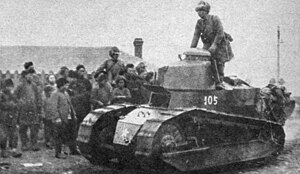
Japanese tank Renault in Manchuria |
| date | November 4, 1931 |
|---|
| A place | bridge across Nenjiang south of Qiqihar |
|---|
| Total | Japanese victory |
|---|
|
 Republic of China Republic of China
|  Japan empire Japan empire
|
|
|
Ma Zhanshan |  Shogo Hasebe Shogo Hasebe
|
|
|
|
|
|
|
After the Mukden incident, Chiang Kai-shek forbade Chinese troops in Manchuria to resist the Japanese invaders. The governor of the northeastern Heilongjiang province , General Ma Zhanshan, did not obey the order and tried to prevent the enemy from entering his province by blowing up a strategically important bridge over the Nenjiang River. On November 4, a detachment of 800 Japanese soldiers arrived to fix it. It is not known who first opened fire: the parties blamed each other. The shootout lasted 3 hours, after which the Chinese retreated. The battle marked the beginning of the Heilongjiang campaign , during which several more battles took place. After the resistance, Zhanshan became a national hero, new volunteers joined in his ranks, who later fought a guerrilla war against Manzhou-go .


