- This article is about the place of residence of athletes during the Olympics. For areas in Moscow, see the articles Old Olympic Village and New Olympic Village .

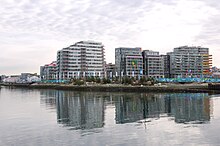


The Olympic Village is a complex of buildings in which members of delegations of countries participating in the Olympic Games are located [1] . According to the Olympic Charter, the Organizing Committee for the Olympic Games is to ensure the functioning of the Olympic Village for the period determined by the IOC Executive Board . The Olympic village must comply with all the requirements of the IOC Executive Board [2] .
Only athletes, coaches, team leaders, technical and support staff live in the Olympic Village (members of international organizations, judges, journalists are not related to them) [3] . Quotas for officials and other staff of teams deployed in the Olympic Village must be approved by the IOC Executive Board [2] .
In addition to residential buildings and premises, the Olympic village should have the necessary infrastructure , including canteens, shops, a cultural center, hairdressers, post offices, etc. [4] . The sports complex of the village should provide all the conditions for training athletes and their comfortable living. Thus, this is a whole town, which should be located close to the Olympic stadiums and venues for sports.
After the Olympics, the buildings of the Olympic village can be used as residential buildings for residents, as student hostels, as well as for other purposes (barracks, prison, etc.)
History
The Olympic Village [5] , as the place where the participants of the Olympic Games lived, dates back to ancient times, when athletes lived and trained in Olympia during the three weeks preceding the games and during the games.
At the first Olympic Games, representatives of each country independently decided on the placement of their delegations during the competition. In 1924, Paris was the first city in which the Olympic Village was built in modern times . During the Olympics in Paris, athletes had to live in wooden buildings, after which they received the established name "Olympic Village".
At the next Olympic Games in 1928 , in Amsterdam , athletes were again placed where necessary. 3,000 people were scattered throughout the city and lived in schools, hotels, boarding houses, private homes, and some, like the American team with all the officials, on the ship, on which they arrived at the competition.
In 1932, at the Summer Olympic Games in Los Angeles , houses for participants were specially built near the stadium. The Olympic village here consisted of 600 prefabricated wooden houses, the construction was funded by private investors and the houses were completely dismantled after the Games. In these houses the participants lived - men. Sportswomen were accommodated in hotels. Since 1932, the tradition of creating Olympic villages appeared. In accordance with the Olympic Charter, the construction of such villages and their maintenance falls on the shoulders of the host city of the games. Only their residents can visit the Olympic villages, and outsiders are allowed to go there only on a special pass.
The next Olympics took place in 1936 in Berlin. For the Olympics in Nazi Germany , about 145 one-and two-story residential buildings, a dining room, a theater, a hospital, an indoor stadium, a swimming pool and a sauna were built in a separate area located about 6 miles west of Berlin. The 1936 Olympics decided to hold with fanfare. After the games, the Olympic village was used for more than 50 years as military barracks.
After the Second World War, the Olympics took place in 1948 in London , which had previously hosted competitions in 1908. Athletes were stationed in and around the capital: men in Uxbridge and West Drayton air force camps, as well as in former military barracks in Richmond Park, and women in London schools [6] .
For the next Olympics in Mexico City and Munich , two large ensembles of apartment buildings were built. In Montreal , a high-altitude decision was made and the apartments of the Olympic Village were empty for a long time due to a lack of willing to buy apartments at high prices.
For the 1980 Olympics in the USSR, an Olympic village was also built. Moscow, which hosted the competition, created an entire residential neighborhood in preparation for the Olympics. However, this village, unlike previous cities, was originally conceived as a residential neighborhood, therefore, in addition to the houses themselves, schools, a hospital, cultural and entertainment facilities were built.
Olympic villages are improving from the Olympics to the Olympics. Over time, the construction of the Olympic Village was given special attention.
For example, the Olympic Village, built for the XXIX Summer Olympic Games in Beijing, was built taking into account the requirements of the Paralympic Games . To create a barrier-free environment, buildings and their equipment took into account the characteristics of various groups of people with disabilities. The sanitary rooms were equipped with special handrails. The elevators were equipped with audio systems, special buttons for blind athletes. The Olympic village included three main zones: residential, managerial and international. The living area is equipped with all necessary facilities. Various sports facilities for sports and recreation, numerous cozy catering facilities were built. Comfortable residential blocks were built for the athletes and accompanying persons at the XXIX Olympiad. Of these, 22 were six-story, and 20 were nine-story. The buildings could accommodate up to 16,000 participants. The ground floors of the buildings were equipped with headquarters. The international zone contained standard facilities: shops, a parking lot, a bus station, a support center, a car inspection station [7] .
Notes
- ↑ Olympic Village . Great Encyclopedic Dictionary. Date of treatment September 3, 2013.
- ↑ 1 2 Chapter 5. The Olympic Games . Olympic Charter. Date of treatment September 4, 2013.
- ↑ Olympic Village . Date of treatment September 4, 2013.
- ↑ What is the Olympic Village . Date of treatment September 4, 2013.
- ↑ Olympic Village (a town for athletes participating in the Olympics) . Lopatin V.V. , Nechaeva I.V. , Cheltsova L.K. Uppercase or lowercase? Orthographic dictionary. - M .: Eksmo , 2009 .-- S. 317. - 512 p.
- ↑ All Olympic villages in history . Date of treatment September 5, 2013.
- ↑ Olympic Village . Date of treatment September 5, 2013. (unavailable link)